


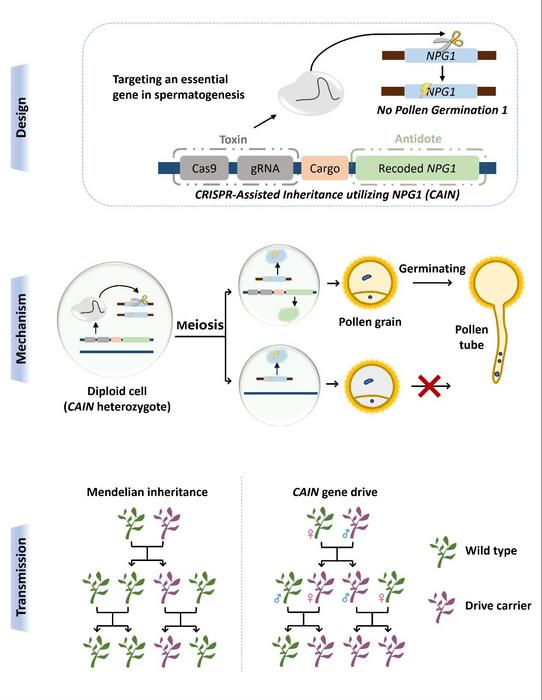
A collaborative research team led by QIAN Wenfeng from the Institute of Genetics and Developmental Biology (IGDB) of the Chinese Academy of Sciences and Peking University has developed a plant gene drive system called CRISPR-Assisted Inheritance utilizing NPG1 (CAIN), which, according to the researchers, uses a toxin-antidote mechanism in the male germline to override Mendelian inheritance in plants.

Credit: IGDB
A collaborative research team led by QIAN Wenfeng from the Institute of Genetics and Developmental Biology (IGDB) of the Chinese Academy of Sciences and Peking University has developed a plant gene drive system called CRISPR-Assisted Inheritance utilizing NPG1 (CAIN), which, according to the researchers, uses a toxin-antidote mechanism in the male germline to override Mendelian inheritance in plants.
Their findings were published in Nature Plants.
In nature, gene inheritance typically follows Mendel’s laws, which provide an equal chance for alleles to pass on to the next generation—a cornerstone of Darwinian natural selection. However, super-Mendelian inheritance allows certain genes to be inherited at rates greater than the expected 50%, potentially allowing these genes to spread through populations even if they are detrimental to organisms. This mechanism opens the door to manipulating natural populations by introducing alleles that benefit humans even if they harm plant organisms themselves, or to eliminating species that are considered detrimental to human interests.
Such advances offer innovative solutions to global challenges, including combating plant diseases, ensuring food security against agricultural pests or weeds, and addressing environmental crises resulting from biodiversity loss.
In this study, the CAIN system works through a toxin antidote mechanism within the male germline, bypassing traditional Mendelian inheritance. It uses a CRISPR-Cas9 construct that disrupts the key gene responsible for pollen germination (NPG1), thereby acting as the “toxin.” The “antidote” is a recoded, CRISPR-resistant NPG1 gene that rescues functionality, but only in pollen cells containing the gene drive.
The researchers used the self-pollinating plant Arabidopsis thaliana for this study in order to prevent unintended spread to natural populations. They reported a strikingly high transmission rate of the gene drive—between 88% and 99%—over two generations.
The demonstration of CAIN in Arabidopsis paves the way for broader applications in plant genetics. As researchers navigate this emerging field, CAIN and similar gene drive systems hold the promise of transforming ecological management and agricultural practices.
Journal
Nature Plants
Method of Research
Experimental study
Subject of Research
Not applicable
Article Title
Overriding Mendelian inheritance in Arabidopsis with a CRISPR toxin-antidote gene drive that impairs pollen germination
Article Publication Date
17-Jun-2024
Cite Scienmag News
Juliet Wilcox. (June 17, 2024). Researchers develop plant gene drive system for enhanced trait inheritance. Scienmag. https://scienmag.com/researchers-develop-plant-gene-drive-system-for-enhanced-trait-inheritance/
Juliet Wilcox. "Researchers develop plant gene drive system for enhanced trait inheritance." Scienmag, 17 June 2024, https://scienmag.com/researchers-develop-plant-gene-drive-system-for-enhanced-trait-inheritance/. Accessed 6 September 2026.
Juliet Wilcox. "Researchers develop plant gene drive system for enhanced trait inheritance." Scienmag. June 17, 2024. https://scienmag.com/researchers-develop-plant-gene-drive-system-for-enhanced-trait-inheritance/

