


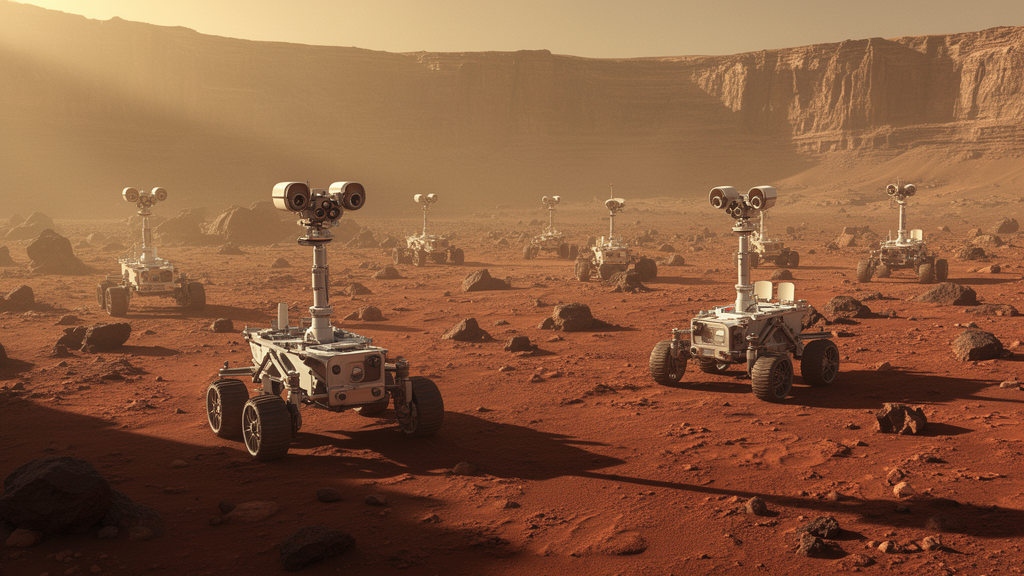
Two research teams from the Institute of Computer Science at the University of Würzburg have joined an ambitious collaborative initiative to explore Mars using interconnected swarms of autonomous robots. The initiative envisions deploying coordinated teams of flying, walking, and driving machines to investigate the vast Valles Marineris canyon system on the Red Planet, operating both across surface terrain and from the air. In addition to surveying open landscapes, the robotic explorer units are designated to enter subterranean caves suspected to exist throughout the valley, where they will gather specialized imagery and complementary environmental measurements.
This research is coordinated under the VaMEx initiative, an exploration program directed by the German Space Agency at the German Aerospace Centre (DLR). Having launched in 2012, the initiative has advanced into its fourth development phase, with participating institutions developing foundational technologies essential for deploying multi-agent robotic swarms across challenging extraterrestrial landscapes. Within this phase, scientists are establishing robust coordination protocols and navigation architectures capable of operating reliably without standard terrestrial infrastructure.
At the University of Würzburg, the effort is led by Hakan Kayal, Professor for Space Technology, and Guido Dietl, Professor of Satellite Communication and Radar Systems. Their joint sub-project has secured approximately 1.4 million euros in funding from the German Aerospace Centre. Operating under the Würzburg Interdisciplinary Research Centre for Extraterrestrial Studies (IFEX), the three-year investigation officially commenced in early October 2026. The two researchers are expanding upon preliminary work previously established during earlier stages of the VaMEx initiative while introducing focused research tracks in navigation, communication, and visual sensing.
Initial responsibilities for the Würzburg teams involve formulating the comprehensive system architecture, authoring technical requirement specifications, and formalizing core hardware and software interfaces. These foundational engineering steps aim to support robust navigation and coordinated operations across heterogeneous swarms combining aerial drones, walking units, and wheeled ground vehicles.
One major line of investigation centers on upgrading the SkyCAM system, a specialized optical tracking platform developed by Professor Kayal’s research group. Engineered to observe the sky and autonomously detect transient atmospheric and celestial events—such as lightning flashes, cloud development, meteors, and unidentified anomalous phenomena—SkyCAM is being modified for direct integration onto the Janus Mars rover platform. The modified optical instrument will subsequently undergo operational validation during the AMADEE-27 analogue mission, an Earth-based planetary simulation conducted by the Austrian Space Forum in Monsaraz, Portugal, scheduled between 5 April and 18 April 2027.
During the AMADEE-27 deployment, Kayal’s team plans to install two or three synchronized SkyCAM observation stations designed to capture simultaneous views of aerial phenomena. Beyond recording still images and video sequences, the networked camera network will calculate the distance, velocity, and flight trajectory of dynamic aerial objects while providing real-time optical tracking to assist with the localization and guidance of the broader VaMEx robot swarm.
Concurrently, Professor Dietl’s laboratory is developing a dedicated local navigation framework tailored to environments where satellite constellations like GPS are entirely unavailable. The proposed localization architecture integrates measurements from celestial sun and star sensors with positional signals transmitted across a distributed mesh of surface radio beacons. By employing ultra-wideband (UWB) radio frequency transmissions, the system calculates precise distance ranges and angular bearings relative to the active beacons, enabling individual robots to independently compute their geographic coordinates and heading across complex topographies.
All sensor packages and localization algorithms engineered at the University of Würzburg will be progressively incorporated into the integrated robot swarm and evaluated through simulated analog deployments and operational field testing. The sub-project, titled VaMEx-ARES, is funded by the German Aerospace Centre under grant reference 50NA2606D through the Federal Ministry of Research, Technology and Space following a German Bundestag resolution. The wider VaMEx-ARES consortium unites the Würzburg groups with partner institutions at the University of Bremen, the German Research Centre for Artificial Intelligence (DFKI), the Technical University of Braunschweig, the University of Erlangen–Nuremberg, and RWTH Aachen University.
Subject of Research: Autonomous swarm robotics and navigation systems for Mars exploration
Article Title: Swarm intelligence for Mars exploration
Article References: Swarm intelligence for Mars exploration. Original publication (Bibliographic details unavailable.)
Image Credits: AI Generated
DOI: Not provided
Keywords: robot swarms, Mars exploration, Valles Marineris, University of Würzburg, VaMEx initiative, German Aerospace Centre, German Space Agency, autonomous navigation, SkyCAM, Janus Mars rover, AMADEE-27, Austrian Space Forum, ultra-wideband technology, radio beacons, extraterrestrial studies, planetary caves, VaMEx-ARES
Cite Scienmag News
Denise Maddox. (November 11, 2026). Researchers Develop Navigation Technologies for Mars Exploration Robot Swarms. Scienmag. https://scienmag.com/researchers-develop-navigation-technologies-for-mars-exploration-robot-swarms/
Denise Maddox. "Researchers Develop Navigation Technologies for Mars Exploration Robot Swarms." Scienmag, 11 November 2026, https://scienmag.com/researchers-develop-navigation-technologies-for-mars-exploration-robot-swarms/. Accessed 13 November 2026.
Denise Maddox. "Researchers Develop Navigation Technologies for Mars Exploration Robot Swarms." Scienmag. November 11, 2026. https://scienmag.com/researchers-develop-navigation-technologies-for-mars-exploration-robot-swarms/




