


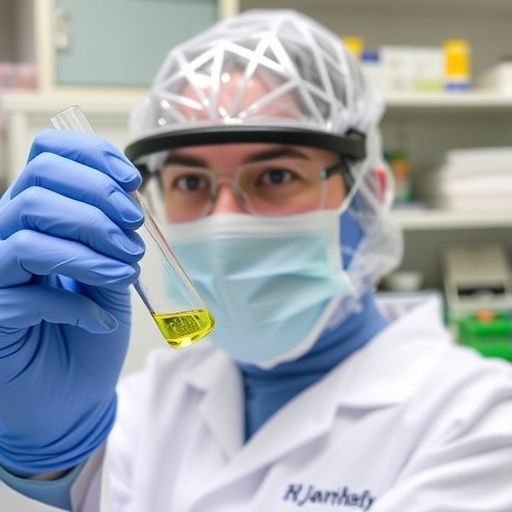
A groundbreaking advancement in environmental monitoring has emerged from Griffith University, where researchers have developed a novel, cost-effective method for detecting per- and polyfluoroalkyl substances (PFAS) in water. This innovation promises to transform the way these persistent “forever chemicals” are monitored globally, overcoming the limitations posed by traditional, laboratory-based testing protocols. With PFAS contamination continuing to pose a significant threat to ecosystems and human health, the advent of a portable, highly sensitive detection sensor marks a major leap forward in environmental safety and public health surveillance.
The new sensor leverages molecularly imprinted polyaniline-functionalized lateral flow technology—an innovative platform that combines the sensitivity of molecular imprinting with the convenience of lateral flow membranes. This approach enables rapid, on-site detection of PFAS compounds, providing quantitative results without the need for complicated sample preparation or expensive laboratory infrastructure. By targeting specific PFAS molecules, the device offers exceptional selectivity, ensuring reliable detection amidst complex environmental samples, a key challenge in current PFAS monitoring methodologies.
PFAS are a vast family of over 10,000 synthetic compounds known for their remarkable chemical stability and water-repellent properties, leading to widespread use in firefighting foams, water-resistant textiles, food packaging, and non-stick cookware. However, their extraordinary persistence in the environment—the inability to naturally break down—has resulted in global contamination of water bodies, soils, and even food chains. This persistence coupled with mounting evidence linking PFAS exposure to adverse health outcomes, including cancers, immune system dysfunctions, and thyroid disease, underscores the urgent need for effective and accessible detection methods.
Historically, PFAS analysis has been dominated by liquid chromatography-tandem mass spectrometry (LC-MS/MS), a powerful but resource-intensive technique. Despite its high sensitivity and ability to handle multiple PFAS analytes simultaneously, LC-MS/MS requires skilled operators, elaborate sample processing, and costly instrumentation, often placing it out of reach for many regions, especially those in remote or developing areas. The financial and logistical burdens associated with LC-MS/MS limit the frequency and geographical scope of PFAS monitoring, hindering timely interventions and informed policy decisions.
Recognizing these constraints, the research team aimed to develop a portable detection system that maintains accuracy and sensitivity while simplifying operation and reducing cost. The resulting sensor mimics the function of a rapid diagnostic test—much like contemporary COVID-19 rapid antigen kits—but is specifically engineered for chemical detection in environmental matrices. This approach not only accelerates the availability of results but also democratizes access to PFAS testing, enabling stakeholders ranging from environmental agencies to local communities to conduct timely water quality assessments.
The heart of the sensor’s functionality lies in its molecular imprinting technique, which fabricates synthetic recognition sites within the polyaniline polymer matrix tailored to the molecular structure of target PFAS molecules. This selective binding capability ensures that the sensor responds primarily to the PFAS of interest, significantly reducing false positives caused by other environmental contaminants. When combined with lateral flow membranes, this creates a user-friendly platform where water samples can be introduced and analyzed with minimal preparation, generating measurable signals indicative of PFAS concentration within minutes.
Experimental validation of the sensor revealed impressive sensitivity to perfluorooctanoic acid (PFOA), one of the most common and notorious PFAS contaminants. PhD candidate Lipeng (Jason) Gan, who played a pivotal role in the study, expressed enthusiasm over the sensor’s strong affinity and specificity, emphasizing its potential to revolutionize environmental surveillance. The rapid detection capabilities align closely with the urgent need for real-time data, which can inform public health advisories and remediation efforts more effectively than delayed laboratory results.
The implications of this technology extend far beyond laboratory innovation. By lowering the financial and technical barriers to PFAS monitoring, this sensor enables more frequent and widespread environmental sampling, particularly in underserved and vulnerable regions such as the Pacific Islands and rural communities. Enhanced surveillance facilitated by this tool could accelerate the identification of contamination hotspots and support proactive measures to mitigate exposure risks, ultimately reducing the burden of PFAS-related diseases on affected populations.
Furthermore, the portability and ease of use of this sensor open new possibilities for integration into routine water quality assessments by regulatory bodies, non-governmental organizations, and even citizen science initiatives. This decentralization of testing aligns with global trends towards empowering localized environmental monitoring and democratizing scientific data collection, fostering greater transparency and responsiveness in managing chemical pollutants.
Despite these promising attributes, the researchers acknowledge that further optimization and field validation are necessary to broaden the sensor’s utility across the diverse spectrum of PFAS chemicals and environmental conditions. Ongoing work aims to enhance multiplexing capabilities to simultaneously detect multiple PFAS variants and improve robustness against interfering substances commonly found in natural waters. Such advancements will solidify the technology’s role as a vital component in the environmental health toolkit.
This research, published in the reputable journal Environmental Science & Technology, signals a paradigm shift in environmental chemical monitoring, combining cutting-edge polymer chemistry with practical sensor design to address one of the most pressing toxicological challenges of our time. By bridging the gap between laboratory precision and field accessibility, the molecularly imprinted polyaniline-functionalized lateral flow membrane platform stands poised to redefine global PFAS monitoring practices and contribute significantly to safeguarding water quality and public health.
In conclusion, the development of this novel field-deployable PFAS sensor demonstrates the power of interdisciplinary research in translating complex chemical detection methods into palpable, real-world solutions. As contamination concerns escalate worldwide, affordable and rapid testing technologies such as this will be pivotal in managing environmental risks, guiding policy initiatives, and ultimately ensuring safer drinking water for communities everywhere. The successful integration of molecular imprinting with lateral flow devices may also inspire similar innovations across other domains of environmental and health diagnostics, heralding a new era of accessible and reliable pollutant detection.
Web References:
https://pubs.acs.org/doi/10.1021/acs.est.5c15559
Keywords
PFAS detection, molecular imprinting, polyaniline, lateral flow sensor, environmental monitoring, on-site water testing, persistent organic pollutants, rapid testing technology, environmental science, water contamination, chemical sensing, portable sensor
Cite Scienmag News
Bethany Barker. (May 6, 2026). Researchers Create Rapid, Low-Cost On-Site Test for ‘Forever Chemicals’. Scienmag. https://scienmag.com/researchers-create-rapid-low-cost-on-site-test-for-forever-chemicals/
Bethany Barker. "Researchers Create Rapid, Low-Cost On-Site Test for ‘Forever Chemicals’." Scienmag, 6 May 2026, https://scienmag.com/researchers-create-rapid-low-cost-on-site-test-for-forever-chemicals/. Accessed 4 September 2026.
Bethany Barker. "Researchers Create Rapid, Low-Cost On-Site Test for ‘Forever Chemicals’." Scienmag. May 6, 2026. https://scienmag.com/researchers-create-rapid-low-cost-on-site-test-for-forever-chemicals/


