

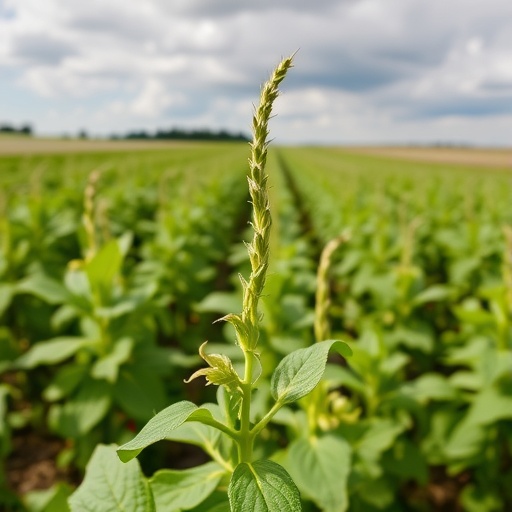
A groundbreaking advancement in agricultural biotechnology has emerged from the laboratories of Universitat Jaume I in Castelló, where researchers have engineered an innovative biostimulant composition that promises to revolutionize crop resilience under increasingly adverse environmental conditions. This breakthrough is led by the Eco-physiology and Biotechnology research group, headed by Carolina Clausell Terol and Aurelio Gómez Cadenas, whose interdisciplinary expertise merges plant physiology with cutting-edge biotechnological methods to address critical challenges in modern agriculture.
Central to this novel development is the encapsulation of proline particles within a silica matrix. Proline, an amino acid intrinsically involved in cellular osmoprotection and stabilization of protein structures, plays a vital role in enhancing plant tolerance to environmental stressors such as drought, heat, and soil salinity. By engineering a controlled-release mechanism, the team has overcome the limitations posed by direct application of proline, notably its rapid degradation and uneven distribution in field conditions.
The manufacturing process leverages aqueous suspension and spray drying technologies to produce a dry, stable powder form of the biostimulant. The encapsulation ensures thermal protection during processing and storage, preserving the bioactivity of proline while enabling consistent, gradual release over time. This controlled delivery system activates endogenous plant defense pathways, mitigating the physiological damages induced by abiotic stress and ensuring sustained growth and yield.
Experimental validations carried out under laboratory conditions have demonstrated substantial improvements in plant performance exposed to stress environments. The controlled-release biostimulant enhances cellular integrity by stabilizing membranes and proteins, while simultaneously modulating osmotic balance—mechanisms that collectively confer improved drought endurance, heat tolerance, and salinity resistance. Such effects translate into maintained photosynthetic capacity and biomass accumulation even under suboptimal cultivation conditions.
The scientific approach taken highlights a move toward synergistic crop management tools that integrate biochemical protection with environmental resilience. Unlike traditional fertilizers or chemical protectants, this biostimulant acts at a physiological level, harnessing plants’ innate adaptive mechanisms rather than applying brute-force external corrections. This strategy aligns with sustainable agriculture principles by minimizing chemical inputs and enhancing resource use efficiency.
The scalability of this technology is another significant facet of the innovation, as the production method is cost-effective and compatible with existing industrial infrastructure. The use of aqueous suspensions combined with spray drying facilitates upscaling while ensuring reproducibility and quality control. This feature is critical to meeting global agricultural demands, particularly in regions vulnerable to climate change-induced stresses.
Moreover, the composition’s protected status through a European patent application underscores its novelty and commercial potential. The research team is actively seeking partnerships with biotechnology and agricultural enterprises to adapt and refine the composition for diverse crop species and specific environmental contexts. Tailored agreements for development and commercialization are envisioned, highlighting the translational nature of this research.
Funding from the AGROALNEXT Programme, supported by both national and European Union agencies, has been instrumental, reflecting a strong institutional commitment to innovative solutions for agro-environmental challenges. The project integrates multidisciplinary scientific, technological, and economic objectives aimed at generating impactful agricultural biotechnologies that align with contemporary global sustainability goals.
The involvement of multiple researchers including Jimmy Sampedro Guerrero and Vanessa Almache Avendaño enriches the project with specialized knowledge in plant-environment interactions and bioprocess engineering, which have been critical in optimizing both the functionality and manufacturability of the biostimulant.
The broader mission of Universitat Jaume I’s institutional framework, through the Research Management and Knowledge Transfer Service (SEGIT) and supporting offices, exemplifies a model of academic innovation driving societal and economic benefits. This framework facilitates effective translation of laboratory discoveries into practical, scalable agricultural technologies that can empower farmers and agribusinesses worldwide.
In summary, the creation of this silica-encapsulated proline biostimulant heralds a new frontier in crop protection technology. By securing plant health and productivity amid climate variability, it offers a promising avenue to sustainably enhance food security. The research underscores the critical interplay between molecular science and applied agricultural innovation, positioning the developed biostimulant as a transformative tool for the future of resilient agriculture. Prospective collaborations and further industrial-scale developments are poised to accelerate its global implementation.
Subject of Research: Development of a silica-encapsulated proline biostimulant for enhanced plant stress tolerance
Article Title: Innovative Silica-Encapsulated Proline Biostimulant Enhances Crop Resilience to Environmental Stress
News Publication Date: Not specified
Web References:
- Eco-physiology and Biotechnology research group, Universitat Jaume I: http://www.uji.es/serveis/ocit/base/grupsinvestigacio/detall?codi=122
Image Credits:
Photo by Jimmy Sampedro Guerrero, Vanessa Almache Avenaño, Aurelio Gómez Cadenas, and Carolina Clausell Terol, Universitat Jaume I of Castellón.
Keywords: Proline, Biostimulant, Silica encapsulation, Controlled release, Crop resilience, Abiotic stress tolerance, Drought resistance, Heat tolerance, Salinity stress, Sustainable agriculture, Spray drying, Plant biotechnology


