


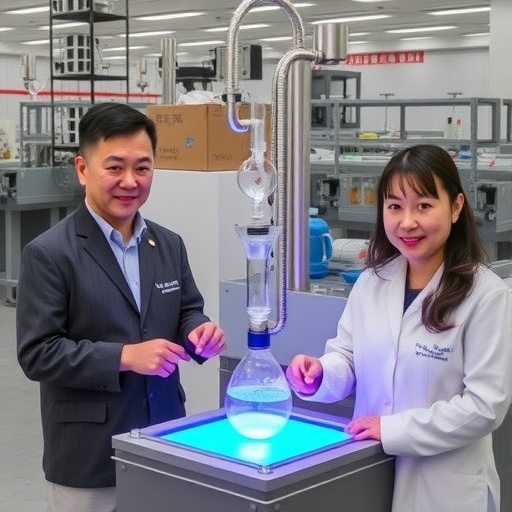
In the relentless quest to combat climate change, the transformation of atmospheric carbon dioxide from a problematic waste product into a valuable resource has taken center stage. A promising frontier in this domain is the electrochemical reduction of CO₂, a process harnessing renewable energy to convert the greenhouse gas into usable fuels and chemicals. Despite its potential, this approach has been hampered by catalytic inefficiencies, particularly in stabilizing the catalyst and directing the reaction toward the generation of multi-carbon (C₂⁺) compounds like ethylene and ethanol. These molecules are especially prized for their energy density and industrial applicability, yet their synthesis via electrochemical pathways has proven exceptionally challenging due to the complex reaction mechanisms and intermediates involved.
In a collaborative effort to overcome these barriers, leading researchers Professor Xiangzhou Yuan from Southeast University, China, and Professor Yong Sik Ok from Korea University, Korea, have made significant strides in developing advanced copper-based electrocatalysts. Their work, recently published in the influential journal Small Structures, offers a nuanced understanding of how copper’s unique properties can be precisely engineered at the atomic and electronic scales to promote the efficient conversion of CO₂ into high-value C₂⁺ products. This breakthrough not only advances the scientific fundamentals of electrocatalysis but also paves the way for scalable technologies that can integrate seamlessly into circular carbon economy frameworks.
Copper’s distinctiveness among elemental catalysts lies in its proficiency to facilitate carbon–carbon (C–C) coupling reactions, a critical step in forming multi-carbon molecules from single-carbon precursors like carbon monoxide (CO). The challenge lies in balancing the adsorption strength of reaction intermediates and controlling their transformation pathways to favor the assembly of these larger molecules. By meticulously designing the copper catalyst’s structure, the researchers achieved a harmonious interplay where active catalytic sites operate in tandem, synergistically optimize charge transfer, and possess atomic spacing conducive to preferred reaction pathways. This multifaceted engineering exploits the tandem effect—distributing the reaction roles across various sites—to magnify activity and selectivity.
Central to the team’s strategy is the stabilization of copper’s multiple oxidation states, notably Cu⁰ and Cu⁺. The coexistence of these valence states forms a dynamic catalytic environment where reaction intermediates are more readily formed and transformed, effectively lowering the energy barriers associated with C₂⁺ product synthesis. Maintaining this mixed-valence state is vital; as Prof. Yuan emphasizes, it creates a dynamic equilibrium that governs molecular interactions on the catalyst surface, directly influencing product selectivity and catalyst durability. This insight into valence state management marks a substantial advancement in catalyst design.
Beyond the intrinsic catalyst properties, the researchers explored how the broader reaction environment impacts performance. Parameters such as local pH, electrolyte composition, and CO₂ concentration dramatically modulate the reaction pathways, often dictating the efficiency and selectivity outcomes. For instance, subtle shifts in pH can alter the protonation steps integral to catalysis, while electrolyte ions can stabilize certain intermediates. Recognizing the complexity of these interdependent factors, the team incorporated machine learning algorithms to predict catalyst behavior under various conditions and to guide experimental adjustments. This data-driven approach accelerates the optimization process, mitigating the extensive trial-and-error historically associated with catalyst development.
Prof. Ok highlights the transformative potential of integrating artificial intelligence into catalysis research, noting that machine learning models enable rapid identification of promising catalyst designs and operational parameters. This convergence of computational and experimental methodologies not only expedites discovery timelines but also enhances the robustness of the resulting catalytic systems. The synergy between AI and hands-on research embodies the cutting edge of materials science and chemical engineering.
The implications of this research resonate well beyond laboratory confines. Industrial processes stand to benefit considerably from improved electrocatalysts, which can convert captured CO₂ emissions into valuable chemicals and fuels, offering a pathway to reduce reliance on fossil resources. This capability aligns with global sustainability goals and carbon-neutrality commitments by providing practical means to recycle carbon continuously. Over time, integrating these catalysts within renewable-energy-powered electrosynthesis platforms could foster a holistic system where environmental impact is minimized, and economic viability is enhanced.
Looking ahead, the researchers point to the necessity of coupling catalyst innovation with advances in reactor design and system-level engineering. Real-time characterization techniques and AI-driven controls could enable dynamic adjustments that sustain optimal catalyst states during operation. Such integrative approaches will be critical to surmounting present scalability constraints, where maintaining selectivity, stability, and productivity simultaneously remains a formidable challenge. The roadmap laid out by Prof. Yuan and Prof. Ok charts a comprehensive vision for the evolution of CO₂ electroreduction modalities.
This pioneering work not only deepens our mechanistic insight into copper-catalyzed CO₂ reduction but also exemplifies how interdisciplinary collaboration can unlock solutions to pressing environmental challenges. By blending atomic-level materials design, reaction environment tuning, and computational intelligence, the team delivers a multifaceted strategy to transform carbon emissions into economically and ecologically valuable assets. Their research signals a paradigm shift toward sustainable energy futures anchored in circular carbon management.
As the global community expedites efforts to mitigate climate change, innovations such as these will play crucial roles in shaping resilient energy infrastructures. Electrochemical CO₂ reduction empowered by tailored copper electrocatalysts encapsulates a promising avenue to turn the tide on atmospheric carbon buildup, presenting not only a scientific triumph but a beacon of hope for environmental stewardship and sustainable industrial practice.
News Publication Date: April 25, 2026
References: DOI: 10.1002/sstr.202600003
Cite Scienmag News
Russell Cooper. (May 18, 2026). Researchers at Southeast University and Korea University Pioneer Advanced Copper Catalysts for Efficient CO₂-to-Fuels Conversion. Scienmag. https://scienmag.com/researchers-at-southeast-university-and-korea-university-pioneer-advanced-copper-catalysts-for-efficient-co%e2%82%82-to-fuels-conversion/
Russell Cooper. "Researchers at Southeast University and Korea University Pioneer Advanced Copper Catalysts for Efficient CO₂-to-Fuels Conversion." Scienmag, 18 May 2026, https://scienmag.com/researchers-at-southeast-university-and-korea-university-pioneer-advanced-copper-catalysts-for-efficient-co%e2%82%82-to-fuels-conversion/. Accessed 4 September 2026.
Russell Cooper. "Researchers at Southeast University and Korea University Pioneer Advanced Copper Catalysts for Efficient CO₂-to-Fuels Conversion." Scienmag. May 18, 2026. https://scienmag.com/researchers-at-southeast-university-and-korea-university-pioneer-advanced-copper-catalysts-for-efficient-co%e2%82%82-to-fuels-conversion/


