


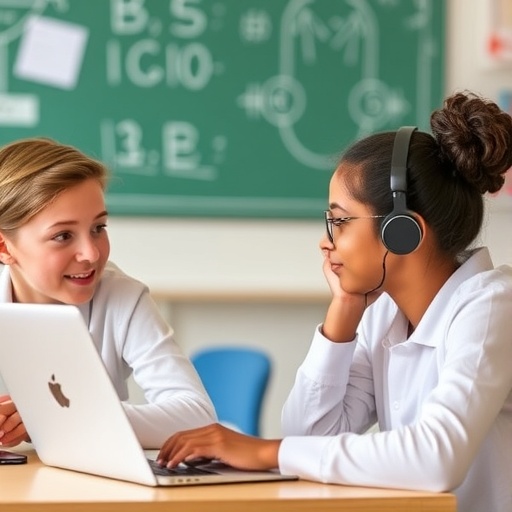
Generative Artificial Intelligence (AI) is poised to revolutionize education by implementing a dialogic approach that emphasizes conversational learning over traditional recall-based methods, according to new research from the University of Cambridge. As AI becomes increasingly sophisticated, it challenges the foundational educational paradigms centered on memorization and regurgitation, ushering in an era where dialogue, critical thinking, and collaborative inquiry take precedence.
The conventional educational framework typically involves students absorbing information—facts, theories, laws—and subsequently reproducing this knowledge under examination conditions. However, the rapid development of AI chatbots such as ChatGPT, which can effortlessly generate essays and answer complex queries, renders traditional assessment methods increasingly obsolete. The crucial implication is that simply memorizing information is no longer sufficient; the way we educate must evolve to foster deeper cognitive skills that machines cannot replicate.
Cambridge researchers propose dialogic learning as a transformative pedagogical model wherein students engage in meaningful conversations with both educators and AI. This method encourages inquiry, reasoning, and exploration of multiple perspectives. In practice, this can involve students questioning fundamental scientific phenomena. For example, instead of passively learning gravitational laws, students might discuss “Why do objects fall to the ground?” tapping into a multifaceted dialogue guided by AI representations of historical scholars like Aristotle, Newton, and Einstein.
Embedding students within these intellectual conversations helps them grasp complex concepts through reasoning rather than rote memorization. The inclusion of AI as an educational interlocutor provides a dynamic, responsive learning environment where diverse viewpoints can be simulated and tested. Such tools could serve as catalysts for intellectual curiosity, scaffolding the student’s journey toward formulating their own understanding.
This shift towards dialogic education aligns well with existing technological advancements that have historically impacted learning, such as the introduction of writing, blackboards, and the internet. Each of these innovations transformed classroom interaction and knowledge transmission. AI, according to Professor Rupert Wegerif of Cambridge, represents the latest disruptive force compelling educators to rethink their methods substantially.
The potential dangers of AI misuse in education are also underlined by the researchers. Unsupervised reliance on chatbots to complete assignments may lead to cognitive stagnation, a phenomenon described as “cognitive poison.” When students offload their thinking onto AI without engaging critically, the very educational process that fosters understanding and skill acquisition is undermined, producing superficial learning outcomes.
To counteract this, the researchers advocate integrating AI as a collaborative learning partner rather than a shortcut. For example, the Open University’s BCause project uses AI to mediate balanced, respectful group discussions, summarizing dialogues to help participants reflect on differing viewpoints. Such innovations exemplify how AI can enhance cooperation and critical dialogue instead of eroding intellectual rigor.
A core concept emerging from this work is “double-dialogic pedagogy.” This dual-layered model promotes two interwoven dialogues: first, active conversational engagement among students and teachers aimed at problem-solving using diverse perspectives; second, dialogic interaction between students and the accumulated body of scholastic thought, mediated by AI tools like the “ModeratorBot.” This AI assistant can encourage equitable participation by highlighting dominant voices and introducing open-ended questions that challenge students to consider alternative ideas.
Further enriching this dialogic framework, AI can serve as a “devil’s advocate.” Instead of supplying direct answers, AI systems such as QReframer, developed by Simon Buckingham Shum, interrogate student assumptions and provoke deeper reflection. This approach cultivates critical thinking by compelling learners to justify, reevaluate, and extend their reasoning in response to AI-generated challenges.
The integration of generative AI within education is not without its complexities. While AI holds potential to scaffold dialogic learning, its effectiveness depends largely on the pedagogy that frames its use. Technologies divorced from dialogic contexts will likely fail to realize their transformative promise, instead perpetuating existing shortcomings in educational systems.
Significantly, this pedagogical evolution aligns with the urgent need to prepare students for contemporary global challenges known as the “polycrisis.” Issues such as climate change, political instability, and technological upheaval require collaborative, interdisciplinary problem-solving. Dialogic learning nurtures the skills necessary for such connected thinking, equipping future generations to navigate and address multifaceted crises effectively.
As AI continues to permeate education, educators, policymakers, and technologists face a critical juncture. The choice lies between reinforcing obsolete models centered on memorization or embracing dialogic methods that foster collective inquiry and reasoned dialogue. Professor Wegerif emphasizes that education must reject the mere regurgitation of information, given that AI already excels at that task. Instead, it should cultivate higher-order thinking skills augmented, not replaced, by technology.
The research by Cambridge highlights a compelling vision for the future: one where AI acts not as a substitute for human cognition but as an enabler of richer, more interactive learning. Dialogic pedagogy, supported by sophisticated AI tools, promises a paradigm shift—transforming education from a solitary endeavor into a collaborative intellectual adventure.
This conceptual foundation challenges the educational community to rethink assessment design, curriculum development, and classroom practices. It advocates for educational environments that reward inquiry, dialogue, and critical reflection, harnessing AI’s capabilities to enrich, rather than diminish, the learning experience. The time has come to reimagine teaching and learning in ways that prepare students not only to navigate but to shape a complex and rapidly changing world.
News Publication Date: 17-Nov-2025
Web References:
- DOI: 10.1111/bjet.70026
- Digital Education Futures Initiative (DEFI): https://www.deficambridge.org/
- BCause Project: https://bcause.kmi.open.ac.uk/
- QReframer Tool: https://oercommons.org/courseware/lesson/114039/student/?section=1
Cite Scienmag News
Courtney Benton. (November 17, 2025). Researchers Advocate for Increased Conversation-Based Learning in Schools Amid Growing AI Influence. Scienmag. https://scienmag.com/researchers-advocate-for-increased-conversation-based-learning-in-schools-amid-growing-ai-influence/
Courtney Benton. "Researchers Advocate for Increased Conversation-Based Learning in Schools Amid Growing AI Influence." Scienmag, 17 November 2025, https://scienmag.com/researchers-advocate-for-increased-conversation-based-learning-in-schools-amid-growing-ai-influence/. Accessed 3 September 2026.
Courtney Benton. "Researchers Advocate for Increased Conversation-Based Learning in Schools Amid Growing AI Influence." Scienmag. November 17, 2025. https://scienmag.com/researchers-advocate-for-increased-conversation-based-learning-in-schools-amid-growing-ai-influence/


