


A retrospective cross-sectional study of 212 community-dwelling middle-aged and older adults with abdominal obesity found that a model combining psychological symptoms with simple physical-fitness tests identified current poor sleep quality better than routine demographic and health information alone. The seven-predictor nomogram had an optimism-corrected area under the receiver operating characteristic curve, or AUC, of 0.751, indicating moderate internal discrimination. Its apparent AUC was 0.779, compared with 0.648 for a routine-information model that did not require psychological questionnaires or fitness testing.
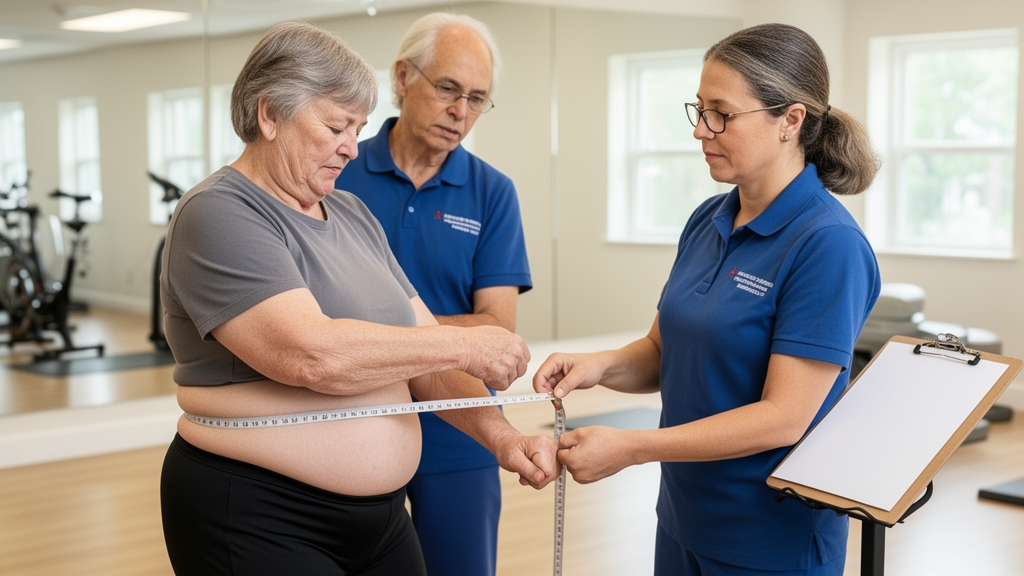
The analysis used data collected in 2026 at the Huayuan Road Community Health Service Center in Haidian District, Beijing. Eligible participants were at least 45 years old, met the study’s abdominal-obesity criterion of a waist circumference of at least 90 cm for men and 85 cm for women, and could complete the required questionnaires and physical-fitness tests. From an original dataset of 308 community residents, 212 were included: nine were excluded because they were younger than 45, 86 because they did not meet or could not be classified by the abdominal-obesity criterion, and one because Pittsburgh Sleep Quality Index data were missing.
The final group had a mean age of 65.81 years, and 152 participants, or 71.7%, were women. Current poor sleep quality was defined as a score above 5 on the validated Chinese version of the Pittsburgh Sleep Quality Index, which assesses sleep during the preceding month through seven components: subjective sleep quality, sleep latency, sleep duration, habitual sleep efficiency, sleep disturbances, use of sleeping medication and daytime dysfunction. Scores range from 0 to 21, with higher values indicating poorer sleep.
Of the 212 participants, 117, or 55.2%, met the poor-sleep threshold, while 95 had scores of 5 or lower. The 55.2% proportion describes this selected sample and should not be treated as a prevalence estimate for all community-dwelling adults with abdominal obesity. Ten candidate predictors were specified before model development: age, sex, depressive symptoms measured with the 9-item Patient Health Questionnaire, or PHQ-9; anxiety symptoms measured with the 7-item Generalized Anxiety Disorder scale, or GAD-7; global cognition measured with the Mini-Mental State Examination; and five tests representing upper- and lower-limb strength, flexibility, cardiorespiratory endurance and functional mobility.
The physical measures were grip strength, repetitions completed in a 30-second chair-stand test, chair sit-and-reach distance, steps completed in a two-minute step test and time in a modified 8-foot up-and-go test. Least absolute shrinkage and selection operator, or LASSO, logistic regression with repeated stratified 10-fold cross-validation retained age, PHQ-9, GAD-7, grip strength, chair-stand repetitions, sit-and-reach distance and two-minute step count. The seven selected variables were entered simultaneously into an unpenalized multivariable logistic regression, from which the researchers constructed the nomogram.
Predictor-specific points are added to produce an estimated probability of current poor sleep quality. In the study’s illustration, a 65-year-old participant with a PHQ-9 score of 8, a GAD-7 score of 8, grip strength of 30 kg, 16 chair stands, a sit-and-reach distance of 0 cm and 100 steps in the two-minute test received approximately 103.2 points, corresponding to an estimated 91% probability of poor sleep quality. This is an example calculated from the development model, not a diagnosis and not an individually validated prediction.
Psychological symptoms produced the clearest individual statistical association in the multivariable analysis. Each one-point increase in PHQ-9 score was associated with 37.4% higher adjusted odds of current poor sleep quality, with an odds ratio of 1.374 and a 95% confidence interval of 1.164 to 1.621. The adjusted associations for age, GAD-7 score, grip strength, chair-stand repetitions, sit-and-reach distance and two-minute step count did not reach conventional statistical significance.
That does not mean the complete model contains no information from those variables: LASSO selects predictors according to their contribution to penalized model fit and prediction error rather than an individual p-value threshold, and prediction models are evaluated primarily through discrimination, calibration and overall prediction error. Participants classified as having poor sleep quality were older and had higher PHQ-9 and GAD-7 scores than those with better sleep. They also had lower grip strength, fewer chair-stand and arm-curl repetitions, shorter sit-and-reach distances, shorter eyes-closed single-leg stance times and fewer repetitions in the two-minute step test.
These are cross-sectional group differences, not evidence that poor sleep caused reduced physical capacity or psychological symptoms. Reciprocal links involving fatigue, physical activity, mood, inflammation and metabolic regulation are possible biological contexts discussed in the research, but the study did not directly test those mechanisms. Its data therefore cannot establish temporality, causality or the direction of any relationship.
After the seven-predictor structure was fixed, 1,000 bootstrap resamples were used to estimate and correct performance optimism. The corrected AUC was 0.751, compared with an apparent value of 0.779. The corrected calibration slope was 0.858, the calibration intercept was 0.002 and the Brier score was 0.206.
The routine-information comparator contained age, sex, number of disease categories, current alcohol consumption and exercise level. Its corrected AUC was 0.608 and its corrected Brier score was 0.245. The apparent AUC difference was 0.131, with a 95% confidence interval of 0.050 to 0.213 and a paired DeLong test p-value of 0.002.
Decision-curve analysis indicated greater theoretical net benefit for the full model across threshold probabilities of 13% to 80% in the development sample, but those thresholds are sample-dependent and do not establish a clinical or screening cutoff. Several limitations sharply constrain interpretation. A post hoc assessment using the Riley framework estimated a minimum of 381 participants, including approximately 211 outcome events, for conservative prediction-model development, so the available sample did not meet all adequacy criteria.
Bootstrap correction did not repeat the entire variable-selection process, meaning some optimism cannot be excluded. Sleep was assessed only by self-report, without actigraphy or polysomnography, and PHQ-9 item 3 asks about sleep disturbance. Because item-level PHQ-9 data were unavailable, the researchers could not remove that overlapping item to test whether it inflated the PHQ-9 association, model performance or the apparent advantage over routine information.
The findings support a possible role for opportunistic triage in community healthy-aging, obesity-management or functional-assessment programs where psychological questionnaires and field-based fitness tests are already collected. In such settings, the model could identify people for whom direct administration of the PSQI or a clinical sleep assessment may be useful, rather than replace direct sleep screening. It would have no clear advantage when the PSQI can already be obtained easily.
Independent external validation in geographically diverse populations, evaluation with objective sleep measures and assessment of staff training, referral pathways and access to sleep services remain necessary. Until those steps are completed, the nomogram is best regarded as an exploratory research tool rather than a basis for individual treatment decisions or public-health policy.
Subject of Research: Internal validation of a nomogram using psychological and physical-fitness indicators to identify current poor sleep quality in adults with abdominal obesity
Article Title: Community-based identification of poor sleep quality in middle-aged and older adults with abdominal obesity using psychological and physical fitness indicators
Article References: Qiao, C., Yang, S., Wang, Y., Yang, C., He, Y., & Zeng, S. (2026). Community-based identification of poor sleep quality in middle-aged and older adults with abdominal obesity using psychological and physical fitness indicators. Frontiers in Public Health, 14, 1964356. https://doi.org/10.3389/fpubh.2026.1964356
Image Credits: AI Generated
DOI: 10.3389/fpubh.2026.1964356
Keywords: poor sleep quality, abdominal obesity, prediction model, physical fitness, depressive symptoms, anxiety symptoms, healthy aging, community health, internal validation, nomogram, Community-based, identification
Cite Scienmag News
Daisy Hatcher. (October 21, 2026). Research report: Community-based identification of poor sleep quality in middle-aged and older adults with abdominal obesity using psychological and physical fitness indicators. Scienmag. https://scienmag.com/research-report-community-based-identification-of-poor-sleep-quality-in-middle-aged-and-older-adults-with-abdominal-obesity-using-psychological-and-physical-fitness-indicators/
Daisy Hatcher. "Research report: Community-based identification of poor sleep quality in middle-aged and older adults with abdominal obesity using psychological and physical fitness indicators." Scienmag, 21 October 2026, https://scienmag.com/research-report-community-based-identification-of-poor-sleep-quality-in-middle-aged-and-older-adults-with-abdominal-obesity-using-psychological-and-physical-fitness-indicators/. Accessed 21 October 2026.
Daisy Hatcher. "Research report: Community-based identification of poor sleep quality in middle-aged and older adults with abdominal obesity using psychological and physical fitness indicators." Scienmag. October 21, 2026. https://scienmag.com/research-report-community-based-identification-of-poor-sleep-quality-in-middle-aged-and-older-adults-with-abdominal-obesity-using-psychological-and-physical-fitness-indicators/


