


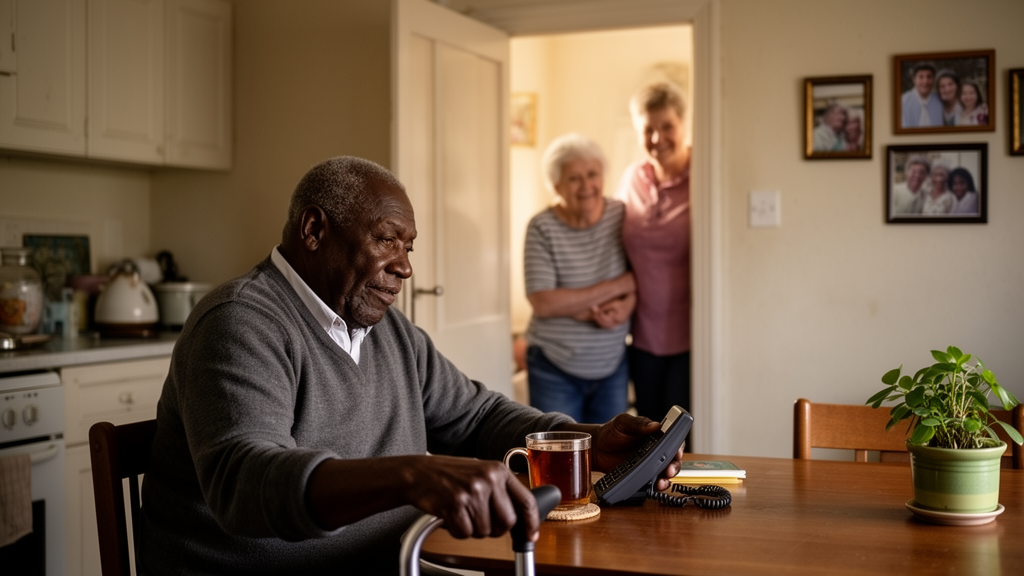
Among Black older adults living with chronic pain, perceived social disconnection showed the strongest measured association with depressive symptoms, ahead of pain interference and adaptive coping, in a cross-sectional analysis of 299 participants with complete data. Greater pain interference was also associated with more depressive symptoms, while stronger adaptive coping was associated with fewer symptoms. Together, the three predictors explained 39.2% of the variance in depressive symptoms, indicating that pain intensity alone did not capture the experiences most closely linked with emotional distress in this cohort.
The researchers conducted a secondary analysis of baseline data from the STEPS randomized controlled trial, which compared a community health worker-led chronic pain self-management program with usual care. The original study enrolled urban, community-dwelling Black adults aged 50 or older who reported muscle or joint pain on most days for at least three months, average pain intensity of at least 4 on a 0–10 scale during the previous week, and interference with usual activities. The full cohort included 335 participants: 290 women, 44 men, and one participant who reported another gender.
The primary regression used 299 participants with complete data, and a secondary analysis examined 264 women, representing approximately 88.3% of that complete-case sample. Depressive symptoms were measured with the four-item PROMIS Emotional Distress-Depression Short Form 4a, which assesses feelings of worthlessness, helplessness, depression, and hopelessness over the preceding seven days. Pain interference was evaluated with the six-item PROMIS Pain Interference 6a, addressing disruption to household chores, social activities, sleep, and enjoyment of life.
The 15-item Coping and Adaptation Processing Scale assessed cognitive and behavioral coping strategies, while the three-item UCLA Loneliness Scale captured subjective social disconnection through lack of companionship, feeling left out, and isolation. Mean depressive-symptom T-scores were 48.63, whereas mean pain-interference T-scores were 61.14, one standard deviation above the U.S. population average of 50. Multiple linear regression showed that social disconnection was the strongest independent correlate of depressive symptoms after adjustment for age and gender.
Each one-point increase on the three-item disconnection measure was associated with a 1.90-point increase in the depressive-symptom T-score, with a 95% confidence interval of 1.30 to 2.50 and a standardized coefficient of 0.389. Pain interference had a positive association: a one-point increase was associated with a 0.20-point increase in depressive-symptom scores, with a 95% confidence interval of 0.07 to 0.32 and a standardized coefficient of 0.180. Greater adaptive coping was associated with lower depressive-symptom scores, with a coefficient of −0.27, a 95% confidence interval of −0.43 to −0.12, and a standardized coefficient of −0.190.
Age and gender were not significant predictors in the primary model. The overall model was statistically significant, with F(5, 293) = 36.74 and p < 0.001. The same pattern appeared in the analysis restricted to women.
Social disconnection remained the strongest predictor, with a coefficient of 1.85, a 95% confidence interval of 1.19 to 2.52, and a standardized coefficient of 0.385. Pain interference remained positively associated with depressive symptoms, with a coefficient of 0.17 and a 95% confidence interval of 0.04 to 0.30, while adaptive coping remained associated with lower scores, with a coefficient of −0.27 and a 95% confidence interval of −0.44 to −0.11. This subgroup model explained 36.9% of the variance in depressive symptoms, with an adjusted R-squared of 0.359.
Because the analysis was cross-sectional, however, the coefficients describe measured associations rather than causal effects or a sequence in which social disconnection, coping, or pain interference led to depression. Household arrangement complicated the relationship between social circumstances and depressive symptoms. Participants living alone reported greater social disconnection than those living with others, with mean UCLA Loneliness Scale scores of 4.91 and 4.52, respectively.
Their unadjusted depressive-symptom scores did not differ significantly: 48.32 for those living alone compared with 49.05 for those living with others. When living arrangement was added to the full regression model, living alone was associated with modestly lower depressive-symptom scores after adjustment for social disconnection, pain interference, adaptive coping, age, and gender. The estimated coefficient was −1.77, with a 95% confidence interval of −3.30 to −0.24, and the expanded model explained 40.4% of the variance in depressive symptoms.
The researchers cautioned that this does not mean living alone protects against depression. The household measure did not capture relationship quality, conflict, caregiving responsibilities, whether isolation was voluntary, or the availability of support outside the home. The authors interpreted the results through the Roy Adaptation Model, a framework that treats adaptation as a reciprocal process involving focal, contextual, and residual stimuli, coping processes, and responses in physiologic, self-concept, role-function, and interdependence domains.
Chronic pain was treated as the focal stimulus; pain interference represented consequences for daily life, adaptive coping operated across the domains, and social disconnection reflected an ineffective response in the interdependence domain. Depressive symptoms were conceptualized as an outcome reflecting compromised adaptation. Within this framework, loneliness is not a peripheral feature of pain but part of the experience itself.
Persistent pain can restrict participation and reciprocity, while unsatisfying relationships can limit emotional affirmation, practical assistance, and encouragement that might support adaptation. The findings also support considering the consequences of pain rather than treating an intensity rating as a complete summary. Pain interference was associated with depressive symptoms even after social disconnection and coping were taken into account.
The authors noted that limitations in mobility, sleep, work, family responsibilities, and social participation may affect emotional well-being and the ability to maintain valued roles. Adaptive coping showed an inverse relationship with depressive symptoms, but the study did not directly measure resilience and cannot establish that coping caused better emotional outcomes. The authors instead treated cognitive and behavioral responses to persistent pain as potentially relevant components of adaptation.
They also emphasized that resilience should not be understood as an expectation that Black older adults endure pain without adequate support; it can emerge from interactions among coping capacity, social relationships, cultural and community resources, and access to appropriate services. Several limitations constrain the findings. The cross-sectional design cannot determine whether depressive symptoms influence perceptions of pain interference, coping capacity, or social connection, and the relationships may be reciprocal.
The main measures were self-reported, complete-case analysis excluded participants with missing data, and variable-level missingness reached 6.3%. Recruitment through a chronic pain self-management trial may also have selected participants with distinctive needs or resources. Most participants were women, and the household analysis lacked information about relationship quality, caregiving, and voluntary living arrangements.
There was no racial or ethnic comparison group, so the results cannot show that these relationships are unique to Black older adults or establish how they differ from those in other populations. The findings are therefore specific to the included urban cohort and should not be generalized to all Black older adults. Overall, the study points toward viewing chronic pain as a combined physical, psychological, and social experience.
A broader assessment could examine how pain affects valued activities and roles, which coping strategies remain effective, the quality of available relationships, and the presence of depressive symptoms. The analysis did not test an intervention or establish clinical recommendations, and it does not show that altering any one factor would reduce depression. Its central empirical message is narrower: within this cohort of Black older adults with chronic pain, social disconnection stood out as the largest measured correlate of depressive symptoms, while pain interference and adaptive coping provided additional statistically significant information.
The results identify dimensions worth examining beyond pain intensity, but longitudinal research will be needed to determine how coping, relationships, functional disruption, and depressive symptoms develop over time.
Subject of Research: Associations among chronic pain, adaptive coping, social disconnection, and depressive symptoms in Black older adults
Article Title: Beyond pain intensity: coping, social disconnection, and depression among Black older adults
Article References: Robinson-Lane, S. G., Tillman-Meakins, P., & Janevic, M. R. (2026). Beyond pain intensity: coping, social disconnection, and depression among Black older adults. Frontiers in Pain Research, 7, Article 1959380. https://doi.org/10.3389/fpain.2026.1959380
Image Credits: AI Generated
DOI: 10.3389/fpain.2026.1959380
Keywords: chronic pain, Black older adults, depressive symptoms, social disconnection, loneliness, adaptive coping, pain interference, Roy Adaptation Model, cross-sectional study, Beyond, pain, intensity
Cite Scienmag News
Glenn Wilkins. (October 21, 2026). Research report: Beyond pain intensity: coping, social disconnection, and depression among Black older adults. Scienmag. https://scienmag.com/research-report-beyond-pain-intensity-coping-social-disconnection-and-depression-among-black-older-adults/
Glenn Wilkins. "Research report: Beyond pain intensity: coping, social disconnection, and depression among Black older adults." Scienmag, 21 October 2026, https://scienmag.com/research-report-beyond-pain-intensity-coping-social-disconnection-and-depression-among-black-older-adults/. Accessed 21 October 2026.
Glenn Wilkins. "Research report: Beyond pain intensity: coping, social disconnection, and depression among Black older adults." Scienmag. October 21, 2026. https://scienmag.com/research-report-beyond-pain-intensity-coping-social-disconnection-and-depression-among-black-older-adults/


