


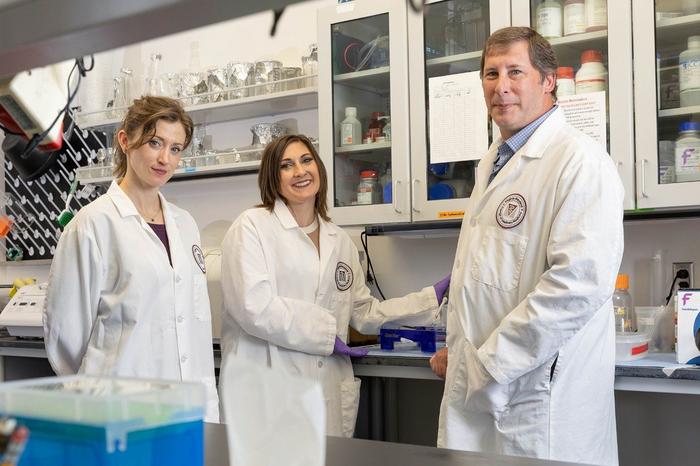
Research led by Irving Coy Allen in the Virginia-Maryland College of Veterinary Medicine has unlocked a pathway to possible future treatments for colorectal cancer in humans.

Credit: Photo by Madison Brown for Virginia Tech.
Research led by Irving Coy Allen in the Virginia-Maryland College of Veterinary Medicine has unlocked a pathway to possible future treatments for colorectal cancer in humans.
A paper published in May in the American Gastroenterological Association journal Cellular and Molecular Gastroenterology and Hepatology focuses on NF-kB-inducing kinase (NIK) and its importance in triggering cellular responses that reduce the risk of the development of colorectal cancer.
“The gene itself is colloquially called NIK, and it encodes a protein that is a kinase, which means it basically turns on or turns off – mostly turns on – lots of different genes and pathways,” said Allen, professor of inflammatory diseases in the Department of Biomedical Sciences and Pathology. “It gives us a central spoke in a hub of biological mechanisms that can be targeted with possible therapeutics. We do know that there are companies working on developing drugs to target NIK. We’re hoping that this can provide them with incentive to go after these drug candidates more aggressively.”
Colorectal cancer is second deadliest form of cancer in the United States, killing over 52,000 people in 2023. Present treatment options are often based on chemotherapy and can be difficult for the patient to endure.
“By identifying new markers and new drug targets, it may provide us with better therapeutic approaches that can minimize side effects and improve overall patient outcomes,” Allen said.
While much of the study was conducted examining mice, and that alone could have generated valuable research, Allen’s team took the extra step of translating it directly to human patients.
“By modeling it in mice, we were able to identify things to look for in humans,” Allen said. “Through collaboration with the Duke University Medical Center and colleagues here at the Virginia Tech Carilion School of Medicine, we were able to get human specimens to confirm that what we were observing in the mouse models was also true in in human colorectal cancer patients.”
The medical application of the findings will be determined in years to come as other researchers seek to identify treatments that can target NIK and its interactions with other proteins.
“Our study identified changes in a significant signaling pathway in human patients,” Allen said. “That presents a variety of possible targets that have not been previously evaluated in that pathway where you could potentially design therapeutics.”
Publication of the paper represents the conclusion of a lengthy study for Allen. Graduate students Kristin Eden ’06, DVM ’10, Ph.D. ’18; Holly Morrison Ph.D. ’23; and Brie Trusiano Ph.D. ’24 took turns helping Allen with the research and carrying it to the finish line.
“When I first came here 12 years ago, my postdoctorate work had identified some hints that this pathway might be important in the context of colorectal cancer and also in the context of inflammatory bowel disease,” Allen said. “Completion of this work has been very satisfying, knowing that it helped to launch the careers of these three talented graduate students and several undergraduate researchers as well.”
Allen said because his studies on the NIK pathway in colorectal cancer are concluded, he and his team will turn toward other types of cancer impacted by NIK and the signaling pathways it controls. But he hopes others can carry the findings forward for life-saving improvements in colorectal cancer treatment.
Journal
Cellular and Molecular Gastroenterology and Hepatology
Article Title
NF-κB Inducing Kinase Attenuates Colorectal Cancer by Regulating Noncanonical NF-κB Mediated Colonic Epithelial Cell Regeneration
Article Publication Date
13-May-2024
Cite Scienmag News
Nathaniel Bowman. (June 17, 2024). Research identifies possible new pathway to treatment of colorectal cancer. Scienmag. https://scienmag.com/research-identifies-possible-new-pathway-to-treatment-of-colorectal-cancer/
Nathaniel Bowman. "Research identifies possible new pathway to treatment of colorectal cancer." Scienmag, 17 June 2024, https://scienmag.com/research-identifies-possible-new-pathway-to-treatment-of-colorectal-cancer/. Accessed 4 September 2026.
Nathaniel Bowman. "Research identifies possible new pathway to treatment of colorectal cancer." Scienmag. June 17, 2024. https://scienmag.com/research-identifies-possible-new-pathway-to-treatment-of-colorectal-cancer/

