


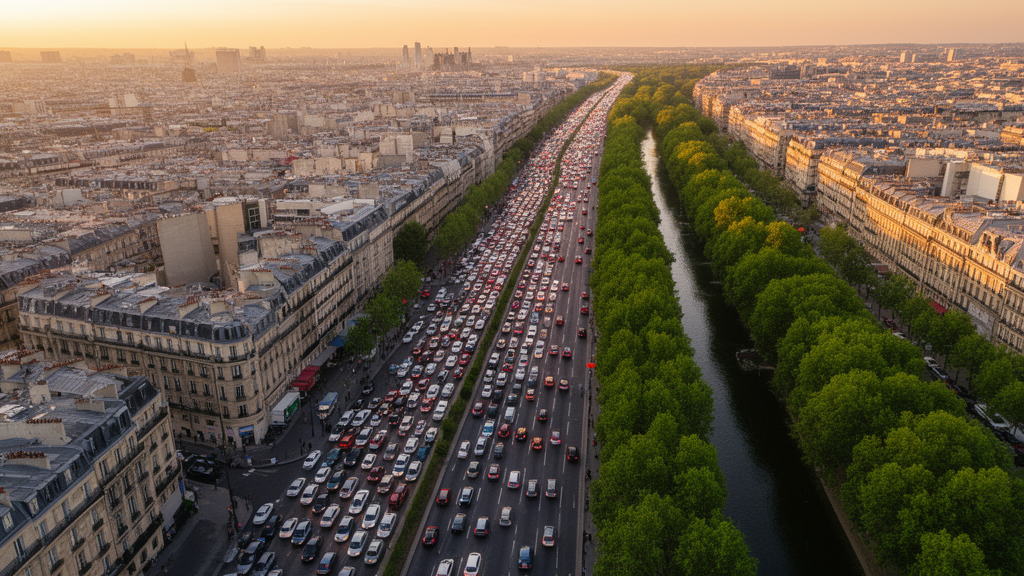
Urban traffic congestion has long been treated as an unavoidable tax on city life, a consequence of too many vehicles chasing too little road space. A new large-scale experimental study published in Nature Cities challenges that fatalism with a strikingly modest prescription: redirect fewer than two percent of trips, and the entire network flows measurably better. The research, summarized in a Research Briefing in the same journal, reports that coordinated routing interventions delivered through routing applications increased average driving speeds and could potentially save hundreds to thousands of tonnes of carbon dioxide emissions per city each year. The finding transforms a decades-old theoretical insight about selfish routing into one of the largest real-world demonstrations of network-level traffic management through behavioral nudges.
The intellectual foundation of the work lies in a concept that traffic scientists call the price of anarchy, famously formalized in Tim Roughgarden’s foundational text on selfish routing. When each driver independently chooses the route that minimizes his or her own travel time, the resulting traffic pattern can be substantially less efficient than one chosen to minimize total delay across all drivers. Individual rationality and collective efficiency diverge because drivers do not account for the congestion they impose on others. In principle, a central planner could assign everyone an optimal route, but such heavy-handed control is impractical, unpopular, and in most cities legally and politically impossible. The new study asks a subtler question: how close can a city get to the coordinated optimum by persuading only a small, targeted fraction of drivers to change their routes voluntarily?
The answer, according to the experimental evidence, is that a very small minority of trips carries a disproportionate share of the congestion burden. Because traffic flow on a road degrades nonlinearly as it approaches capacity, the marginal delay imposed by an additional vehicle is highest precisely when a link is near saturation. A single well-placed rerouting decision, made by a driver whose alternative path imposes little cost on others, can relieve a bottleneck that was slowing thousands of vehicles behind it. Conversely, rerouting drivers who are already on uncongested roads accomplishes little and may even create new hotspots. The art of the intervention is therefore identification: finding the trips whose redirection yields the largest system-wide benefit at the smallest individual cost.
Conducting a scientifically credible test of such interventions at city scale posed a formidable methodological challenge. Traffic conditions vary by hour, day, weather, and season, so a naive comparison of periods with and without rerouting could easily confuse the effect of the intervention with ordinary fluctuations in demand. The researchers addressed this with a switchback experimental design, a crossover framework drawn from the statistics literature on platform experiments, notably the work of Bojinov, Simchi-Levi, and Zhao published in Management Science. In a switchback experiment, the treatment is switched on and off across time periods, allowing each period to serve as its own baseline and enabling the researchers to separate the causal effect of coordinated routing from seasonal and daily variation in traffic patterns.
The scale of the experiment is what distinguishes it from earlier simulation studies. Dynamic traffic assignment models, surveyed in the Transportation Research Board primer by Chiu and colleagues, have long predicted that coordinated route guidance could improve network performance, but such predictions rest on assumptions about driver behavior that rarely survive contact with reality. Drivers differ in their willingness to accept longer routes, their familiarity with local streets, and their responsiveness to app-based suggestions. By deploying the intervention through routing applications at scale, the study captured these behavioral realities directly, measuring not only what happened to the rerouted drivers but what happened to everyone else on the network. The results confirmed that the theoretical gains from coordination are achievable in practice, not merely in silico.
Quantifying the environmental payoff required a second layer of modeling expertise. Fuel consumption and emissions depend on the detailed velocity profile of each trip: repeated acceleration from a standstill, hard braking, and stop-and-go crawling are far more carbon-intensive per kilometer than steady cruising at moderate speed. The researchers estimated energy use with RouteE, a vehicle energy consumption prediction engine developed by Holden, Reinicke, and Cappellucci and described in the SAE International Journal of Advances in Current Practices in Mobility. RouteE translates the speed and grade profiles of routes into expected energy consumption for representative vehicle types, allowing the team to convert measured improvements in average driving speeds into estimates of avoided carbon dioxide emissions. The resulting figures, ranging from hundreds to thousands of tonnes of CO2 per city annually, are meaningful at the municipal scale and, if replicated across many cities, consequential for national inventories.
The emissions arithmetic deserves careful attention because it runs in both directions. Faster traffic means less time idling and less energy wasted in acceleration cycles, which reduces emissions per trip. But there is a well-documented countervailing force, examined in the induced travel literature by Volker and Handy: improving road performance can attract new trips or shift travelers from other modes to driving, partially eroding the environmental gains. The study’s estimates of CO2 savings are framed as potential rather than guaranteed, an appropriately cautious formulation that acknowledges the possibility of induced demand. How large that rebound effect proves to be in any given city will depend on the availability of transit alternatives, the price of driving, and the elasticity of travel demand, factors that vary enormously across urban contexts.
What makes the result genuinely viral in its implications is the asymmetry between the size of the intervention and the size of the effect. Cities have historically pursued congestion relief through capital-intensive means: building new lanes, expanding transit networks, or implementing congestion pricing. Each of these requires years of planning, billions in investment, and often contentious political battles. Coordinated routing, by contrast, leverages infrastructure that already exists in the pockets of hundreds of millions of drivers. The marginal cost of nudging an additional two percent of trips toward less congested paths is close to zero, and the intervention can be tuned dynamically as conditions change throughout the day. In effect, the study demonstrates that a portion of the price of anarchy can be reclaimed through software and incentives rather than concrete and steel.
Several open questions remain before such systems can be deployed as standard municipal policy. The study demonstrates that rerouting a small fraction of trips improves aggregate flow, but the durability of the effect under sustained deployment is less certain: drivers who repeatedly receive longer suggested routes may opt out, and the population of persuadable drivers may shrink over time. Equity is a further consideration, since routing apps are used unevenly across demographic and income groups, and the burden of accepting slower individual routes should not fall systematically on any particular community. Privacy concerns also loom, because effective coordination requires detailed knowledge of trip patterns. None of these challenges undermines the central experimental finding, but each will shape how the approach translates from a research demonstration into everyday practice.
The broader lesson extends beyond traffic engineering. The study offers a template for managing any congested shared system, from electricity grids to data networks to logistics fleets, in which individually optimal choices impose externalities on others. By combining a rigorous switchback experimental design with domain-specific energy modeling and deployment at genuine city scale, the researchers have shown that small, targeted, voluntary behavioral changes can capture a meaningful share of the efficiency that full coordination would provide. For the millions of commuters stuck in traffic each day, the message is quietly radical: the fastest route for everyone may begin with a slight detour for a very few.
Subject of Research: Coordinated routing interventions to reduce urban traffic congestion and vehicle emissions
Article Title: Coordinated routing improves travel times and cuts emissions
Article References: Coordinated routing improves travel times and cuts emissions. (2026). Nature Cities. https://doi.org/10.1038/s44284-026-00539-4
Image Credits: AI Generated
DOI: 10.1038/s44284-026-00539-4
Keywords: traffic congestion, coordinated routing, price of anarchy, switchback experiments, CO2 emissions, routing apps, urban networks, dynamic traffic assignment, energy modeling, induced demand, Nature Cities, behavioral nudges
Cite Scienmag News
Courtney Benton. (October 8, 2026). Rerouting Just 2% of Trips Could Ease Traffic and Slash City Emissions. Scienmag. https://scienmag.com/rerouting-just-2-of-trips-could-ease-traffic-and-slash-city-emissions/
Courtney Benton. "Rerouting Just 2% of Trips Could Ease Traffic and Slash City Emissions." Scienmag, 8 October 2026, https://scienmag.com/rerouting-just-2-of-trips-could-ease-traffic-and-slash-city-emissions/. Accessed 8 October 2026.
Courtney Benton. "Rerouting Just 2% of Trips Could Ease Traffic and Slash City Emissions." Scienmag. October 8, 2026. https://scienmag.com/rerouting-just-2-of-trips-could-ease-traffic-and-slash-city-emissions/


