


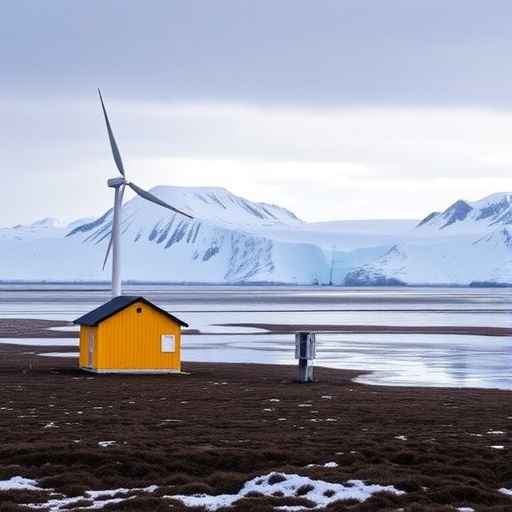
As the Arctic region undergoes rapid environmental and societal changes due to climate warming, the quest for sustainable food production in these remote and inhospitable landscapes has become a global scientific priority. A recent breakthrough study published in npj Sustainable Agriculture presents an innovative approach to achieving food sufficiency through the integration of renewable energy technologies specifically adapted for Arctic conditions. This pioneering research elucidates how harnessing wind, solar, and geothermal energy can overcome the logistical and climatic hurdles that have long impeded reliable food cultivation and supply chains in the far North.
The profound challenges of Arctic agriculture stem from its extreme cold, permafrost soil, prolonged darkness during winter months, and short growing seasons. Traditional agrarian practices are fundamentally unsuitable for this environment without significant energy inputs for heating, lighting, and infrastructure maintenance. The research team led by Hailu, Najm, and Aspholm examines how renewable energy infrastructures can serve as sustainable power sources to enable controlled-environment agriculture, such as greenhouses powered by wind turbines and photovoltaic systems designed to operate under polar conditions.
Central to the study is the recognition that Arctic communities suffer from chronic food insecurity exacerbated by high costs and the carbon footprint of food imports. The authors propose an integrated energy-food nexus, whereby local renewable energy generation can operationalize vertical farming, hydroponics, and aquaponics within insulated structures that mitigate the impact of external climate variability. Their models demonstrate how hybrid renewable energy systems can maintain stable indoor climates while minimizing reliance on fossil fuels, thereby significantly reducing environmental impact and dependency on distant food supply chains.
Wind energy emerges as a particularly promising resource due to the Arctic’s persistent, strong wind currents. The researchers detail the engineering adaptations required for turbines to endure extreme cold, ice accumulation, and low sunlight visibility. Innovations such as cold-resistant lubricants, blade de-icing technologies, and reinforced structural components are critical to maintaining turbine performance and longevity. These advancements not only ensure steady electrical output for agricultural applications but also contribute to localized grid resilience.
Solar photovoltaic (PV) technology, often underrated in polar zones due to limited winter insolation, gains new relevance when combined with energy storage systems and efficient demand management. The study highlights the importance of maximizing solar utilization during the extended summers, while relying on energy storage solutions — including advanced batteries and thermal energy storage — to bridge periods of darkness. The synergy between wind and solar generation creates a complementary system capable of delivering continuous power across fluctuating seasonal conditions.
Perhaps the most novel aspect of the research involves tapping into geothermal sources, which remain underexploited in Arctic locales despite the presence of sub-surface heat reservoirs. By integrating shallow geothermal heat pumps, the system can provide reliable baseline heating necessary for maintaining optimal growing temperatures year-round. This approach not only leverages a clean energy source particularly suited to permafrost regions but also ensures thermal stability critical for plant growth and aquaculture systems.
The authors employ comprehensive techno-economic analyses to assess the feasibility and scalability of these renewable energy systems for community-scale food production. Their findings suggest that initial capital expenditures are offset by long-term reductions in fossil fuel consumption, supply chain vulnerabilities, and greenhouse gas emissions. Moreover, the localized production enabled by renewables enhances food sovereignty and resilience against global supply disruptions — a factor increasingly vital amid geopolitical and climatic uncertainties.
Another dimension addressed by the investigation pertains to the socio-cultural implications of renewable-powered Arctic agriculture. The study acknowledges the importance of aligning technological deployment with indigenous knowledge systems and community priorities. Co-development strategies involving local stakeholders ensure that energy-food innovations are culturally appropriate, economically inclusive, and environmentally respectful, thus fostering holistic sustainability outcomes.
Technological integration extends beyond energy generation to include advances in smart farming techniques. The authors describe how sensor networks, AI-based monitoring, and automation can optimize resource use efficiency within Arctic greenhouses. Precision irrigation, nutrient delivery, and climate control minimize waste and adapt dynamically to changing environmental parameters, further enhancing the viability and productivity of northern food systems powered by renewables.
The environmental benefits of this approach resonate beyond food security. By drastically curbing fossil fuel dependency, renewable energy-driven Arctic agriculture offers a pathway to mitigating local contributions to climate change — creating a positive feedback loop where sustainable food systems also help preserve fragile polar ecosystems. The research highlights potential reductions in black carbon emissions and soil degradation, pivotal for maintaining biodiversity and ecological balance.
Policy implications emanating from the work underscore an urgent need for coordinated Arctic energy and food security strategies that prioritize renewable technology deployment. The authors recommend targeted investments, incentivization of green innovation, and the establishment of supportive regulatory frameworks to accelerate transitions toward clean, resilient food production infrastructures in northern communities.
Beyond the Arctic, the principles demonstrated by this study carry transformative potential for other extreme environments confronted with similar constraints on energy and agriculture. Deserts, high-altitude settlements, and isolated islands could adopt tailored renewable energy-food systems inspired by the Arctic model, contributing to global efforts to create more equitable and sustainable food networks.
The convergence of climate science, renewable energy engineering, and sustainable agriculture represented here marks a milestone in addressing the multifaceted challenges of northern food security. This interdisciplinary endeavor paves the way for new paradigms in how humanity can sustainably inhabit and thrive in the planet’s most extreme frontiers.
As the urgency of climate adaptation intensifies, this research offers a compelling vision where Greenland’s glaciers, Siberian tundra, and Canadian Arctic communities may transform from food-deficient zones into sources of nutritional self-reliance, powered purely by the winds, sunlight, and earth beneath their feet.
In sum, the work of Hailu and colleagues presents a comprehensive blueprint for harnessing Arctic renewable energy resources to deliver sustainable and sufficient food production. This promising fusion of cutting-edge energy technology with controlled-environment agriculture not only addresses immediate nutritional needs but also aligns with broader goals of environmental stewardship, cultural respect, and economic development in the circumpolar North.
The Arctic’s frozen landscape no longer needs to be a barrier to food security; through innovation and sustainability, it can become a beacon of humanity’s ability to adapt and flourish even in the harshest of climates. The future of Arctic food sufficiency lies at the intersection of wind turbines, solar arrays, geothermal heat pumps, and intelligent farming systems, heralding a new era of resilience and prosperity.
Hailu, G., Najm, M.A., Aspholm, P.E. et al. Renewable energy sources for arctic food sufficiency and sustainability.
npj Sustain. Agric. 3, 43 (2025). https://doi.org/10.1038/s44264-025-00079-9
Cite Scienmag News
Faith Mcneil. (July 26, 2025). Renewable Energy Powers Arctic Food Sustainability. Scienmag. https://scienmag.com/renewable-energy-powers-arctic-food-sustainability/
Faith Mcneil. "Renewable Energy Powers Arctic Food Sustainability." Scienmag, 26 July 2025, https://scienmag.com/renewable-energy-powers-arctic-food-sustainability/. Accessed 4 September 2026.
Faith Mcneil. "Renewable Energy Powers Arctic Food Sustainability." Scienmag. July 26, 2025. https://scienmag.com/renewable-energy-powers-arctic-food-sustainability/


