

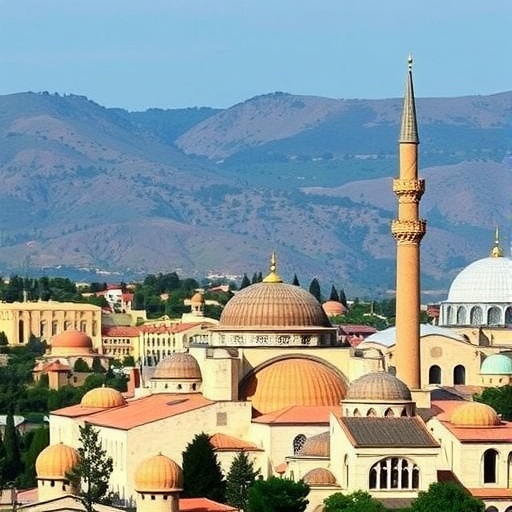
In the intricate tapestry of global architectural heritage, sacred buildings stand as profound testaments to the complex interplay of religion, culture, and history. Negar Hakim, a distinguished scholar from the Institute of Art History, Building Archaeology, and Conservation at TU Wien, has spearheaded research into the dynamic interrelations of architectural traditions across religious boundaries. Her groundbreaking work delves into Christian architectural manifestations within predominantly Islamic countries—regions often overlooked as mere outposts of cultural homogeneity but which, in reality, harbor a vibrant legacy of religious and architectural coexistence that challenges prevailing narratives.
Hakim’s investigation into the construction of modern mosques within Muslim-minority contexts established a foundational understanding of how religious architecture adapts amid sociopolitical plurality. Building on this foundation, she has redirected her focus toward Christian edifices situated in Islamic cultural milieus. In collaboration with Johann Hinrich Claussen, Cultural Commissioner of the Protestant Church in Germany, Hakim co-edited a thought-provoking issue of the journal Kunst und Kirche, titled “Churches in Islamic Countries.” This volume presents a compelling argument that Christian religious architecture is far from an alien imposition; rather, it constitutes an intrinsic component of the historical and cultural DNA permeating numerous Islamic regions.
The historical lineage of the Middle East and North Africa, foundational cradles of early Christianity, offers some of the most compelling evidence supporting this synthesis. These areas host some of the world’s most ancient churches and monastic complexes, predating the advent of Islam by centuries. Nations including Lebanon, Iran, Tunisia, and Turkey boast a rich architectural heritage, with Christian sites often surpassing in antiquity many famed European Christian structures. These ancient constructions encapsulate a panoply of styles—from late antique basilicas to medieval rock and monastic churches—each enveloped in a historical narrative that transcends simple religious demarcations.
Hakim underscores the striking variability in the status and preservation of Christian architecture depending on the sociopolitical context of the host country. States such as Iran, Tunisia, and Turkey actively recognize Christian religious buildings as vital cultural assets. In these nations, churches are often protected by governmental heritage preservation frameworks and included within UNESCO World Heritage designations. This official recognition not only safeguards architectural integrity but underlines the importance of these structures as pillars in shaping national cultural identity and promoting heritage tourism. Moreover, these buildings retain remarkable aesthetic qualities that have endured centuries of shifting cultural tides and geopolitical upheavals.
Despite their physical endurance, many Christian communities affiliated with these architectural wonders face demographic decline and existential fragility. While churches often remain structurally sound as protected monuments, their liturgical use diminishes in tandem with shrinking congregations. Yet, active Christian minorities persist in many Islamic countries, dedicated to maintaining their ecclesiastical traditions, iconography, and architectural patrimony despite socio-political challenges. The erosion or disappearance of these communities would represent not only a regional cultural loss but also a profound diminishment of the shared heritage that connects Europe and the Middle East—a perspective fiercely advocated by Hakim.
Regions plagued by ongoing armed conflict present the gravest threats to ecclesiastical architecture. Syria and Gaza epitomize this vulnerability, where immeasurable architectural treasures have been decimated. These conflicts underscore an urgent imperative to document, conserve, and revitalize sacred heritage sites before political and military strife obliterates these irreplaceable cultural markers. The interplay between conflict and heritage preservation adds an additional layer of complexity to safeguarding the intertwined Christian-Islamic architectural legacy.
Architectural hybridity emerges as a critical theme in Hakim’s research. Sacred architecture often transcends rigid symbolic boundaries, incorporating hybrid styles that manifest religious and cultural intermingling as a historically normative phenomenon. Churches in Islamic countries frequently embody design elements borrowed from local Islamic architectural vernaculars, creating a tapestry of hybridized aesthetics that defy simplistic categorization. This symbiotic relationship disrupts prevalent assumptions that Christian traditions face systematic architectural rejection or exclusion within Islamic environments.
The coexistence model advanced by Hakim reflects centuries of symbiotic religious interaction wherein Christianity and Islam have not only endured side by side but have woven each other’s cultural fabrics. The contemporary emergence of new church constructions within predominantly Islamic societies—often erected amid challenging political climates—attests to the vitality and adaptability of these traditions. Such evolving architectural forms sustain a living lineage, continuously reinventing the visual and spatial languages of faith and community.
Examining specific national contexts reveals the variegated expressions of this phenomenon. For instance, Iran’s Armenian monastic ensembles, recognized by UNESCO, spotlight Christian architecture as an integral component rather than a marginal anomaly of Iranian cultural history. In Tunisia, post-independence transformations witnessed Christian sacred spaces repurposed as vibrant cultural centers rather than neglected ruins, illustrating the resilience and reinterpretation of religious architecture within urban fabric dynamics.
Egypt’s New Administrative Capital showcases deliberate spatial juxtaposition—the mosque and cathedral constructed side by side embodying a symbolic gesture promoting religious harmony. This dual religious architectural program serves less as an organically evolved urban form and more as a curated national statement reflecting contemporary political discourses on identity and unity.
Turkey’s Hagia Sophia epitomizes the complex and layered identity of sacred architecture. Its successive transformations—from church to mosque, to museum, and back to mosque—demonstrate how sacred buildings function as palimpsests of political change and identity negotiations, bearing witness to the contested ownership and interpretation of cultural heritage.
In the Gulf, Qatar’s Christian complex in Doha exemplifies the nuanced spatial politics of religious minorities. This architectural entity permits Christian worship yet deliberately limits its public profile, symbolizing a measured tolerance rather than full parity. Such projects reveal how architecture becomes a medium for negotiating intricate relationships between faith, state sovereignty, and geopolitical diplomacy in the Gulf context.
Hakim’s work ultimately challenges reductive narratives about religious and architectural boundaries, underscoring that sacred architecture in Islamic countries is not only a repository of shared histories but also a dynamic forum where cultures intersect and adapt. Her research illuminates the indispensable role that preservation and scholarly attention must play in sustaining this rich, hybrid heritage that holds universal significance well beyond regional confines.
Subject of Research: Not applicable
Article Title: Kirchen in islamischen Ländern
News Publication Date: 28-Jan-2026
Image Credits: Sam Bajoghli
Keywords: Christian architecture, Islamic countries, sacred buildings, cultural heritage, architectural hybridity, religious coexistence, heritage preservation, Middle East, North Africa, UNESCO, Hagia Sophia, Christian minorities


