


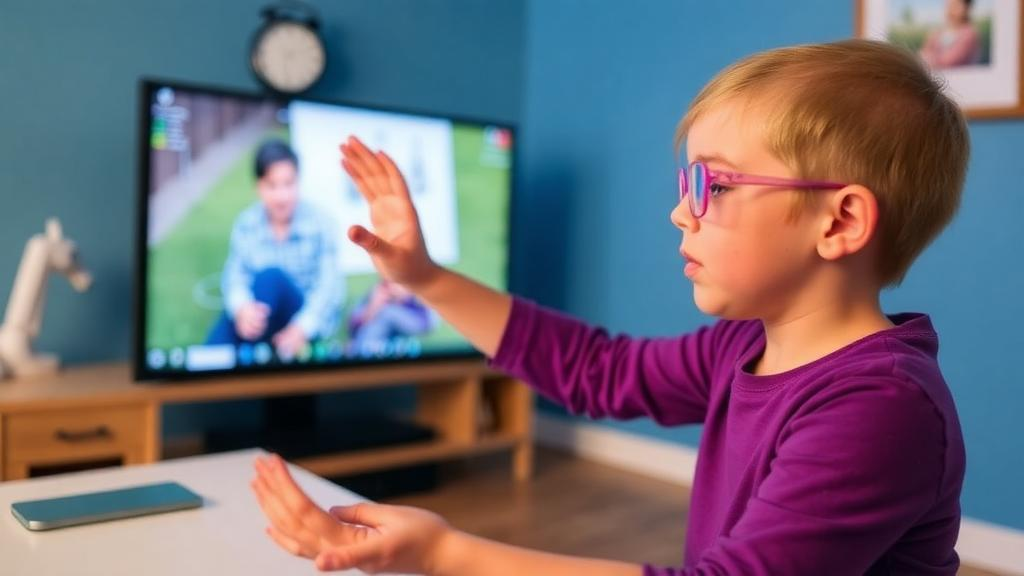
For children and adolescents with cerebral palsy, the road to stronger, more coordinated movement has traditionally run through clinics: weekly appointments, long drives, waiting rooms, and therapists delivering hands-on sessions that families must rearrange their lives around. A new systematic review and meta-analysis published in Pediatric Research suggests that a growing share of that journey may soon happen at home. The review, led by Patricia Domínguez-López and colleagues at the University of Castilla-La Mancha in Toledo, Spain, together with the cerebral palsy support association APACE, examined whether home-based telerehabilitation — therapist-guided rehabilitation delivered remotely through video calls, web platforms, and interactive gaming technology — can meaningfully improve motor function in young people with neurodevelopmental disorders. The answer, the authors conclude, is a cautious and qualified yes for gross motor function, with important caveats about the quality of the underlying evidence.
The research team set out with a broad ambition. Neurodevelopmental disorders, a category that includes cerebral palsy, autism spectrum disorder, attention deficit hyperactivity disorder, and developmental coordination disorder, affect motor, cognitive, and social functioning in children and adolescents, often limiting autonomy and quality of life. For many families, limited access to specialized rehabilitation services is a persistent barrier, and the COVID-19 pandemic dramatically accelerated interest in remote delivery models as a way to keep therapy going when in-person care became impossible. The Spanish team therefore asked a focused question: in individuals aged 3 to 18 years with neurodevelopmental disorders, does home-based telerehabilitation improve motor function compared with usual care, conventional face-to-face rehabilitation, or other non-telehealth interventions?
To answer it, the researchers conducted a rigorous search across five major databases — PubMed, the Cochrane Library, PEDro, CINAHL, and Scopus — covering the period from database inception to January 2026, with the earliest eligible trial dating from 2014. They restricted their inclusion to randomized controlled trials, the gold standard for testing whether an intervention actually causes an effect, rather than merely coinciding with one. Methodological quality was assessed with the Cochrane RoB 2.0 tool, which evaluates bias in randomized trials across domains such as randomization, deviations from intended interventions, and outcome measurement. The certainty of the pooled evidence was graded using the GRADE framework, and the results of individual trials were combined into standardized mean differences, or SMDs, using a random-effects model that allows the true effect to vary from study to study.
What emerged from the search was revealing in itself. Eight randomized controlled trials met the criteria, encompassing a total of 419 participants. Although the review was designed to cover neurodevelopmental disorders in general, every single included trial involved children or adolescents with cerebral palsy. That mismatch between the review’s broad aim and the narrow evidence base is one of the study’s most important findings, because it means the conclusions can only speak with confidence to the cerebral palsy population, leaving open questions about conditions such as autism or developmental coordination disorder. The trials themselves spanned a decade of technological change, from motion-interactive video games and Wii-based upper limb training to web-based multimodal therapy programs and home-based virtual reality systems designed to prevent regression after intensive constraint-induced movement therapy.
The headline result concerns gross motor function — the large-muscle abilities that underpin walking, balance, and transfers. Pooling the trial data, the meta-analysis suggested possible improvements with a standardized mean difference of 1.29, with a 95 percent confidence interval stretching from 0.11 to 2.47. In plain terms, the point estimate points to a large benefit, but the confidence interval is strikingly wide, and its lower bound sits barely above zero, meaning the data are compatible with anything from a trivial effect to a very large one. The statistical heterogeneity across studies was extreme, with an I² value of 96 percent, indicating that almost all of the variability between pooled results reflects genuine differences between the trials rather than random chance. The authors note that the estimates were influenced by this heterogeneity and by outlier studies, individual trials whose results pulled the pooled estimate in particular directions.
Fine motor function — the precise, small-muscle control needed for grasping, writing, and manipulating objects — told a different story. Here the pooled effect was smaller and statistically non-significant, with a standardized mean difference of 0.62 and a confidence interval spanning from minus 0.25 to 1.49, crossing the line of no effect. Heterogeneity was again very high, at 90 percent. This pattern is clinically plausible: fine motor skills are notoriously harder to train remotely, since they often require hands-on facilitation, careful grading of task difficulty, and immediate physical correction of movement patterns that a therapist can deliver in person but struggles to replicate through a screen. Many of the included trials, such as those testing computer-assisted arm rehabilitation gaming and Wii Sports Resort-based training for hemiplegic cerebral palsy, targeted the upper limb, yet the aggregated evidence for distal, precise control remains unconvincing.
Why does heterogeneity matter so much here? When I² approaches 100 percent, the pooled number becomes less a single truth than an average of very different experiments. The eight trials varied in the technology used, the dose and duration of therapy, the age and severity of participants, the comparison conditions, and the outcome measures chosen to capture motor function. A trial comparing telerehabilitation against no additional therapy may show large effects that would shrink dramatically against an equally intensive in-person program. Outlier studies with unusually large effects can dominate a random-effects meta-analysis, inflating the summary estimate. The authors’ decision to flag these influences rather than simply report the large SMD reflects a mature reading of the evidence, and it is precisely why the GRADE assessment delivered a verdict of low certainty.
The low-certainty rating deserves emphasis, because it changes how the findings should be used. GRADE downgrades evidence for risk of bias, inconsistency, indirectness, imprecision, and publication bias, and this evidence base ticks several of those boxes: extreme inconsistency, wide confidence intervals signaling imprecision, and a population narrower than the review’s intended scope. What the review supports is not a claim that home-based telerehabilitation works, but a hypothesis that it may support gross motor rehabilitation in youth with cerebral palsy, strong enough to justify further high-quality trials. The authors explicitly call for research to confirm effectiveness, determine clinical relevance, and understand implementation factors such as adherence and how interventions are actually delivered in families’ homes.
The broader context makes the question urgent. Rehabilitation science has established that motor learning depends on practice intensity and repetition, and recent dose-response meta-analyses in cerebral palsy suggest that both overall and modality-specific exercise doses matter for motor skill improvement. Yet access barriers — geographic, financial, and logistical — keep many children from receiving enough therapy. Telerehabilitation offers a potential solution, and its track record in adult neurology and musculoskeletal care, along with economic evaluations suggesting favorable cost-utility profiles, has fueled enthusiasm for pediatric applications. The pandemic-era literature documented rapid implementation of pediatric telerehabilitation and continuity of care during lockdowns, but enthusiasm has often outrun controlled evidence. This review is valuable precisely because it applies the strictest study design filter — randomized trials only — and refuses to overstate what those trials show.
For clinicians and families, the practical takeaway is one of tempered optimism. Home-based telerehabilitation appears to be a credible complementary approach for supporting gross motor development in children and adolescents with cerebral palsy, one that could extend therapy dose, reduce travel burdens, and reach families in rural or underserved regions — a model already being tested in settings such as rural Bangladesh. But it should not yet be treated as a replacement for conventional rehabilitation, particularly for fine motor goals where the evidence is weakest. The 419 participants across eight trials represent a beginning, not an endpoint. As sensor-based systems, motion-interactive games, and virtual reality platforms grow more sophisticated and more affordable, the next generation of trials — larger, better standardized, and designed to disentangle which delivery formats work for which children — will determine whether the living room can truly become an extension of the rehabilitation clinic.
Subject of Research: Effectiveness of home-based telerehabilitation for motor function in youth with cerebral palsy and neurodevelopmental disorders
Article Title: Home-based telerehabilitation on motor function in youth with cerebral palsy: systematic review and meta-analysis
Article References: Domínguez-López, P., Lirio-Romero, C., Coello-Villalón, M., López-Muñoz, P., Martínez-Olagüe Jácome, M., & Palomo-Carrión, R. (2026). Home-based telerehabilitation on motor function in youth with cerebral palsy: systematic review and meta-analysis. Pediatric Research. https://doi.org/10.1038/s41390-026-05382-w
Image Credits: AI Generated
DOI: 10.1038/s41390-026-05382-w
Keywords: telerehabilitation, cerebral palsy, neurodevelopmental disorders, gross motor function, fine motor function, pediatric rehabilitation, systematic review, meta-analysis, randomized controlled trials, telehealth, motor function, Pediatric Research
Cite Scienmag News
Denise Maddox. (October 3, 2026). Rehab From the Living Room: Telerehabilitation Shows Promise for Gross Motor Gains in Youth With Cerebral Palsy. Scienmag. https://scienmag.com/rehab-from-the-living-room-telerehabilitation-shows-promise-for-gross-motor-gains-in-youth-with-cerebral-palsy/
Denise Maddox. "Rehab From the Living Room: Telerehabilitation Shows Promise for Gross Motor Gains in Youth With Cerebral Palsy." Scienmag, 3 October 2026, https://scienmag.com/rehab-from-the-living-room-telerehabilitation-shows-promise-for-gross-motor-gains-in-youth-with-cerebral-palsy/. Accessed 4 October 2026.
Denise Maddox. "Rehab From the Living Room: Telerehabilitation Shows Promise for Gross Motor Gains in Youth With Cerebral Palsy." Scienmag. October 3, 2026. https://scienmag.com/rehab-from-the-living-room-telerehabilitation-shows-promise-for-gross-motor-gains-in-youth-with-cerebral-palsy/


