

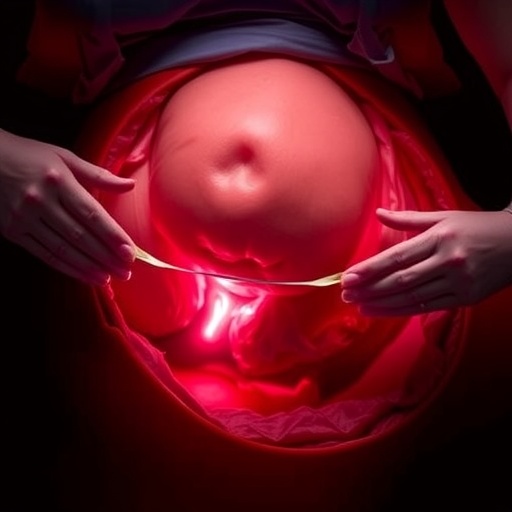
In the realm of modern obstetrics, cesarean delivery has become an increasingly common method of childbirth, now accounting for approximately one out of every two births globally. Despite its life-saving potential, there has been growing concern about the long-term complications resulting from the surgical techniques used during cesarean sections, particularly regarding how the uterus is closed post-delivery. Recent groundbreaking research by two esteemed experts in obstetrics and gynecology has cast serious doubt on the conventional approach of uterine closure, urging a critical re-examination of this decades-old practice.
The conventional uterine closure technique, employed for the past half-century, involves suturing that penetrates and unites the uterine lining—the endometrium—with the muscular layers beneath it. Although this method is favored for its simplicity and expediency, thereby minimizing intraoperative bleeding, accumulating evidence now suggests it may have significant drawbacks. The scar tissue formed by this approach fails to reconstitute the uterus’s natural anatomical and functional architecture, thus potentially predisposing women to a spectrum of severe complications in subsequent pregnancies and beyond.
Among the most alarming consequences identified are issues during future deliveries, such as abnormal placental attachment—medical professionals term this placenta accreta spectrum—which can afflict as many as 6% of women with prior cesarean sections. This abnormal attachment heightens the risk of life-threatening hemorrhage and often necessitates hysterectomy to control bleeding. Furthermore, uterine rupture, a catastrophic event compromising both mother and fetus, can occur in up to 3% of cases. Preterm birth rates amongst women with prior cesarean deliveries are also considerably high, approaching 28%, which carries additional neonatal risks.
Beyond obstetrical dangers, the health implications extend to chronic issues faced by women themselves. Post-cesarean closure complications manifest as chronic pelvic pain affecting up to 35% of women, alongside persistent postmenstrual bleeding and menstrual irregularities in approximately one-third of cases. Another noteworthy consequence is the increased incidence of endometriosis and adenomyosis, conditions that severely impact quality of life due to pain and fertility challenges, and which have been linked in up to 43% of affected women in some studies.
The traditional technique’s fundamental flaw lies in indiscriminately stitching together disparate uterine tissue layers. Professor Emmanuel Bujold, a leading researcher at Université Laval, elucidates the problem with a striking analogy: one would never close a facial laceration by suturing together oral mucosa, muscle, and skin indiscriminately, yet this is precisely what is done with uterine tissue. This realization demands a surgical principle shift towards meticulous restoration of the uterus’s natural layered structure rather than prioritizing the speed of closure.
Proposed as a superior alternative, the innovative uterine closure technique developed by Drs. Bujold and Roberto Romero centers on precise suturing of homogenous tissue layers, thereby respecting the biological and anatomical integrity of the uterus. This method involves placing separate sutures in the muscular layer, specifically targeting the upper and lower segments independently, followed by a third suture to close the outer peritoneal envelope enveloping the organ. Importantly, this approach avoids suturing the endometrial lining altogether, allowing for its uninhibited natural regeneration—a critical factor for uterine healing and function.
While this refined technique does come with some practical trade-offs—a modest increase in surgical time from the customary 2-3 minutes to approximately 5-8 minutes—the marginal uptick in intraoperative blood loss is clinically insignificant. The compelling argument maintained by the researchers prioritizes the long-term reproductive well-being of women over the expediency of surgery. Given the immense number of cesarean deliveries worldwide, this paradigm shift holds the promise of substantially reducing the incidence of these debilitating complications.
Cesarean delivery rates have notably surged over recent decades, exemplified by the Canadian context where nearly 27% of births now occur via cesarean, a figure that has practically doubled in thirty years. This dramatic increase amplifies the urgency of revisiting closure techniques to safeguard women’s health over their reproductive lifespan. The conventional fast closure approach, while initially effective in reducing immediate operative risks, neglects the profound biological consequences that unfold subsequently.
The literature review, meticulously conducted by Drs. Bujold and Romero and published in a special issue of the American Journal of Obstetrics & Gynecology, aggregates a vast array of scientific data drawing direct correlations between closure methodology and subsequent morbidities. This comprehensive analysis underscores the systemic neglect afforded to uterine tissue integrity post-cesarean and highlights the importance of applying surgical principles grounded in biology rather than convenience.
Moreover, the repercussions extend beyond the immediate obstetric circle, reverberating into women’s long-term pelvic health and quality of life—a dimension historically underappreciated in surgical protocols. Chronic pelvic pain syndromes, menstrual dysfunctions, and the emergence or exacerbation of uterine pathologies such as adenomyosis deepen the narrative, illustrating that cesarean surgery’s impact is as much about restoring tissue coherence as it is about delivering a baby safely.
The adoption of this novel closure technique necessitates a cultural and educational shift within obstetric surgery, transcending traditional paradigms to embrace a more nuanced, tissue-respecting philosophy. This aligns with broader trends in surgical disciplines emphasizing regenerative healing and anatomical fidelity. The authors advocate that such refined techniques should be incorporated into surgical training programs, professional guidelines, and public health policies globally.
In conclusion, the evidence presented impels the medical community to recognize that the uterine closure after cesarean is not a mere procedural formality but a critical determinant of both immediate and future maternal outcomes. By adopting closure methods that replicate the uterus’s natural architecture, obstetric surgeons can meaningfully mitigate the spectrum of long-term complications, thereby elevating the standard of care for millions of women worldwide. As cesarean delivery continues to grow in frequency, prioritizing biological integrity over surgical speed is not merely an option but an imperative.
Subject of Research: People
Article Title: Uterine closure after cesarean delivery: surgical principles, biological rationale, and clinical implications
News Publication Date: 13-Nov-2025
Web References: http://dx.doi.org/10.1016/j.ajog.2025.10.007
Keywords: Human health, Obstetrics, Gynecology


