


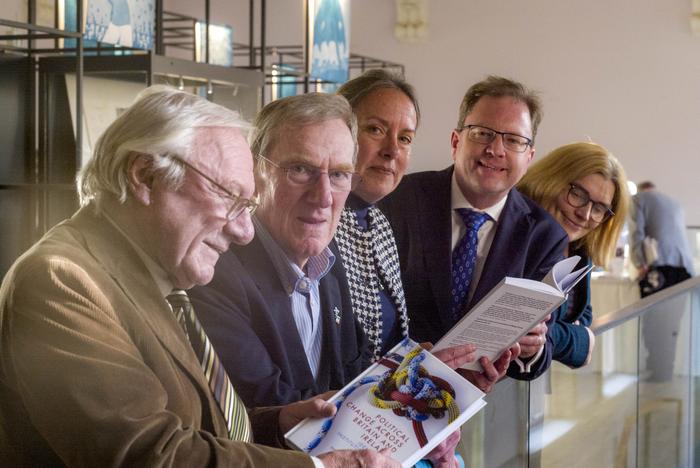
Minister James Lawless recently launched the book Political Change across Britain and Ireland: Identities, Institutions and Futures at a gathering in the Museum of Literature of Ireland. This significant publication is not just a mere collection of essays; it is an integral output of a research initiative titled ‘Constitutional Futures after Brexit’ (CFaB). This project, which has garnered support from a strategic partnership between University College Dublin (UCD) and the Reconciliation Fund of the Department of Foreign Affairs, aims to navigate the complex landscape of politics post-Brexit.
At the heart of this endeavor is a recognition of the extraordinary changes currently reshaping the identities and relationships among nations within the British Isles. Minister Lawless emphasized the timely nature of this exploration into national identities and the pressing need to address how these identities are expressed. He indicated that the book opens up critical discussions about the future relationships between these nations, particularly in the wake of Brexit, which represents a significant turning point in British-Irish relations. Lawless’s speech underscored the importance of examining these relationships at a time when complexities abound and partnerships are being reevaluated.
Dr. Paul Gillespie, one of the book’s co-editors and the director of the CFaB project, spoke passionately about the innovative concepts presented within the book. He articulated the goal of examining the multifaceted and intertwined dynamics of British-Irish relationships. The book attempts to provide a lens through which to view the new complexities arising from Britain’s departure from the European Union. Given the recent shifts, Gillespie’s remarks serve as a reminder that this academic work is grounded in pressing geopolitical realities that require new frameworks of understanding.
The issue of identity is central to the book’s thesis, particularly as it relates to how different cultures within these islands interact. Prof. Kate Robson Brown, Vice-President for Research, Innovation and Impact, added another layer to this conversation by stressing the critical need for robust, evidence-based research to inform policy decisions. In a time characterized by change, she articulated that understanding our past and present through diligent scholarly work can lead to more effective collaboration across borders.
The narratives woven throughout this book do not stop at mere analysis of current events; they extend into the realm of future possibilities. By scrutinizing existing political structures and exploring new avenues for cooperation, the authors aim to contribute positively to the discourse surrounding governance and partnership in these volatile times. The book necessarily includes analyses of identity and representation, spotlighting how entities like the Republic of Ireland and England fit into this larger puzzle.
The launch event also coincided with a related conference focusing on the theme of ‘Ireland, Britain, and Europe: Constitutional Futures after Brexit.’ This gathering of scholars and political practitioners illustrates the urgent need to reassess relationships in light of recent historical events. The synergy of the book’s content and the conference format encourages a ripe climate for discussion and dissemination of ideas crucial for advancing our understanding of these complex interrelations.
Given the historical symbols of loyalty and division that have characterized British-Irish relations, the authors highlight the transformative potential hidden within these identities. They urge for a closer examination of the collective histories that bind, as well as the divisive narratives that separate, the peoples of Britain and Ireland. By placing the two islands within a framework that considers their constitutional futures, the co-editors inspire fresh academic inquiries into the role of identity politics at play in shaping policy decisions.
The book not only brings scholarly analysis to the challenges faced but also opens doors for future research that could model cooperation among nations. The editors advocate for ongoing dialogues centered around identity and governance to navigate the evolving political landscapes. The nuanced exploration of established frameworks draws attention to the fact that new narratives may be necessary to steer the future away from conflict and division.
As the event concluded, the discussions underscored a critical realization: the shared futures of these islands depend on informed discourse and collaborative relationships. The last decade has witnessed profound changes, and as such, policy and research must adapt in response. By promoting independent scientific advice, the book paves a hopeful path toward enhanced understanding and cooperation that benefits societies across borders.
With the publication of Political Change across Britain and Ireland, the scholarly community is encouraged to rethink established narratives and question existing frameworks. As we forge ahead, it’s imperative to approach statecraft and governance through comprehensive research that captures both individual and collective identities. The book acts as an essential tool for researchers, policymakers, and the public to engage in productive discussions about what the future may hold for these intertwined nations.
In conclusion, this book challenge assumptions and provoke thought amongst a diverse audience keen to understand the intricacies of British-Irish relations. By diving deep into this timely research, we collectively position ourselves to make sense of a shifting world, recognizing that the preservation of peace and collaboration rests in our ability to understand and appreciate the multifaceted identities that exist between and within nations.
Cite Scienmag News
Courtney Benton. (April 9, 2025). Reevaluating Britain’s and Ireland’s Constitutional Landscape Amidst Transformative Shifts. Scienmag. https://scienmag.com/reevaluating-britains-and-irelands-constitutional-landscape-amidst-transformative-shifts/
Courtney Benton. "Reevaluating Britain’s and Ireland’s Constitutional Landscape Amidst Transformative Shifts." Scienmag, 9 April 2025, https://scienmag.com/reevaluating-britains-and-irelands-constitutional-landscape-amidst-transformative-shifts/. Accessed 4 September 2026.
Courtney Benton. "Reevaluating Britain’s and Ireland’s Constitutional Landscape Amidst Transformative Shifts." Scienmag. April 9, 2025. https://scienmag.com/reevaluating-britains-and-irelands-constitutional-landscape-amidst-transformative-shifts/


