


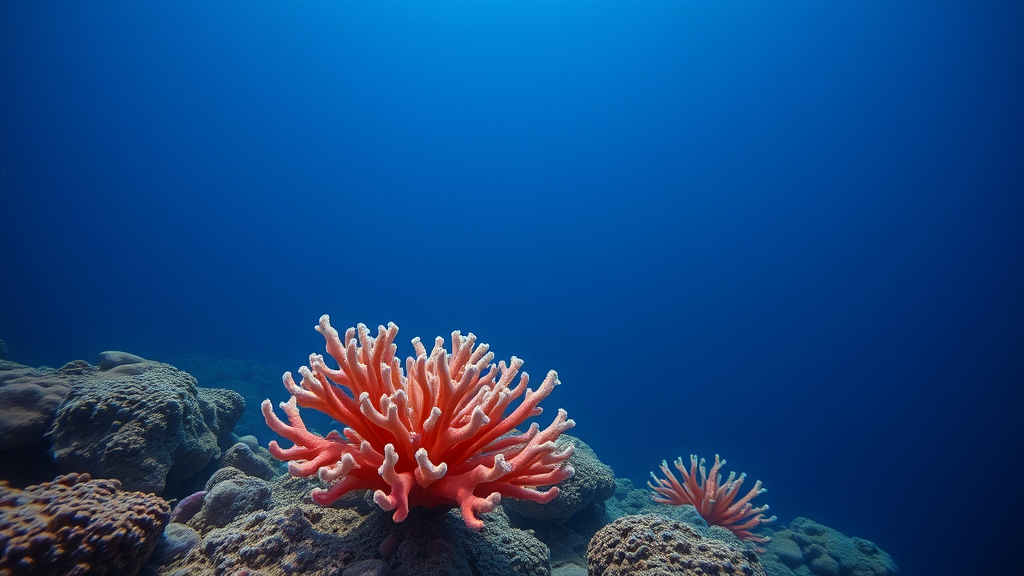
On a reef slope eighteen metres beneath the surface of the Arabian Sea, divers from the Kerala University of Fisheries and Ocean Studies collected a small fragment of a wine-red, tree-like soft coral that would soon upend what scientists thought they knew about where this animal lives. The colony, gathered on 15 March 2022 from Suheli Par reef in India’s Lakshadweep Archipelago, has now been identified as a close relative of Dendronephthya sinaiensis, a species until now known only from the northern Red Sea. The finding, published in the open-access journal Discover Oceans, represents the first molecular record of the genus Dendronephthya from the Lakshadweep Archipelago and extends the known range of this striking group of azooxanthellate octocorals into the Arabian Sea.
Soft corals of the genus Dendronephthya are among the most visually spectacular animals on tropical reefs. Lacking the symbiotic algae called zooxanthellae that power most reef-building corals, they cannot rely on photosynthesis and instead feed by capturing tiny particles from the water column. Their polyps bear comb-like pinnules along the borders of their tentacles, an adaptation that improves their ability to strain phytoplankton from passing currents, and research has shown they absorb considerable amounts of dissolved organic matter in addition to their planktonic diet. Because they depend entirely on external food, these corals thrive on flow-exposed reef slopes, where their bushy, tree-like colonies sway in the current in shades of red, pink, orange and purple. Their vibrant colours and branching forms have also made them popular in the aquarium trade, adding commercial pressure to a group that remains poorly understood scientifically.
Taxonomically, Dendronephthya is a nightmare. The genus comprises more than 247 species whose distinguishing characters, chiefly the form, size and arrangement of their microscopic calcium carbonate skeletal elements known as sclerites, are subtle and frequently overlap between species. This morphological ambiguity has long frustrated efforts to delimit species boundaries, and the problem is compounded by the slow evolutionary rate of the genetic markers traditionally used in octocoral systematics. The species at the centre of the new study, Dendronephthya sinaiensis, was originally described by the Dutch taxonomist Jan Verseveldt from the Gulf of Aqaba in the northern Red Sea, and every subsequent record has come from Red Sea localities, where the species inhabits current-swept reef slopes at mesophotic depths. No confirmed occurrence outside the Red Sea had ever been documented, which is precisely why the Lakshadweep specimen is biogeographically noteworthy.
The research team, led by Nayana Narayanankutty with C. A. Riyas, K. K. Idreesbabu and S. Sureshkumar, collected a single colony fragment from the reef slope at Suheli Par using SCUBA. Portions of the colony were preserved in 75 percent ethyl alcohol for morphological examination and in 100 percent molecular-grade alcohol for genetic analysis, and the specimen was deposited and curated in the Biodiversity Laboratory at Kerala University of Fisheries and Ocean Studies under the catalogue number BDLKUFOS-03-001. The colony itself was an arborescent, tree-like form roughly 75 millimetres tall with a polypary spread of about 55 millimetres, displaying a divaricate growth pattern with long, slender terminal twigs bearing polyps grouped into bundles of five to six. The overall colouration was wine-red, with whitish to greyish stems and branches, white polyps, and wine-red sclerites within the stem.
The morphological work focused on the sclerites, the microscopic skeletal spicules that serve as primary diagnostic characters in octocoral taxonomy. The researchers dissolved small tissue fragments from different colony regions in 10 percent sodium hypochlorite, rinsed the liberated sclerites repeatedly with distilled water, and treated them with neutralised hydrogen peroxide to remove residual organic debris. Under light microscopy, the specimen revealed large, slender, spindle-shaped sclerites measuring approximately 1.7 to 2.5 millimetres in length within the supporting bundles, smaller spindles of 0.1 to 0.3 millimetres, tiny spiny rods of 0.05 to 0.1 millimetres in the tentacles, and characteristic antler-shaped sclerites up to 0.03 millimetres in the stalk. The anthocodiae, the cup-shaped feeding portions of the polyps, carried well-developed point sclerites arranged in longitudinal rows around the anthocodial wall, a configuration corresponding to a Grade II anthocodial armature, while crown sclerites were conspicuously absent.
These characters collectively matched Verseveldt’s original description of Dendronephthya sinaiensis with striking fidelity: the colony colouration, the polyp arrangement, the antler-shaped stalk sclerites, the anthocodial armature, the absence of crown sclerites, and the strongly developed supporting bundles that project beyond the anthocodial apex all agreed. The specimen could be distinguished from morphologically similar relatives such as D. hemprichi, which forms larger, more robust colonies with densely aggregated polyps, D. klunzingeri, which exhibits bushier colonies with different coenenchymal sclerite composition, and D. cervicornis, which shows a distinctly dichotomous branching pattern and lacks the combination of wine-red colouration and antler-shaped stalk sclerites. Nevertheless, the authors could not unequivocally verify the complete anthocodial formula reported by Verseveldt, because overlapping point rows and the inability to fully flatten the anthocodia prevented an exact count of point pairs and intermediate sclerites. Combined with the absence of a direct comparison with type material, this led the team to a deliberately conservative identification: Dendronephthya cf. sinaiensis, with the abbreviation cf. signalling a close but provisional match.
To strengthen the case, the team turned to genetics. Genomic DNA was extracted from the ethanol-preserved tissue and two gene fragments were amplified and sequenced: a 735-base-pair segment of the mitochondrial mtMutS gene, widely used in octocoral systematics, and an approximately 810-base-pair fragment of the nuclear 28S rRNA gene. The sequences were deposited in GenBank under accession numbers PV469418 and PZ568242 respectively. The results were remarkable. The mtMutS sequence showed 100 percent identity, with a Kimura two-parameter genetic distance of zero, to three published sequences attributed to Dendronephthya sinaiensis from the Red Sea, while intrageneric distances to other Dendronephthya species ranged from 0.4 to 0.5 percent and intergeneric distances to outgroup species of Sinularia reached 10.0 to 10.4 percent. The 28S rRNA dataset told the same story, showing complete identity to two reference sequences of D. sinaiensis.
Phylogenetic analyses reinforced the genetic evidence. Maximum likelihood trees constructed with IQ-TREE placed the Lakshadweep specimen squarely within the Dendronephthya clade, and the mtMutS sequence clustered directly with the published Red Sea D. sinaiensis sequences with a bootstrap support value of 97 percent, while remaining clearly separate from congeners such as D. hemprichi, D. putteri and D. suensoni. The 28S rRNA analysis produced a congruent topology, with the new sequence forming a distinct lineage with the D. sinaiensis references and the Sinularia outgroups forming a well-supported sister clade with 100 percent bootstrap support. Yet the authors caution that these markers, though among the most informative currently available for octocorals, often fail to reliably distinguish closely related nephtheid species, and public databases contain limited Dendronephthya sequences, many unverified against type specimens. The molecular data therefore support a close relationship with D. sinaiensis rather than serving as the sole basis for species confirmation, which is why the cf. designation stands pending further examination of fully dissected anthocodiae and comparison with type material.
Beyond taxonomy, the occurrence raises fascinating questions about how a Red Sea-affiliated soft coral reached an atoll in the Arabian Sea, roughly two thousand kilometres away. Several mechanisms could theoretically facilitate dispersal across such distances: transport of larvae on ocean currents, rafting of asexually detached fragments, which Dendronephthya species are known to produce through autonomous fragmentation, or human-mediated vectors such as ballast water and hull fouling on ships. Global maritime traffic is a well-documented conveyor of marine organisms, and the Lakshadweep reefs lie close to major international shipping routes connected through the Bab-el-Mandeb Strait at the southern entrance to the Red Sea, suggesting that both natural and anthropogenic dispersal could be involved. The authors stress, however, that in the absence of direct evidence these mechanisms remain speculative, and resolving them will require population-level genetic studies and broader spatial sampling across the Indian Ocean.
The study also underscores how little is known about soft coral diversity in the Lakshadweep Islands compared with other Indo-Pacific reef systems. While hard corals of the archipelago have received substantial attention, systematic studies of its soft corals remain scarce, with only a handful of historical works documenting the region’s octocoral fauna. The first molecular record of Dendronephthya from the archipelago therefore fills a genuine gap and provides a foundation for future taxonomic and biogeographic research on nephtheid octocorals in the northern Indian Ocean. The authors, whose work was supported by a Core Research Grant from the Department of Science and Technology, Government of India, argue that accurately delineating species in this challenging genus will demand a fully integrative approach combining SEM-based sclerite analysis, nuclear genetic markers, expanded reference datasets and much wider sampling. For now, a wine-red fragment from a Lakshadweep reef slope stands as a reminder that the distributions of even familiar reef animals may be far less settled than the textbooks suggest.
Subject of Research: First molecular record of a Dendronephthya sinaiensis-like azooxanthellate soft coral from the Lakshadweep Archipelago, Arabian Sea
Article Title: Occurrence of a Dendronephthya cf. sinaiensis-like nephtheid octocoral in the Arabian Sea, India
Article References: Narayanankutty, N., Riyas, C. A., Idreesbabu, K. K., & Sureshkumar, S. (2026). Occurrence of a Dendronephthya cf. sinaiensis-like nephtheid octocoral in the Arabian Sea, India. Discover Oceans, 3(1), Article 60. https://doi.org/10.1007/s44289-026-00175-9
Image Credits: AI Generated
DOI: 10.1007/s44289-026-00175-9
Keywords: Dendronephthya, Nephtheidae, octocoral, soft coral, azooxanthellate, Lakshadweep, Arabian Sea, Red Sea, mtMutS, 28S rRNA, integrative taxonomy, biogeography
Cite Scienmag News
Gavin Prescott. (September 20, 2026). Red Sea Soft Coral Turns Up Thousands of Kilometres Away in the Arabian Sea. Scienmag. https://scienmag.com/red-sea-soft-coral-turns-up-thousands-of-kilometres-away-in-the-arabian-sea/
Gavin Prescott. "Red Sea Soft Coral Turns Up Thousands of Kilometres Away in the Arabian Sea." Scienmag, 20 September 2026, https://scienmag.com/red-sea-soft-coral-turns-up-thousands-of-kilometres-away-in-the-arabian-sea/. Accessed 4 October 2026.
Gavin Prescott. "Red Sea Soft Coral Turns Up Thousands of Kilometres Away in the Arabian Sea." Scienmag. September 20, 2026. https://scienmag.com/red-sea-soft-coral-turns-up-thousands-of-kilometres-away-in-the-arabian-sea/


