


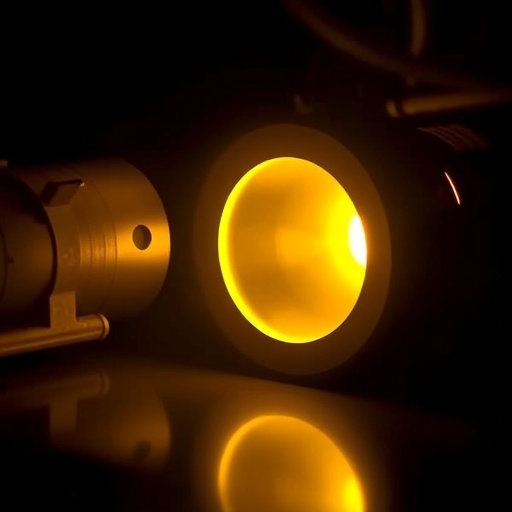
In a groundbreaking advance that heralds a new era for wavelength-specific laser technology, researchers have achieved an unprecedented brightness level in yellow laser emission through second-harmonic generation (SHG). This extraordinary feat was realized using metal-organic chemical vapor deposition (MOCVD)-grown, high-strain indium gallium arsenide (InGaAs)/gallium arsenide (GaAs) quantum well vertical-external-cavity surface-emitting lasers (VECSELs). The breakthrough, recently reported in the journal Light: Science & Applications, pushes the boundaries of laser brightness at the 590 nm wavelength—a spectral region traditionally challenging for high-power coherent light sources.
The team, led by Zhang, Zhan, and Xiao, meticulously engineered their quantum well laser structure to exploit the delicate physics of high-strain InGaAs/GaAs materials. By finely tuning the strain within these quantum wells, they enhanced the efficiency of SHG, converting near-infrared photons generated by the laser gain medium into intense yellow light. This remarkable manipulation of semiconductor nanostructures unlocks a level of brightness exceeding 1.65 gigawatts per square centimeter per steradian (GW cm⁻² sr⁻¹), setting a new global benchmark for yellow laser sources.
The innovative use of a vertical-external-cavity surface-emitting laser configuration is crucial to this success. VECSELs combine the advantages of edge-emitting and surface-emitting lasers, offering high beam quality and scalable output powers while allowing additional intracavity nonlinear optical processes like SHG. In this study, the laser cavity was carefully designed to optimize the nonlinear frequency doubling process, enabling a compact but highly efficient conversion of infrared radiation into visible yellow light.
One of the perennial challenges in generating yellow laser light is the lack of suitable direct semiconductor laser gain media emitting at this wavelength. Historically, either complex and inefficient dye lasers or frequency conversion techniques from other color lasers were employed, limiting brightness, stability, and lifetime. The approach taken in this study circumvents these obstacles by directly growing high-quality quantum wells that produce near-infrared light optimally tailored for frequency doubling, resulting in efficient, stable, and scalable yellow emission.
MOCVD has long been the industry standard for producing high-quality epitaxial semiconductor layers. In this work, the precise control of MOCVD growth conditions enabled the researchers to implement a high-strain InGaAs composition within the quantum wells. This high strain alters the bandgap energies and electronic properties, fostering enhanced optical nonlinearities ideal for second-harmonic generation. The interplay between the quantum well electronic structure and the VECSEL cavity design was exploited to maximize SHG output without compromising laser stability or operational thresholds.
The implications for the laser technology landscape are substantial. Yellow laser light at 590 nm plays a vital role in numerous fields including biomedical imaging, spectroscopy, metrology, display technology, and laser-based lighting. System miniaturization and increased power efficiency made possible by these high-brightness VECSELs open pathways toward portable diagnostic devices, improved high-resolution fluorescence microscopy, and next-generation optical data storage systems.
Beyond brightness, beam quality and spectral purity are critical for applications demanding high spatial coherence and narrow linewidth. The VECSEL design inherently provides superior beam characteristics due to its surface-emitting nature and vertical cavity geometry. Coupled with the nonlinear conversion process, the output beam exhibits excellent mode profiles, enabling precision focusing and efficient coupling into optical systems—a quality paramount for advanced scientific and industrial use.
This achievement also contributes to the ongoing global quest for compact semiconductor laser sources spanning the visible spectrum with customizable output. The ability to engineer strain in quantum wells and harness nonlinear intracavity effects sets a versatile platform that can be potentially extended to other wavelengths by appropriate material and cavity engineering. Such adaptability promises a flexible toolkit for coherent light generation far beyond traditional semiconductor laser limitations.
The interdisciplinary effort combined materials science, photonics engineering, nonlinear optics, and epitaxial growth technology. Extensive theoretical modeling of quantum well band structures, nonlinear optical susceptibilities, and cavity dynamics was integrated into the experimental design. This enabled the researchers to predict and optimize performance parameters before device fabrication, accelerating development cycles and ensuring maximal yield of high-brightness output.
From a fundamental physics perspective, this study expands understanding of strain-induced modifications in semiconductor quantum wells and their nonlinear optical responses. The observed enhancement of second-harmonic generation efficiency under high strain contributes valuable insights to the broader field of nonlinear semiconductor photonics. Such knowledge underpins future endeavors in designing active devices that exploit quantum mechanical effects for novel functionalities.
In practical terms, fabricating these high-strain quantum well VECSELs requires stringent control of epitaxial layer thickness, composition gradients, and interface quality to avoid dislocations and degrade device performance. The successful growth via MOCVD demonstrates the maturity of epitaxial techniques and paves the way for scalable manufacturing of similarly advanced photonic devices. This reliability is essential for transitioning laboratory achievements into commercial products.
Collaborations between academic institutions and industry partners likely played a pivotal role in this project, facilitating access to state-of-the-art growth reactors, laser testing facilities, and computational resources. Such partnerships highlight the synergy required to translate cutting-edge research into technologies that address real-world demands. The impact of these results could catalyze further investment into high-performance VECSEL development.
In summary, the delivery of over 1.65 GW cm⁻² sr⁻¹ brightness at 590 nm from MOCVD-grown high-strain InGaAs/GaAs quantum well VECSELs represents a transformative advance in visible laser technology. This milestone underscores the power of integrated quantum materials engineering and sophisticated cavity design to overcome longstanding spectral and brightness challenges. As the field moves forward, these yellow lasers will undoubtedly stimulate innovations across science, medicine, and industry—redefining the boundaries of laser performance.
Looking ahead, continued progress in material strain engineering, cavity optimization, and nonlinear optics may produce entire families of brightly emitting semiconductor lasers tailored to precise application niches. Further miniaturization coupled with enhanced electrical pumping efficiencies could usher a new generation of accessible photonic devices, fueling a wave of technological breakthroughs. The future of high-brightness visible lasers, vividly imagined by this research, is indeed bright.
Cite Scienmag News
Katie Riggs. (March 10, 2026). Record Brightness 590nm Yellow SHG in Quantum Well VECSEL. Scienmag. https://scienmag.com/record-brightness-590nm-yellow-shg-in-quantum-well-vecsel/
Katie Riggs. "Record Brightness 590nm Yellow SHG in Quantum Well VECSEL." Scienmag, 10 March 2026, https://scienmag.com/record-brightness-590nm-yellow-shg-in-quantum-well-vecsel/. Accessed 3 September 2026.
Katie Riggs. "Record Brightness 590nm Yellow SHG in Quantum Well VECSEL." Scienmag. March 10, 2026. https://scienmag.com/record-brightness-590nm-yellow-shg-in-quantum-well-vecsel/


