


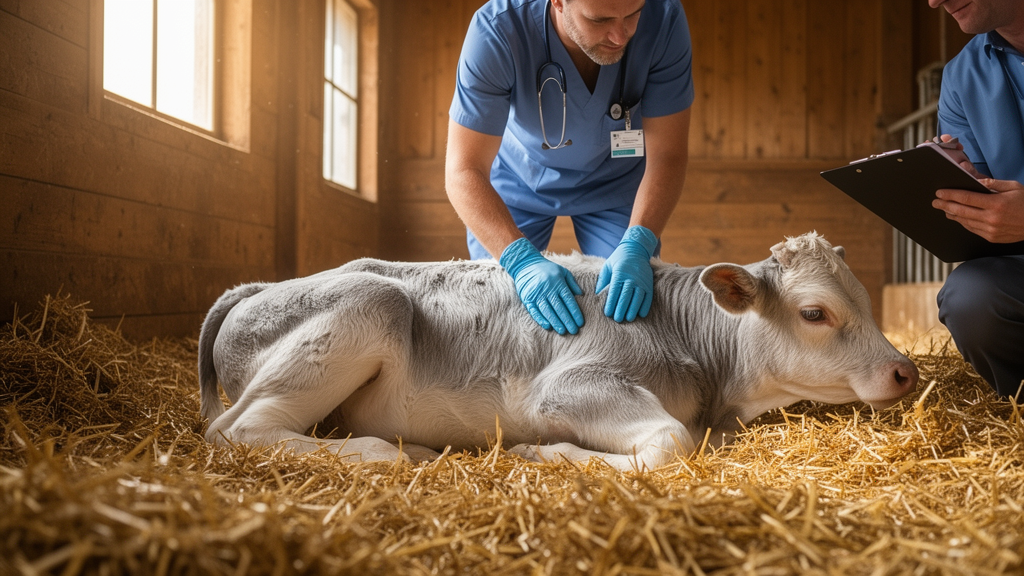
In a region where more than 80 percent of Piedmontese cattle farms cluster in the Italian provinces of Cuneo and Turin, a four-year prospective study has systematically investigated calves born with suspected congenital malformations of the central nervous system. The findings, published in Frontiers in Veterinary Science, provide the first structured picture of a group of disorders that has long remained poorly characterized: congenital structural malformations of the spinal cord. The study, running from 2021 to 2025, was designed as a prospective observational investigation.
Rather than combing through old records, the team examined each affected calf as it appeared, applying a standardized diagnostic pipeline that included clinical and neurological examinations, cerebrospinal fluid analysis, diagnostic imaging, molecular testing for regionally relevant teratogenic viruses, and full necropsy with histopathology. That rigor mattered. Of 70 calves that underwent necropsy for suspected congenital central nervous system anomalies, only five were confirmed to have structural spinal cord malformations.
The strict inclusion criterion—necropsy confirmation—means the reported cases represent definitively characterized anomalies rather than clinical impressions, an important distinction in a field where spinal cord malformations in cattle are considered likely underreported and their true incidence poorly characterized. The five cases revealed a strikingly heterogeneous spectrum of developmental defects. Myelodysplasia, a malformation of the spinal cord's intrinsic structure, was present in four of the five calves.
Hydrosyringomyelia, in which fluid-filled cavities form within the cord, appeared in three. Segmental spinal cord aplasia, the failure of a portion of the cord to develop at all, and diplomyelia, a duplication of the spinal cord, were each identified in two calves. Malformations of the vertebral column accompanied the spinal defects in several cases.
Open spina bifida, in which the neural tube remains uncovered, was identified in two of the five calves, while a further calf showed the closed form of the defect. The researchers also noted that concurrent musculoskeletal and urogenital abnormalities were common across the affected animals, reinforcing the impression of a broad developmental syndrome rather than a single, isolated lesion. One of the study's most consequential findings was what the molecular tests did not show.
Screening for bovine viral diarrhea virus, bluetongue virus, and Schmallenberg virus—all regionally relevant teratogenic viral pathogens—came back negative in every case. While the study was not designed to establish etiology, the uniform negativity shifts attention toward other possible causes, including genetic factors, and underscores why the authors frame their work as a foundation for future investigation rather than a definitive explanation. The Piedmontese breed itself provides a compelling context.
A companion study by the same group characterized congenital structural brain malformations in the breed, and the present paper completes the picture by addressing the spinal cord. Together, the two studies establish a phenotypic framework—a detailed catalog of what these malformations look like clinically and pathologically—that had not previously existed for Piedmontese cattle. Such frameworks are the essential first step toward identifying developmental mechanisms and, ultimately, genetic underpinnings.
The authors are careful about the limits of their data. With only five confirmed cases, the study characterizes the spectrum of anomalies but cannot estimate incidence, and its geographic scope is confined to the heartland of Piedmontese cattle farming. The findings describe associations among malformations and between spinal defects and other congenital abnormalities; they do not demonstrate causal relationships or identify a genetic mutation.
Even so, the work marks a genuine advance. By prospectively assembling, examining, and definitively characterizing every suspected case over four years, the team has transformed a scattered collection of anecdotal reports into a coherent phenotypic framework—the first of its kind for this breed. The next chapter, the authors suggest, will be to use that framework to probe the developmental and genetic mechanisms behind these disorders, work that could eventually benefit both veterinary medicine and the breeders who depend on the health of their herds.
Subject of Research: Congenital structural spinal cord malformations in Piedmontese calves
Article Title: Congenital central nervous system malformations in piedmontese calves—part 2. structural spinal cord disorders
Article References: Ferrini, S., Scaglione, F., Cagnotti, G., Borriello, G., Cantile, C., Aytaş, Ç., Catania, A. M., Di Muro, G., Grego, E., Manassero, L., Quaglino, A., Tessarolo, C., Tomassone, L., Valazza, A., Bellino, C., & D'Angelo, A. (2026). Congenital central nervous system malformations in piedmontese calves—part 2. structural spinal cord disorders. Frontiers in Veterinary Science, 13, Article 1977752. https://doi.org/10.3389/fvets.2026.1977752
Image Credits: AI Generated
DOI: 10.3389/fvets.2026.1977752
Keywords: Piedmontese cattle, spinal cord malformations, myelodysplasia, spina bifida, hydrosyringomyelia, diplomyelia, veterinary neurology, congenital anomalies, bovine teratology, necropsy, Italy, Congenital
Cite Scienmag News
Cassandra Pierce. (October 26, 2026). Rare Spinal Cord Malformations Documented in Piedmontese Calves. Scienmag. https://scienmag.com/rare-spinal-cord-malformations-documented-in-piedmontese-calves/
Cassandra Pierce. "Rare Spinal Cord Malformations Documented in Piedmontese Calves." Scienmag, 26 October 2026, https://scienmag.com/rare-spinal-cord-malformations-documented-in-piedmontese-calves/. Accessed 26 October 2026.
Cassandra Pierce. "Rare Spinal Cord Malformations Documented in Piedmontese Calves." Scienmag. October 26, 2026. https://scienmag.com/rare-spinal-cord-malformations-documented-in-piedmontese-calves/


