


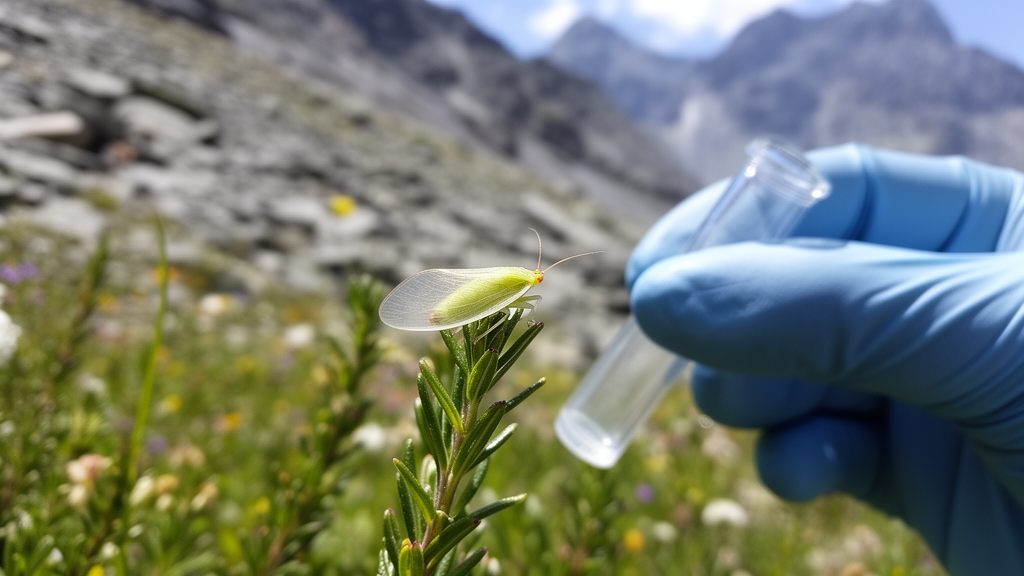
High on the southern slopes of Mount Pilatus in central Switzerland, in an alpine meadow dotted with rocks known as the Chilchsteine, two small insects collected more than a decade apart have turned out to belong to a species entirely new to science. The species, formally described as Eryngiofaga perrara, is a jumping plant louse, or psyllid, and its description also marks the first time the genus Eryngiofaga has been recorded anywhere in Switzerland or in the Alps. The finding, published in the journal Alpine Entomology, rests on a remarkably slender evidentiary base: a single male and a single female, gathered at the same spot on the mountain but separated by ten years of intensive searching.
The story of the discovery began in 2000, when a single female of an unknown psyllid was found at the Chilchsteine site, which lies between 1850 and 1900 metres above sea level. Despite repeated and intensive searches of the locality, no further specimens appeared until 2010, when one male was finally collected at the same place. The two specimens, examined in the collections of Swiss museums, proved to be conspecific and to represent an undescribed species of Eryngiofaga. The holotype male and the paratype female are deposited in the Naturhistorisches Museum in Basel, and the species name perrara derives from the Latin perrarus, meaning very rare, in direct reference to the paucity of available material.
Psyllids constitute a superfamily of the plant-lice group Sternorrhyncha with slightly over 4000 described species worldwide. As immatures, most species are mono- or oligophagous, meaning they develop on only one or several phylogenetically close plant species. Often, related psyllid species develop on related host taxa, and many genera are restricted to a single plant genus or family. Eryngiofaga, a genus of the family Triozidae established in 1968, illustrates this pattern precisely: its 13 described species are associated with the plant genera Bupleurum and Eryngium, both in the carrot family Apiaceae. Most species of the genus occur in temperate Asia and Eastern Europe, but five are also found in Central and Western Europe. Until now, the genus had never been reported from Switzerland or the Alps.
The adult of E. perrara is yellow to orange, with a more or less distinct greyish brown longitudinal stripe running along the head and thorax, very light in the male and darker in the female. The antennal segments one to three are yellow while segments four to ten are almost black, and the forewing is transparent and colourless with yellow to light brown veins. The genal processes are conical and subacute at the tip, measuring 0.3 to 0.4 times as long as the vertex along the midline, and the antenna is 1.9 to 2.2 times as long as the head width.
The forewing of the new species is 4.3 to 4.4 times as long as the head width and 2.8 times as long as wide, with a strongly and evenly curved costal margin, an almost straight anal margin, and a short, distinctly concave vein Rs. Surface spinules are lacking apart from the base of the wing. The male terminalia provide the decisive diagnostic characters: the paramere is bifid, with a narrow inner anterior process that is sclerotised apically and bears a small anterior and posterior toothlet, and a broader outer posterior lobe that narrows irregularly to a strongly sclerotised apex forming an apical tooth. The distal segment of the aedeagus is hardly expanded basally and weakly expanded apically, bearing a small subapical hook ventrally. The female terminalia are short, with the proctiger ending in a small apical tubercle.
Measurements taken from the two specimens, one male and one female, give a body length of 2.5 millimetres for the male and 2.7 millimetres for the female, with a head width of 0.46 to 0.50 millimetres, an antenna length of 0.96 to 1.00 millimetres, and a forewing length of 1.98 to 2.20 millimetres. The male proctiger measures 0.24 millimetres, the paramere 0.16 millimetres, the distal segment of the aedeagus 0.22 millimetres, and the female proctiger 0.40 millimetres. The hindwing is two thirds the length of the forewing, and the circumanal ring of the female is oval, consisting of two unequal rows of pores. Immature stages of the species remain unknown, so nothing can yet be said about the nymphal form or its development.
The shape of the parameres places E. perrara in the congenita species group of the genus, one of two groups recognised on the basis of paramere form. The congenita group, with lamellar or triangular parameres bearing a large sclerotised process, includes E. armeniaca, E. congenita, E. hungarica, E. maga, E. matura and E. refuga, while the mesomela group, with digitiform parameres, comprises E. babugani, E. deserta, E. dlabolai, E. lautereri, E. loewiana and E. mesomela. An additional species, E. expectata, is known from a single female only. The new species differs from E. armeniaca and E. maga in the basally more slender distal segment of the aedeagus, and from E. congenita, E. refuga, E. hungarica and E. matura in the much shorter subapical ventral hook on that segment. It also differs from the other species of the group in details of the paramere, and in colouration: the head, thorax and abdomen of E. congenita, E. refuga and E. hungarica are dark brown or almost black, but yellow, ochreous or at most light brown in E. perrara.
The host plant of E. perrara remains unknown, but the biology of the genus offers a strong clue. Hosts are known for only five of the 13 previously described Eryngiofaga species: three species of the mesomela group develop on Eryngium species, and one species each of the congenita group and the mesomela group on Bupleurum falcatum. The available data suggest that species of Eryngiofaga are monophagous, each depending on a single host plant. Because host plants of the genus are restricted to the genera Bupleurum and Eryngium, and because Bupleurum ranunculoides grows at the Chilchsteine site on Mount Pilatus, the authors consider this plant a likely host for the new species. Confirmation, however, must await further fieldwork, since no immature stages or feeding observations are yet available.
The type locality itself has a history of yielding surprises. Studies on the psyllid fauna of the Central Swiss Prealps over the last 45 years have shown an unexpected diversity, including four species that were new to science at the time of their description. Pilatus, which rises from Lake Lucerne at about 430 metres above sea level to just over 2100 metres, has been regularly visited by researchers. At the Chilchsteine meadow, about a dozen psyllid species have been found, of which Aphalara longicaudata on Polygonum bistorta and Bactericera femoralis on Alchemilla species were by far the most common. The identification of the new species was carried out by comparison with material of E. deserta, E. hungarica, E. lautereri, E. matura and E. mesomela held in the Geneva and Basel museum collections, using Loginova’s 1977 revisionary key of the genus.
Although narrow geographic endemism is generally rare in psyllids, at least five species are already known to be restricted to the Alps: Craspedolepta carinthica, Cyamophila prohaskai, Livilla vicina, Livilla vittipennella and Trioza remaudierei. The biogeographic pattern of E. perrara is similar to that of Cyamophila prohaskai, the only Alpine species of a genus that is very species rich in Central Asia. The authors note that it is unlikely E. perrara occurs only on Mount Pilatus, judging from the much wider distribution of its potential host plant, but with only two specimens known it is impossible to explain why the species has been collected so rarely and at a single locality. More intensive and targeted fieldwork, the description concludes, is needed to unravel the many questions surrounding this rare insect, including the true extent of its range and the identity of its host.
Subject of Research: The description of a new psyllid species, Eryngiofaga perrara, from Mount Pilatus, Switzerland, based on two specimens and representing the first record of the genus Eryngiofaga from Switzerland or the Alps.
Article Title: Eryngiofaga perrara sp. nov. ( Hemiptera , Psylloidea ) from Mount Pilatus (Obwalden), a new species of a genus previously unknown from Switzerland or the Alps
Article References: Burckhardt, D. (2022). Eryngiofaga perrara sp. nov. (Hemiptera, Psylloidea) from Mount Pilatus (Obwalden), a new species of a genus previously unknown from Switzerland or the Alps. Alpine Entomology, 6, 147-151. https://doi.org/10.3897/alpento.6.97595
Image Credits: AI Generated
Keywords: Eryngiofaga perrara, psyllids, jumping plant lice, Mount Pilatus, Switzerland, Alps, new species, taxonomy, Hemiptera, Triozidae, host plants, Bupleurum
Cite Scienmag News
Gavin Prescott. (October 27, 2026). Rare New Psyllid Species Discovered on Mount Pilatus Marks a Genus First for the Alps. Scienmag. https://scienmag.com/rare-new-psyllid-species-discovered-on-mount-pilatus-marks-a-genus-first-for-the-alps/
Gavin Prescott. "Rare New Psyllid Species Discovered on Mount Pilatus Marks a Genus First for the Alps." Scienmag, 27 October 2026, https://scienmag.com/rare-new-psyllid-species-discovered-on-mount-pilatus-marks-a-genus-first-for-the-alps/. Accessed 27 October 2026.
Gavin Prescott. "Rare New Psyllid Species Discovered on Mount Pilatus Marks a Genus First for the Alps." Scienmag. October 27, 2026. https://scienmag.com/rare-new-psyllid-species-discovered-on-mount-pilatus-marks-a-genus-first-for-the-alps/


