


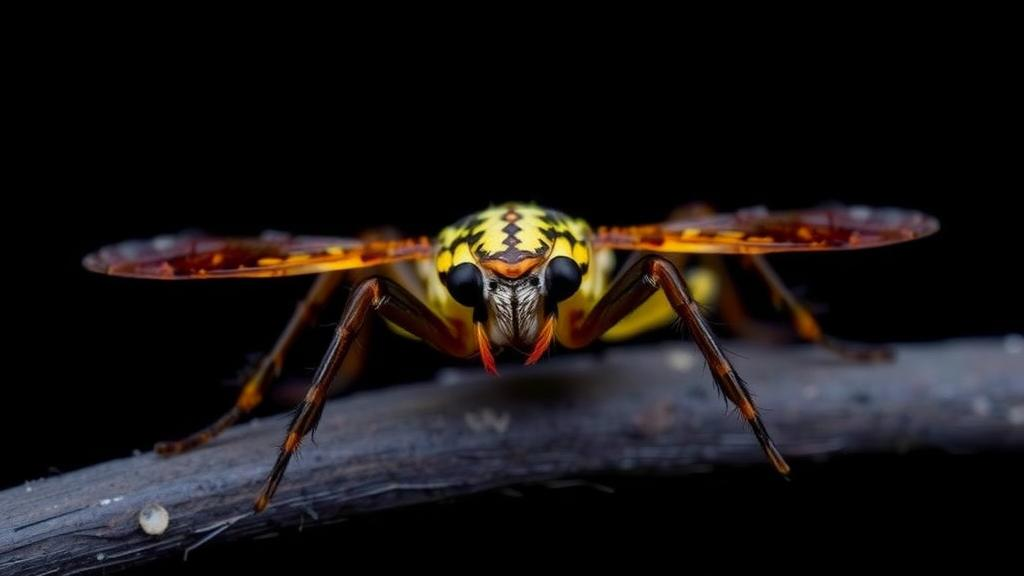
Deep in the collections of South African and European museums, a handful of strange, hump-backed flies have been waiting decades for someone to take a closer look. They belong to Africaterphis, one of the most rarely encountered genera of small-headed flies in the Afrotropical region, and until now only two species were known from a mere 21 published specimens scattered across central and southern Africa. A new taxonomic revision published in African Invertebrates has finally pulled this obscure lineage out of the shadows, redescribing the known species and adding a third, previously unknown member to the genus: Africaterphis stefanfoordi sp. nov., named in honour of the late South African entomologist Stefan Foord.
The revision, led by researchers working with material from eight institutions including the Natural History Museum in London, the KwaZulu-Natal Museum in Pietermaritzburg and the United States National Museum in Washington D.C., represents the first substantial publication on Africaterphis in more than 40 years. Both of the previously known species had originally been described in the 1950s and 1960s as members of the genus Terphis, before Schlinger recognised in 1968 that they were not congeneric with the South American type species and erected Africaterphis to accommodate them. Barraclough added notes on sexual dimorphism in 1984, and then the genus effectively disappeared from the scientific literature for four decades.
Africaterphis belongs to the family Acroceridae, the so-called spider flies, an enigmatic group of more than 430 described species worldwide, of which 65 have been recorded from the Afrotropics. All five of the family’s subfamilies occur in the region: Acrocerinae with eight species, Panopinae with 27, Philopotinae with 16, Ogcodinae with 10 and Cyrtinae with four. Despite this diversity, Afrotropical small-headed flies have received remarkably little taxonomic attention in recent years, with only four new species described in the last 40 years and several genera still awaiting revision.
What makes acrocerids so fascinating is their peculiar anatomy and even more peculiar life history. Adults typically have tiny heads perched on arched thoraces and enlarged, globose abdomens, and many species sport elongated mouthparts that make them important pollinators. The genus Psilodera, for example, is known to pollinate Plectranthus and the Cape iris Gladiolus brevifolius. Other genera have reduced or absent mouthparts and are assumed not to feed at all as adults, which may explain why they turn up so rarely in collections. The feeding behaviour of adults directly shapes how often they are encountered: Psilodera is the most commonly collected acrocerid genus in Southern Africa, followed by Thyllis, while genera with reduced mouthparts are comparatively scarce in museum drawers.
The larvae are where the family earns its common name. All acrocerids are obligate parasites of arachnids, with their planidial larvae seeking out and penetrating spiders before developing inside their hosts. However, host relationships are often unknown or incomplete, and for Africaterphis specifically, no information at all is known about biology or host preferences. Adults have been collected both by hand and in Malaise traps, but everything else about their ecology remains a blank page.
The new species, Africaterphis stefanfoordi, is known from just two female specimens: the holotype from Serowe, Botswana, collected in September 1983 by P. Forchhammer, and a paratype from Kaapmuiden in South Africa’s Mpumalanga Province, collected in April 1967. Measuring 7.6 to 8.8 millimetres in body length with wings of 6.1 to 6.8 millimetres, it is the largest species in the genus. The male remains unknown. Morphologically, it can be distinguished by the combination of a yellow anterior half of the postpronotal lobes and a predominantly brown scutum, features that separate it from female A. gertschi and A. acroceroides, in which the postpronotal lobes are brown. The species is dedicated to Stefan Foord in recognition of his contributions to entomology, arachnology and zoology in South Africa, Africa and the world; the authors describe him as a great colleague and friend whose presence in the world is missed.
Ecologically, the new species appears to occupy a different niche from its relatives. While the known sites for A. acroceroides are all in woodlands or forests, the collection sites for A. stefanfoordi are in scrubland, and although both species occur in the summer rainfall region, the new species is associated with drier habitats. A. acroceroides itself has the widest known distribution in the genus, ranging from the Democratic Republic of the Congo through Zimbabwe, Mozambique and Eswatini, with striking yellow and black colour patterns in the males that make them relatively easy to identify. A. gertschi, by contrast, is limited to the winter rainfall region of South Africa, where it has been found in Fynbos and Thicket vegetation in the Western and Eastern Cape provinces, from Ceres and Gamkaskloof to Grabouw and Makhanda.
The revision also provides the first colour photographs of two of the three species, an updated identification key, and detailed redescriptions grounded in modern morphological terminology. The authors examined specimens and photographs from the Albany Museum in Makhanda, the National Museum in Bloemfontein, the Natural History Museum in London, the KwaZulu-Natal Museum, Iziko South African Museum in Cape Town, the Stellenbosch University Entomology Collection and the United States National Museum. Morphological observations were made using a Leica M80 binocular microscope, with body and wing lengths recorded as minimum and maximum values across the studied material. Photographs were taken with a modified imaging system, focus-stacked in Helicon Focus 8 and edited in Photoshop, while the distribution map was created in SimpleMappr.
The diagnostic features that define Africaterphis within the subfamily Philopotinae are a curious package: bare eyes, highly reduced wing venation, a globose abdomen, and postpronotal lobes that are proximate but not abutted medially. The body coloration is drab rather than metallic, the eyes are contiguous above and below the antennal base, the antennae sit on the lower part of the head adjacent to the mouthparts, the flagellum is stylate, the legs are not elongated, and the abdominal tergites are smooth and rounded in lateral view. Within the genus, species can be told apart by patterns on the sternites, the presence or absence of the median ocellus, the coloration of the scutum and scutellum, and the distribution of brown and yellow on the legs and wing veins.
For a genus represented by so few specimens, the geographic and ecological breadth now covered by three species is remarkable, and the revision underscores how much remains to be discovered about Afrotropical Acroceridae. With only 21 published specimens across three species, every new record has the potential to reshape our understanding of the group’s distribution, host associations and evolutionary history. The authors hope that the redescriptions, colour images and updated key will make these elusive flies easier to recognise in the field and in collections, encouraging entomologists across the region to look more carefully at the small-headed flies that so often go unnoticed among the insects of Africa’s woodlands, forests and scrublands.
Subject of Research: Revision of the Afrotropical spider fly genus Africaterphis Schlinger, 1968 ( Diptera , Acroceridae ) with the description of a new species
Article Title: Revision of the Afrotropical spider fly genus Africaterphis Schlinger, 1968 ( Diptera , Acroceridae ) with the description of a new species
Article References: Midgley, J. M., & Theron, G. L. (2025). Revision of the Afrotropical spider fly genus Africaterphis Schlinger, 1968 (Diptera, Acroceridae) with the description of a new species. African Invertebrates, 66(1), 193-206. https://doi.org/10.3897/afrinvertebr.66.138761
Image Credits: AI Generated
DOI: 10.3897/afrinvertebr.66.138761
Keywords: Revision, Afrotropical, spider, genus, Africaterphis, Schlinger, Diptera, Acroceridae, description, species, scientific research
Cite Scienmag News
Gavin Prescott. (October 16, 2026). Rare African spider flies get a long-overdue taxonomic makeover. Scienmag. https://scienmag.com/rare-african-spider-flies-get-a-long-overdue-taxonomic-makeover/
Gavin Prescott. "Rare African spider flies get a long-overdue taxonomic makeover." Scienmag, 16 October 2026, https://scienmag.com/rare-african-spider-flies-get-a-long-overdue-taxonomic-makeover/. Accessed 16 October 2026.
Gavin Prescott. "Rare African spider flies get a long-overdue taxonomic makeover." Scienmag. October 16, 2026. https://scienmag.com/rare-african-spider-flies-get-a-long-overdue-taxonomic-makeover/


