

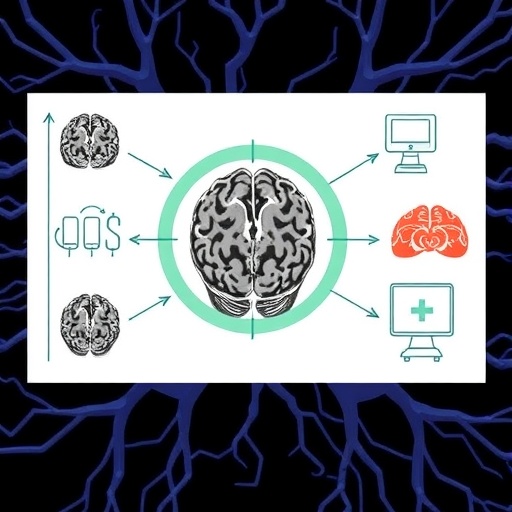
Neuromodulation, a cutting-edge approach that manipulates specific brain circuits to treat neurological and psychiatric disorders, is poised for a major leap forward thanks to a new generic, rapid, and robust computational platform. This innovative technology, known as the Unified Platform for Neuromodulation with Individualized Target Estimation (UNITE), addresses longstanding challenges in personalized brain stimulation therapies by harnessing advanced neuroimaging and automated processing techniques. As brain disorder treatments increasingly rely on precise targeting of functional circuits, UNITE promises to accelerate clinical translation and improve therapeutic effectiveness by delivering patient-specific targets with unprecedented speed and accuracy.
Resting-state functional magnetic resonance imaging (rs-fMRI) has emerged as a powerful tool for mapping intrinsic brain activity and identifying functional circuits noninvasively. However, conventional approaches to using rs-fMRI for neuromodulation targeting remain plagued by cumbersome preprocessing pipelines, variability in data robustness, and a lack of integrated automated solutions. These obstacles have limited widespread clinical adoption despite the clear potential of individualized circuit-guided interventions. The UNITE platform directly confronts these barriers by integrating a novel end-to-end preprocessing pipeline—called DeepPrep—with sophisticated targeting algorithms that collectively streamline and standardize the workflow.
DeepPrep, the computational engine behind UNITE’s enhanced speed and reliability, significantly outpaces state-of-the-art clinical pipelines by achieving a tenfold reduction in processing time. Its design emphasises robustness, reducing susceptibility to noise and artifacts that often compromise neuroimaging outputs. By automating critical steps—from image realignment to artifact correction—DeepPrep ensures high-quality, reproducible preprocessing results within minutes. This leap in efficiency is critical for clinical settings where time constraints have historically hampered personalized neuromodulatory planning.
Once the fMRI data is preprocessed by DeepPrep, UNITE leverages advanced functional circuit mapping algorithms to localize individualized neuromodulation targets accurately. The platform currently offers specialized targeting solutions for several neurological conditions and neuromodulation modalities. For instance, it integrates three transcranial magnetic stimulation (TMS)-based algorithms designed to facilitate targeted post-stroke functional rehabilitation by identifying disrupted motor and cognitive circuits. In parallel, UNITE incorporates a focused ultrasound stimulation algorithm specifically tailored for Parkinson’s disease, pinpointing optimal regions for modulating pathological activity. Notably, the platform’s framework is extensible, designed to incorporate additional algorithms that address other brain disorders and emerging neuromodulation technologies.
UNITE also incorporates rigorous quality assurance measures, generating comprehensive data quality control reports alongside visual verification outputs that validate target identification. These user-friendly reports provide clinicians and researchers with transparent feedback to ensure confidence in targeting decisions. Moreover, the platform exports target coordinates in formats compatible with various neuronavigation systems, facilitating seamless integration into existing clinical workflows. This level of interoperability is a critical step toward real-world applicability, bridging the gap between computational advances and practical neuromodulation delivery.
Among the most striking features of UNITE is its computational efficiency, enabling complete personalized targeting within 30 minutes on a locally equipped workstation featuring a graphics processing unit (GPU). This rapid turnaround contrasts sharply with traditional pipelines that could take hours or longer for a single patient, making UNITE an accessible solution for clinical environments where timely decision-making is vital. Importantly, the platform is designed to be user-friendly, requiring only a basic understanding of computer science alongside neuroimaging experience, thus democratizing access to high-precision neuromodulation targeting.
The development of UNITE represents a paradigm shift in translational neuroimaging and neuromodulation research. By offering a generic, adaptable platform that is not confined to a specific disorder or technology, it transcends niche applications and opens avenues for precision treatment across a broad spectrum of brain disorders. The capacity for rapid adaptation means that as our understanding of neurological disease circuits evolves, UNITE can integrate newly discovered biomarkers or novel stimulation modalities with minimal delay.
DeepPrep’s innovative preprocessing capabilities underpin the platform’s transformative potential. Unlike traditional pipelines that may rely on piecemeal processing using disparate tools, DeepPrep optimizes the entire preprocessing sequence end-to-end, significantly reducing manual intervention and user error. The incorporation of machine learning techniques enhances noise correction and signal extraction, contributing to the improved robustness critical for clinical decision-making where inaccuracies can lead to suboptimal therapy.
Transcranial magnetic stimulation (TMS) targeting algorithms implemented in UNITE leverage resting-state network connectivity profiles to identify individualized stimulation sites correlated with functional recovery markers in stroke patients. This personalized approach contrasts with conventional “one-size-fits-all” targeting, which often yields variable therapeutic outcomes. By precisely modulating circuits implicated in motor and cognitive functions, TMS sessions guided by UNITE’s outputs have the potential to accelerate recovery timelines and enhance patient quality of life post-stroke.
Similarly, the focused ultrasound stimulation (FUS) algorithm for Parkinson’s disease within UNITE harnesses finely localized functional circuit disruptions characteristic of the disorder. Parkinson’s disease exhibits pathological rhythmicity in basal ganglia-thalamocortical circuits, and FUS targeting of these nodes holds promise for modulating aberrant patterns noninvasively. UNITE’s ability to delineate such targets with precision may usher in minimally invasive, personalized interventions that complement or reduce reliance on pharmacotherapy.
The quality control module is another cornerstone of UNITE’s clinical viability. By producing detailed reports on data fidelity and target localization reliability, the platform ensures end-users can assess and verify targeting accuracy before proceeding to stimulation. This transparency is essential for clinical research trials and regulatory approval pathways, providing documented evidence of reproducibility and safety.
Moreover, UNITE’s open framework allows research groups worldwide to incorporate disease-specific or technology-specific targeting algorithms, fostering a collaborative ecosystem in neuromodulation innovation. As new neuroimaging biomarkers are validated and novel stimulation techniques emerge, the platform’s flexible architecture means it can evolve dynamically rather than requiring complete redevelopment.
UNITE’s user interface and workflow design further emphasize clinical accessibility. The interface offers streamlined navigation, visual overlays for target verification, and straightforward export functions compatible with commercial neuronavigation and stimulation delivery systems. This integration reduces training burdens and accelerates adoption in settings ranging from academic centers to community hospitals.
In summary, the Unified Platform for Neuromodulation with Individualized Target Estimation (UNITE) sets a new standard for personalized brain stimulation therapy by combining groundbreaking preprocessing technology with automated targeting and quality control. Its design addresses long-standing bottlenecks in translating resting-state fMRI insights into actionable clinical interventions, paving the way for faster, safer, and more effective neuromodulation treatments across diverse neurological and psychiatric disorders. As the field advances, platforms like UNITE are critical to realizing the promise of precision neurotherapeutics tailored to individual patient brain circuit profiles.
With its powerful combination of speed, robustness, and versatility, UNITE is likely to become an indispensable tool for clinicians and researchers striving to harness functional brain mapping for targeted intervention. This breakthrough underscores the rapidly evolving intersection of neuroimaging, machine learning, and neuromodulation technology—heralding a future where personalized brain circuit modulation is a clinical reality for millions worldwide.
Cite Scienmag News
Colin Clarke. (May 27, 2026). Rapid, Robust Platform for Personalized Neuromodulation Targeting. Scienmag. https://scienmag.com/rapid-robust-platform-for-personalized-neuromodulation-targeting/
Colin Clarke. "Rapid, Robust Platform for Personalized Neuromodulation Targeting." Scienmag, 27 May 2026, https://scienmag.com/rapid-robust-platform-for-personalized-neuromodulation-targeting/. Accessed 4 September 2026.
Colin Clarke. "Rapid, Robust Platform for Personalized Neuromodulation Targeting." Scienmag. May 27, 2026. https://scienmag.com/rapid-robust-platform-for-personalized-neuromodulation-targeting/


