


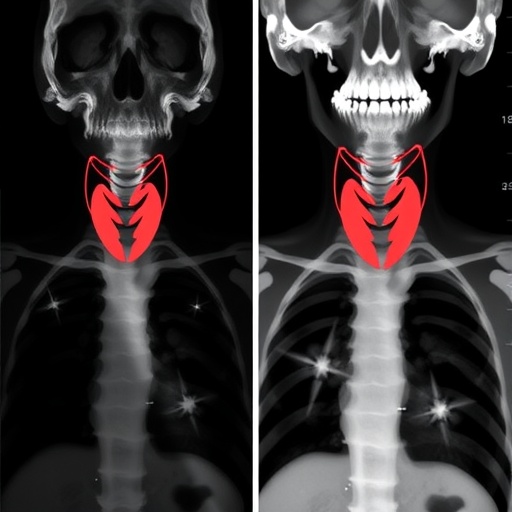
For patients diagnosed with thyroid cancer, one of the most consequential decisions may come before the operation begins: whether to remove one thyroid lobe or the entire gland. A randomized clinical trial reported in JAMA Otolaryngology–Head & Neck Surgery is examining not yet which operation is superior, but whether patients and surgeons can realistically carry out a rigorous comparison between the two approaches. The study is designed as a feasibility trial, intended to determine how many eligible patients will agree to randomization and then complete the surgery to which they are assigned. Those findings could provide the practical foundation for a much larger, multicenter clinical trial.
The question is important because thyroid lobectomy and total thyroidectomy can both be appropriate for selected patients, yet they carry different long-term implications. A lobectomy removes the thyroid lobe containing the tumor while leaving the other half of the gland in place. Total thyroidectomy removes both lobes and generally requires lifelong thyroid hormone replacement. The choice can depend on tumor characteristics, lymph-node involvement, patient preference, family history, radiation exposure, the condition of the remaining thyroid tissue, and the surgeon’s assessment of risk. Because these factors often influence treatment decisions, comparing the operations scientifically is challenging.
Thyroid cancer is frequently detected at an early stage, and many patients have an excellent prognosis. That success has intensified interest in reducing treatment-related effects without compromising cancer control. For some patients, removing only the affected lobe may preserve natural thyroid function and reduce exposure to complications associated with operating near the parathyroid glands and recurrent laryngeal nerves. The parathyroid glands regulate calcium levels, while the recurrent laryngeal nerves control vocal-cord movement. Injury to either structure is uncommon in experienced hands but can produce clinically meaningful consequences, including low blood calcium or voice changes. Total thyroidectomy may be necessary or preferable in other circumstances, particularly when disease is extensive, bilateral, or considered at higher risk.
The trial’s central endpoint is therefore not a comparison of survival, recurrence, complications, or quality of life. Instead, it asks whether the study design itself is workable. Investigators are measuring the proportion of eligible patients who consent to randomization and the proportion who ultimately complete the assigned thyroid operation. These metrics are essential because a definitive randomized trial requires participants to accept an element of uncertainty: rather than choosing their operation or receiving the procedure recommended solely by their surgeon, they agree to be assigned by a research protocol. If too few patients enroll, or if many cross over from their assigned treatment, a larger study may be unable to produce reliable evidence.
Randomization is a cornerstone of clinical research because it helps balance known and unknown factors between treatment groups. In a thyroid surgery trial, those factors could include age, tumor size, tumor location, ultrasound findings, genetic risk, baseline thyroid function, and the experience of the operating surgeon. Without randomization, patients receiving total thyroidectomy might differ systematically from those receiving lobectomy, making it difficult to determine whether later outcomes were caused by the operation or by the patients’ underlying disease. A feasibility study can reveal whether participants, clinicians, and institutions are prepared to accept that structure before substantial resources are committed to a large trial.
The study also addresses a practical issue that is often overlooked in surgical research: treatment assignment must remain clinically and technically achievable after enrollment. A patient may consent to randomization but later require a different procedure because imaging, intraoperative findings, or pathology changes the assessment of disease. In thyroid surgery, additional tissue may need to be removed if cancer extends beyond the thyroid or if lymph-node disease is discovered. Conversely, a planned total thyroidectomy may be reconsidered when updated information suggests that a lobectomy would be adequate. Tracking whether participants complete the assigned operation helps investigators distinguish reluctance to accept randomization from medically necessary changes in treatment.
The trial’s design could also illuminate how patients weigh immediate surgical choices against long-term management. After lobectomy, some patients retain enough functioning thyroid tissue to avoid hormone replacement, although others eventually require medication. After total thyroidectomy, hormone replacement is generally necessary, but follow-up blood tests and dosing can make thyroid levels predictable and manageable for many patients. Total thyroidectomy can also simplify certain forms of postoperative surveillance and radioactive iodine treatment, although those considerations do not apply equally to every patient. A future large trial could examine how these trade-offs affect complications, medication use, cancer surveillance, patient-reported quality of life, and health-care costs.
Feasibility results are particularly valuable in surgery because technical expertise, institutional protocols, and patient expectations can strongly influence outcomes. A multicenter trial would need common eligibility criteria, standardized definitions of complications, consistent approaches to pathology and follow-up, and safeguards to ensure that both procedures are performed according to accepted standards. It would also need to account for differences in surgeon volume and hospital resources. By identifying barriers during the preliminary study, investigators can refine consent materials, improve communication about equipoise, and establish clearer rules for situations in which the assigned treatment can no longer be safely completed.
The work comes as professional guidelines and clinical practice continue to evolve for patients with localized thyroid cancer. Advances in ultrasound, molecular testing, pathology, and risk stratification have expanded the number of patients who may be candidates for less extensive surgery. At the same time, variation persists in how clinicians interpret risk and discuss the benefits and drawbacks of each procedure. A definitive randomized trial could offer stronger evidence than retrospective comparisons, which are vulnerable to selection bias because patients with more aggressive disease are often more likely to undergo total thyroidectomy from the outset. The present study is a critical preliminary step toward determining whether such a trial can be conducted.
The study’s findings should be interpreted within that limited but important purpose. A high rate of consent would suggest that eligible patients are willing to participate in a randomized comparison, while successful completion of assigned surgery would indicate that the protocol can operate within real clinical practice. A low rate in either measure would not prove that one operation is better; it would instead signal that the research question, eligibility criteria, consent process, or treatment rules may need modification. The investigators’ goal is to generate the evidence needed to plan a future multicenter study capable of addressing the clinical outcomes that matter most to patients. Until those results are available, the trial does not establish that lobectomy or total thyroidectomy is universally preferable. It shows that the path toward answering that question is being tested scientifically.
News Publication Date: Not provided.
Web References: https://doi.org/10.1001/jamaoto.2026.2258
References: JAMA Otolaryngology–Head & Neck Surgery. DOI: 10.1001/jamaoto.2026.2258.
Keywords
Thyroid cancer, thyroid lobectomy, total thyroidectomy, randomized clinical trial, endocrine surgery, surgical oncology, feasibility study, patient consent, clinical research, JAMA Otolaryngology–Head & Neck Surgery
Cite Scienmag News
Nathaniel Bowman. (August 20, 2026). Randomized Trial Compares Lobectomy and Total Thyroidectomy for Indeterminate-Risk Thyroid Cancer. Scienmag. https://scienmag.com/randomized-trial-compares-lobectomy-and-total-thyroidectomy-for-indeterminate-risk-thyroid-cancer/
Nathaniel Bowman. "Randomized Trial Compares Lobectomy and Total Thyroidectomy for Indeterminate-Risk Thyroid Cancer." Scienmag, 20 August 2026, https://scienmag.com/randomized-trial-compares-lobectomy-and-total-thyroidectomy-for-indeterminate-risk-thyroid-cancer/. Accessed 3 September 2026.
Nathaniel Bowman. "Randomized Trial Compares Lobectomy and Total Thyroidectomy for Indeterminate-Risk Thyroid Cancer." Scienmag. August 20, 2026. https://scienmag.com/randomized-trial-compares-lobectomy-and-total-thyroidectomy-for-indeterminate-risk-thyroid-cancer/


