


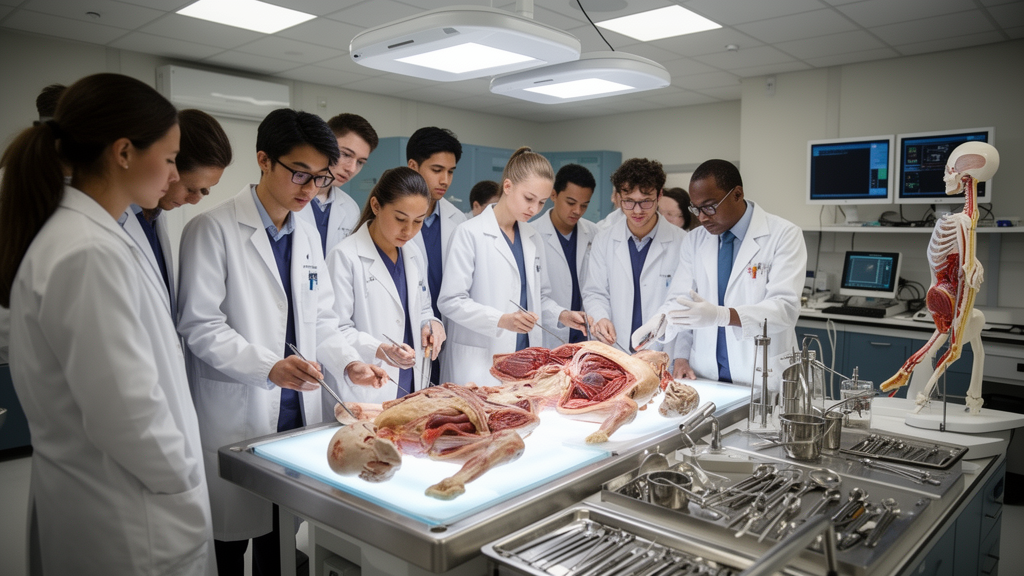
A randomized comparison within a first-year medical anatomy course found no statistically significant difference in body-donor identification between students who received brief compassion training and those who followed the curriculum as usual. The study, published in BMC Medical Education, evaluated an adaptation of “Compassionatomy,” a humanistic anatomy-training approach developed at the University of California, San Diego, and adapted for the pre-clinical program at Case Western Reserve University. The project was designed as an iterative curriculum-development and evaluation effort rather than as a demonstration of clinical benefit.
Compassionatomy incorporates compassion-cultivating practices into anatomy laboratories. In the earlier University of California, San Diego work cited by the researchers, the approach was associated with increased identification with body donors and greater contemplation. The new study asked whether the approach could be transferred to a different institution, how implementers and students would experience it, and whether adding brief training would change students’ identification with their body donor.
The researchers used a multi-staged, mixed-methods design. First, Compassionatomy experts collaborated with Case Western Reserve University personnel to adapt the program’s manual to the local setting. Second, a facilitated group interview with implementers and students identified five anticipated challenges and informed mitigation strategies before implementation.
This preparatory work was intended to support refinement of the curriculum, rather than to measure the program’s effects on students. The evaluated course included a two-week dissection boot camp followed by six weeks of virtual anatomy laboratories. During the boot camp, 184 first-year medical students were randomly assigned either to compassion training or to curriculum as usual.
The intervention group received five minutes of compassion training per session and included 92 students; the control group also included 92 students and received the usual curriculum. All participants were invited to complete surveys before and after the course assessing identification with the body donor and post-course satisfaction, while interviews with students and implementers provided qualitative feedback. This result means the study did not detect a statistically significant change in that measured outcome between the training and control groups.
It does not establish that the intervention has no effect, nor does it show that compassion training is ineffective in every educational setting. The comparison was conducted within one pre-clinical anatomy program at one institution, using a specific donor-identification measure and a brief intervention embedded in a particular course structure. Student feedback nevertheless suggested that the training was perceived as useful by some participants.
In post-surveys, 71% rated compassion training in the boot camp as worthwhile. When asked whether they would recommend it, 48% said they would and 27% selected a neutral response. These are reported perceptions from the training group rather than evidence of improved empathy, clinical behavior or patient outcomes.
The supplied results also report that qualitative interviews identified program strengths and considerations for refinement, without providing quantified counts for those themes. The findings therefore describe a mixed picture: the intervention was regarded as worthwhile by a substantial share of students, while the randomized comparison did not find a statistically significant improvement in the specified measure of donor identification. The most direct conclusion is limited to the educational setting tested: the measured difference in donor identification was not statistically significant, even though some students found the brief training worthwhile.
The authors emphasized the value of the adaptation process itself. By combining expert collaboration, pre-implementation interviews, a randomized comparison, survey measurement and qualitative feedback, the project offers a structured example of how a humanistic anatomy program can be refined across institutions. Its scope is that of a curriculum-development study involving first-year medical students, not a multicenter efficacy trial or an assessment of clinical outcomes.
Subject of Research: Evaluation of Compassionatomy in first-year medical anatomy training
Article Title: Adapting and implementing “Compassionatomy”: a compassion-cultivating approach to humanistic anatomy training for medical students
Article References: Stadnick, N. A., Rabin, B., Klaus, F., PJC Noel, G., McLin, R., Lee, M., Mansouri, S., Peek, E., Hernandez, V., Wish-Baratz, S., & Eyler, L. T. (2026). Adapting and implementing “Compassionatomy”: a compassion-cultivating approach to humanistic anatomy training for medical students. BMC Medical Education. https://doi.org/10.1186/s12909-026-10294-8
Image Credits: AI Generated
DOI: 10.1186/s12909-026-10294-8
Keywords: Compassionatomy, medical education, anatomy training, compassion training, body donation, first-year medical students, randomized comparison, mixed-methods study, student perceptions, Adapting, implementing, compassion-cultivating
Cite Scienmag News
Courtney Benton. (October 26, 2026). Randomized anatomy course trial finds no significant donor-identification difference. Scienmag. https://scienmag.com/randomized-anatomy-course-trial-finds-no-significant-donor-identification-difference/
Courtney Benton. "Randomized anatomy course trial finds no significant donor-identification difference." Scienmag, 26 October 2026, https://scienmag.com/randomized-anatomy-course-trial-finds-no-significant-donor-identification-difference/. Accessed 26 October 2026.
Courtney Benton. "Randomized anatomy course trial finds no significant donor-identification difference." Scienmag. October 26, 2026. https://scienmag.com/randomized-anatomy-course-trial-finds-no-significant-donor-identification-difference/


