


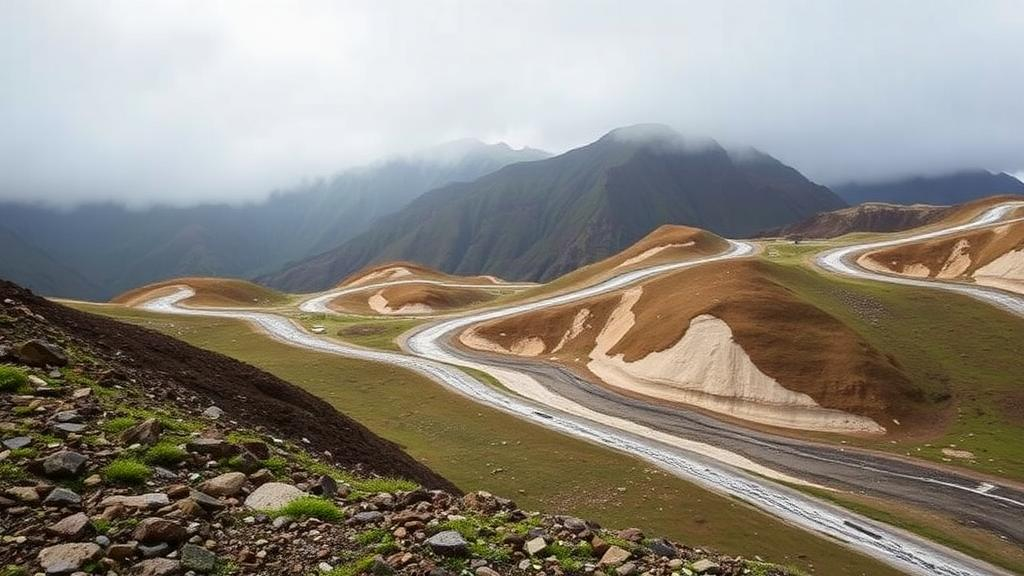
High on the central Qinghai–Xizang Plateau, at nearly 4,500 meters above sea level, the timing of a plant’s life is a matter of survival. A new three-year field experiment published in Ecology and Evolution reveals that whether alpine forbs flower earlier, leaf out sooner, or stretch their growing season under a warming climate depends far less on temperature alone than scientists often assume—and far more on how much rain falls from the sky. The study, conducted at the Naqu Alpine Meadow Ecosystem Research Station in Tibet, tracked the phenology of two common forbs across moderately and severely degraded grasslands, and its findings upend the simple expectation that warming uniformly accelerates plant development in cold environments.
The research team focused on two species with fundamentally different life histories: Chenopodium glaucum, an annual forb that must complete its entire life cycle—from germination to seed production—within a single growing season, and Aster tataricus, a perennial that can propagate vegetatively and reproduce across multiple years. Both species thrive in degraded alpine meadows but are absent from intact, non-degraded communities, making them ideal models for understanding how grassland deterioration interacts with climate change. Using open-top chambers to passively warm plots, the researchers created a two-factor experiment crossing warming with degradation status, replicating each of four treatments across the harsh landscape where mean annual temperature hovers at minus 2.1 degrees Celsius and roughly 80 percent of the 430 millimeters of annual precipitation falls between June and September.
The results were strikingly asymmetric between the two functional groups. For the annual C. glaucum, warming, degradation, and their combination produced no significant effects on the three-year mean onsets of any phenophase—germination, budding, flowering, fruiting, or leaf coloring—nor on their durations. The annual plant appeared phenologically inert to the experimental manipulations when averaged across years. The perennial A. tataricus told a different story: severe degradation combined with warming significantly advanced its mean onset of leaf-out and prolonged its total active period relative to moderate degradation. In other words, the perennial behaved as the more sensitive species, its phenology shifting measurably under the combined pressures of a hotter microclimate and a more devastated habitat.
Yet the three-year averages concealed the most dramatic finding: interannual variation in precipitation effectively reprogrammed the plants’ responses. In 2014, a year of normal rainfall, warming marginally delayed first fruiting of the annual by nearly fifteen days under moderate degradation. In 2015, a drought year with only 280 millimeters of precipitation, warming combined with either degradation level significantly delayed first fruiting by five to eleven days. But in 2016, a wet year, the pattern reversed—warming under moderate degradation advanced first budding by up to ten days and first flowering by up to nearly twenty-five days. Abundant rain, the data suggest, can offset the soil-moisture deficit that warming otherwise imposes, releasing the annual plant’s reproductive schedule from drought-imposed constraints.
The perennial’s leaf-out followed an equally water-dependent logic. In the dry year 2015, when spring precipitation totaled just 79 millimeters, warming advanced leaf-out in severely degraded plots—likely because sparse vegetation cover allowed rapid soil warming, and the thermal cue outweighed the water deficit. In the wet year 2016, with spring rainfall 20 percent higher, warming instead delayed leaf-out in moderately degraded plots, possibly through a legacy effect of the prior year’s drought and through warming-enhanced nitrogen mineralization, which previous meta-analyses associate with delayed phenological timing. The same treatment produced opposite outcomes in consecutive years, purely as a function of water availability.
Structural equation modeling disentangled the mechanistic pathways behind these shifts, and the results are technically revealing. For the annual plant, the total net effect of warming on leaf-out was a negligible 0.02—the product of a strong direct advance of minus 0.75 nearly cancelled by indirect delays of 0.63 through elevated soil temperature and 0.14 through reduced species richness. Mean annual precipitation exerted significant negative correlations with the onsets of budding, flowering, fruiting, and leaf coloring, meaning wetter years pushed all reproductive events earlier. For the perennial, precipitation showed a strong net delay effect of 0.62 on leaf-out, while warming’s net effect on leaf coloring was an advance of minus 0.37, driven by a direct effect of minus 0.99 partially buffered by soil-moisture-mediated delays. On the duration side, degradation strongly shortened the annual’s total active period with a total effect of minus 1.78, while warming shortened it by minus 1.19 through soil warming and moisture loss.
The soil chemistry underlying these responses painted a grim picture of degradation. Severely degraded meadows exhibited soil pH 11 percent higher than moderately degraded plots, alongside staggering nutrient losses: total organic carbon down 45.5 percent, total nitrogen down 76.9 percent, available nitrogen down 58.9 percent, and total phosphorus down 66.6 percent. Warming itself left soil chemistry untouched but amplified the microclimate contrasts—raising soil temperature more in severely degraded plots, by 1.08 degrees versus 0.69 degrees, while suppressing soil moisture far less there, a 15 to 19 percent reduction compared with 46 to 49 percent in moderately degraded plots. Degradation, in effect, pre-dried and pre-warmed the soil, changing the very medium through which climate signals reach plant roots.
The community-level consequences compounded these effects. Warming reduced species richness by 17.6 percent, severe degradation by 54.6 percent, and their interaction explained 57.3 percent of the variation in community composition. Severe degradation boosted the perennial’s relative cover by 173.5 percent, while warming increased the annual’s relative cover by 66.5 percent. These shifts matter mechanistically: reduced diversity is known to weaken phenological sensitivity to temperature, and nitrogen limitation dampens phenological plasticity, so the impoverished, simplified communities of desertified plots may simply lack the capacity to respond to warming that richer communities retain.
The deeper explanation for the annual–perennial divergence lies in evolutionary strategy. Annuals pursue a bet-hedging approach, prioritizing rapid seed output within one season and anchoring their germination to precipitation and pre-germination soil moisture rather than temperature—hence their phenological stasis under experimental warming. Perennials spread reproduction across years, drawing on developed root systems and carbohydrate reserves that buffer stress and permit greater phenological adjustment when conditions improve. Precipitation modulates each strategy differently: for annuals it governs germination and seedling establishment directly, while for perennials it interacts with warming and degradation through soil moisture and nutrient availability, integrating moisture signals with thermal cues to set optimal timing.
The authors caution that their findings come from a single site, two forb species, and three growing seasons, and that longer-term demographic monitoring and multi-site replication are needed to test generality across the plateau. Still, the implications are considerable. Warming may promote the growth and reproduction of perennial forbs in alpine desertified grasslands, potentially aiding the recovery of the forb component of degraded meadows—but whether that translates into genuine ecosystem restoration, requiring the concurrent return of grasses, sedges, and intact community structure, remains an open question. What is already clear is that any projection of alpine phenology under climate change that ignores precipitation, degradation status, and life-history strategy will misread the future of one of the planet’s most vulnerable biomes.
Subject of Research: Phenological responses of annual and perennial alpine forbs to experimental warming and grassland degradation on the Qinghai–Xizang Plateau
Article Title: Precipitation Regulates Phenological Responses of Annual and Perennial Forbs to Warming and Degradation in an Alpine Meadow on the Qinghai–Xizang Plateau
Article References: Chen, L., Cui, S., Sun, J., Lv, W., Lv, J., Yuan, F., Zhou, Y., Wang, A., & Wang, S. (2026). Precipitation Regulates Phenological Responses of Annual and Perennial Forbs to Warming and Degradation in an Alpine Meadow on the Qinghai–Xizang Plateau. Ecology and Evolution, 16(10), Article e74423. https://doi.org/10.1002/ece3.74423
Image Credits: AI Generated
DOI: 10.1002/ece3.74423
Keywords: phenology, alpine meadow, Qinghai–Xizang Plateau, warming, precipitation, grassland degradation, annual plants, perennial plants, soil moisture, open-top chambers, life-history strategies, climate change
Cite Scienmag News
Gavin Prescott. (October 2, 2026). Rain, Not Just Heat, Decides How Alpine Plants Answer Warming on the Tibetan Plateau. Scienmag. https://scienmag.com/rain-not-just-heat-decides-how-alpine-plants-answer-warming-on-the-tibetan-plateau/
Gavin Prescott. "Rain, Not Just Heat, Decides How Alpine Plants Answer Warming on the Tibetan Plateau." Scienmag, 2 October 2026, https://scienmag.com/rain-not-just-heat-decides-how-alpine-plants-answer-warming-on-the-tibetan-plateau/. Accessed 4 October 2026.
Gavin Prescott. "Rain, Not Just Heat, Decides How Alpine Plants Answer Warming on the Tibetan Plateau." Scienmag. October 2, 2026. https://scienmag.com/rain-not-just-heat-decides-how-alpine-plants-answer-warming-on-the-tibetan-plateau/


