

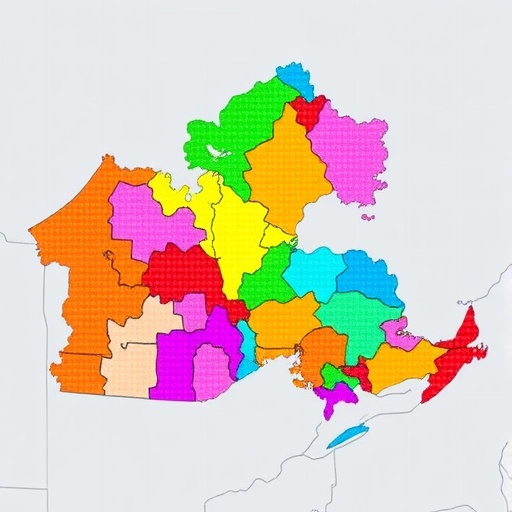
In a groundbreaking advance for population genetics and precision medicine, researchers have unveiled a comprehensive multi-ancestry genetic reference for the Quebec population. This ambitious project, detailed in a recent Nature Communications article, represents a monumental step forward in capturing the rich genetic diversity of one of North America’s most historically complex populations. By integrating genetic data from individuals across multiple ancestral backgrounds, scientists aim to empower genetic studies and enhance health outcomes specifically tailored to Quebec’s unique demographic tapestry.
Quebec’s genetic landscape is marked by a complicated blend of indigenous peoples, French settlers, and waves of immigration from various global populations over centuries. This intricate mixture has traditionally posed challenges for genetic research, as standard reference genomes have often failed to fully represent the heterogeneity intrinsic to Quebec’s population. The new multi-ancestry reference genome addresses this gap by including genomic data reflective of the region’s broad ancestral variability, providing a high-resolution map of genetic variants present within the population.
The development of this genetic reference was no small feat. It involved sequencing and analyzing the genomes of thousands of Quebec residents, carefully selected to cover a wide spectrum of ancestral origins. Advanced bioinformatic tools and population genetics methodologies were applied to resolve complex haplotypes and population structure nuances. This approach not only captures common variants within the population but also rare allele frequencies that contribute to disease susceptibility and pharmacogenomic diversity.
One of the driving forces behind this project was the recognized limitation of existing population references, which often lean heavily on European-centric data. Such biases can lead to disparities in medical genetics applications, including the risk profiling of complex diseases such as cancer, cardiovascular disease, and neurodegenerative conditions. The comprehensive representation of multi-ancestry backgrounds in this new dataset is poised to mitigate these biases, enhancing the accuracy and equity of genetic risk predictions.
The structure of the reference genome was meticulously curated to enable a broad array of downstream applications. This includes facilitating genome-wide association studies (GWAS) better tuned to the population’s genetic architecture and improving the imputation accuracy of genotyping arrays used in both research and clinical settings. The project team employed cutting-edge statistical genetics frameworks to integrate sequencing data, ensuring that rare variants and structural variations were thoroughly characterized.
Furthermore, the reference provides a critical resource for understanding population history and migration dynamics within Quebec. Genetic markers gleaned from the dataset illuminate historical admixture events and evolutionary pressures that have shaped the gene pool. By reconstructing demographic histories with unprecedented detail, the reference aids anthropological inquiries and enriches the contextual understanding of genetic variation observed in present-day populations.
Clinically, this resource opens new avenues for precision medicine initiatives targeting Quebec’s diverse populace. With a better grasp on genetic predispositions distributed across different ancestries, healthcare professionals can tailor screening strategies, preventative interventions, and therapeutic regimens more effectively. This personalized approach is essential for managing heritable diseases and optimizing responses to pharmaceutical treatments where ancestry-linked pharmacogenetic effects may influence outcomes.
The study also highlights ethical and social considerations integral to population genomics research. The collaborative framework embraced transparent community engagement and consent processes, ensuring that the use of genetic data respected cultural sensitivities and individual privacy. This ethical foundation underscores the project’s commitment to responsible science that respects the heritage and rights of participants while advancing scientific knowledge.
Technologically, the endeavor pushed the envelope on high-throughput sequencing and computational analysis capabilities. Large-scale genome sequencing efforts were paired with sophisticated machine learning algorithms designed to detect subtle genetic signals masked by population admixture. Automation in variant calling and annotation pipelines improved reliability and resolution, reducing the chance for error in identifying clinically relevant mutations.
The significance of creating a multi-ancestry genetic reference for Quebec transcends regional importance. It provides a scalable model for other populations grappling with similar complexities arising from admixture and migration histories worldwide. As global health initiatives increasingly acknowledge the value of inclusivity, frameworks like this set precedence for generating diverse, representative genomic datasets that can fuel breakthroughs in medicine and biology.
Moreover, this reference enhances our ability to study genotype-phenotype correlations in mixed-ancestry individuals, a group often underrepresented or excluded in genetic research. Reliable genomic data from such cohorts are critical for uncovering genetic modifiers and interactions that influence disease pathways uniquely in admixed populations. The knowledge gleaned here strengthens the foundations of genomics, enabling broader applications that can accommodate the versatility of human genetic diversity.
The multidisciplinary nature of the project joined expertise from genetics, bioinformatics, epidemiology, and clinical sciences. This fusion was necessary to ensure the reference genome was robust, analytically sound, and clinically relevant. Each discipline contributed to overcoming specific challenges, such as handling confounding population stratification, validating variant pathogenicity, and mapping linkage disequilibrium patterns specific to Quebec’s genetic milieu.
Looking forward, the dataset serves as an invaluable baseline for longitudinal studies investigating gene-environment interactions and the evolution of population-specific health trends. It supports integrative analyses combining genomic information with lifestyle, environmental exposures, and clinical phenotypes, fostering a holistic viewpoint of disease causation and resilience factors within diverse genetic backgrounds.
The publication of this multi-ancestry reference marks a pivotal moment for genomics research in Canada and internationally. It underscores an emerging consensus in the field that inclusivity and representation are not mere ideals, but prerequisites for achieving true precision in medicine. With this blueprint in hand, genetic studies can move beyond homogeneous models towards nuanced understandings that account for the rich complexity of human diversity.
Ultimately, the multi-ancestry genetic reference for the Quebec population lays the groundwork for a future where genetic information is a powerful, equitable tool in improving health outcomes. It invites the global scientific community to acknowledge and integrate the mosaic nature of human ancestry into research paradigms fully. As the benefits of this resource unfold, it promises to accelerate discoveries that are as diverse and dynamic as the populations they aim to serve.
Subject of Research: Genetic reference genome development, population genetics, ancestry diversity
Article Title: A multi-ancestry genetic reference for the Quebec population
Article References:
McClelland, P., Femerling, G., Laflamme, R. et al. A multi-ancestry genetic reference for the Quebec population. Nat Commun 17, 1319 (2026). https://doi.org/10.1038/s41467-026-68820-7
Image Credits: AI Generated


