

Tuesday, October 20, 2026
Science
No Result
View All Result
  • Login
  • HOME
  • SCIENCE NEWS
  • CONTACT US
  • HOME
  • SCIENCE NEWS
  • CONTACT US
No Result
View All Result
Scienmag
No Result
View All Result
Home Science News Medicine

Quasi-experimental study links scalable end-of-life care simulation with short-term competence gains in nursing students

October 20, 2026
in Medicine
Ophelia Keating
By Ophelia Keating Scienmag Editorial Profile - Health Services Research
Reading Time: 2 mins read
0
Scalable Simulation Program Boosts Nursing Students’ End-of-Life Care Skills

Scalable Simulation Program Boosts Nursing Students' End-of-Life Care Skills

65
SHARES
587
VIEWS
Share on FacebookShare on Twitter
ADVERTISEMENT

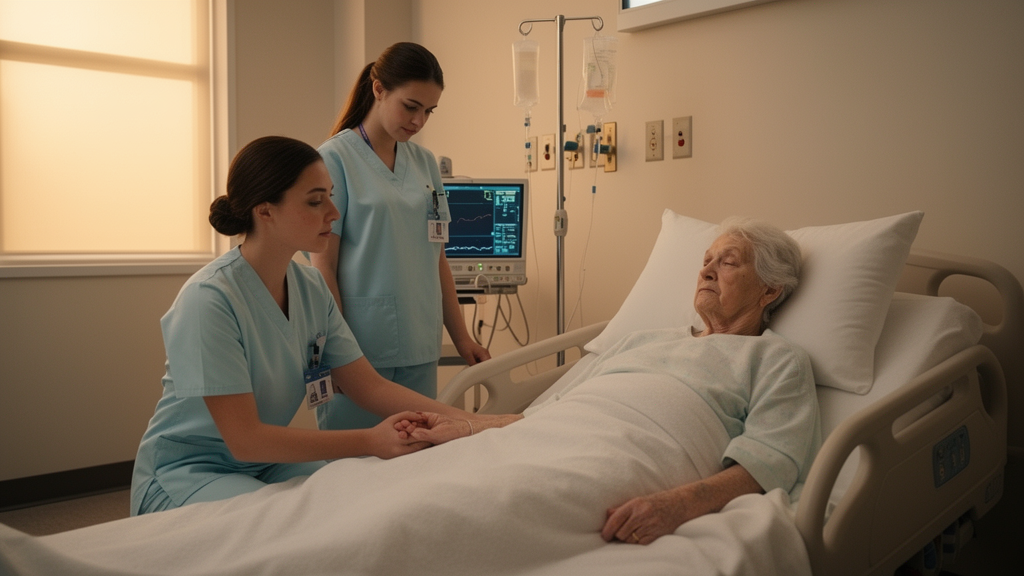
A single-group pretest–posttest study reported that an 80-minute, scalable end-of-life care simulation was associated with improved objective clinical competence, knowledge and self-reported confidence among third-year undergraduate nursing students in Japan. The findings, summarized in the study abstract, were observed in a small volunteer cohort at one national university and do not establish that the program caused the changes. The researchers called for larger controlled studies to confirm the results.

Twenty-seven of approximately 80 eligible third-year students enrolled voluntarily, and 25 completed all evaluations. The intervention was adapted from a previously evaluated small-group scenario for delivery to approximately 25–30 students in one session. Students participated through direct care roles, structured observation, small-group discussion and sequential debriefing. Objective structured clinical examination assessments were conducted before the program and two weeks later. Knowledge and confidence were measured at baseline, immediately after the program and at the two-week follow-up.

The primary outcome was OSCE-assessed clinical competence. Mean scores for physical assessment skills increased from 3.08 ± 1.50 at baseline to 5.96 ± 1.17 two weeks after the program, a mean difference of 2.88 (95% CI 1.95–3.81; p < 0.001) with a reported Cohen’s dz of 1.285. Scores for psychological care skills increased from 3.40 ± 2.80 to 7.80 ± 3.92, a mean difference of 4.40 (95% CI 2.57–6.23; p < 0.001), with Cohen’s dz of 0.990.

Knowledge scores rose from 7.00 ± 2.29 at baseline to 8.16 ± 1.57 immediately after the simulation and 8.20 ± 1.47 two weeks later; the Friedman test result was p = 0.001, with Kendall’s W = 0.262. Confidence in physical and psychological care also changed over time, although the abstract did not provide the corresponding numerical results. The study’s uncontrolled one-group design, single-university setting, small volunteer sample and short follow-up restrict causal interpretation. Two enrolled students did not complete all evaluations, and larger controlled studies are required to determine whether the observed improvements are reproducible and attributable to the program.

Subject of Research: Short-term outcomes of a scalable end-of-life care simulation for third-year nursing students in Japan

Article Title: A scalable simulation program for end-of-life care education in undergraduate nursing students: changes in OSCE-assessed clinical competence, knowledge, and confidence—a quasi-experimental one-group pretest-posttest study

Article References: Tamaki, T., Inumaru, A., Yokoi, Y., Fujii, M., Ohno, Y., & Tsujikawa, M. (2026). A scalable simulation program for end-of-life care education in undergraduate nursing students: changes in OSCE-assessed clinical competence, knowledge, and confidence—a quasi-experimental one-group pretest-posttest study. BMC Nursing. https://doi.org/10.1186/s12912-026-05358-5

Image Credits: AI Generated

DOI: 10.1186/s12912-026-05358-5

Keywords: nursing education, end-of-life care, simulation, clinical competence, OSCE, knowledge, self-reported confidence, quasi-experimental study, scalable, program, end-of-life, care

Cite Scienmag News

Ophelia Keating. (October 20, 2026). Quasi-experimental study links scalable end-of-life care simulation with short-term competence gains in nursing students. Scienmag. https://scienmag.com/quasi-experimental-study-links-scalable-end-of-life-care-simulation-with-short-term-competence-gains-in-nursing-students/


Ophelia Keating. "Quasi-experimental study links scalable end-of-life care simulation with short-term competence gains in nursing students." Scienmag, 20 October 2026, https://scienmag.com/quasi-experimental-study-links-scalable-end-of-life-care-simulation-with-short-term-competence-gains-in-nursing-students/. Accessed 20 October 2026.

Ophelia Keating. "Quasi-experimental study links scalable end-of-life care simulation with short-term competence gains in nursing students." Scienmag. October 20, 2026. https://scienmag.com/quasi-experimental-study-links-scalable-end-of-life-care-simulation-with-short-term-competence-gains-in-nursing-students/

Tags: Careclinical competenceclinical skills assessment in nursing studentsconfidence development in nursing studentsend of lifeend-of-life careend-of-life care simulationimpact of simulation on end-of-life care skillsKnowledgeNursing educationnursing education research Japannursing student clinical competenceObjective Structured Clinical ExaminationsOSCEpretest-posttest study designprogramquasi-experimental studyscalablescalable nursing education programsself-reported confidenceshort-term knowledge gains in nursingsimulationsmall-group simulation trainingvolunteer-based nursing training evaluation
Share26Tweet16
Previous Post

Disparities in late-stage cancer diagnosis across a multi-site academic health system

Next Post

Machine-learning model shows moderate accuracy for predicting specialist nurse transfer intentions

Related Posts

Machine Learning Model Flags Which Specialist Nurses Are Most Likely to Quit
Medicine

Machine-learning model shows moderate accuracy for predicting specialist nurse transfer intentions

October 20, 2026
Eco-Anxiety Questionnaire Proves Reliable in Spanish Young Adults, Study Finds
Medicine

EAQ-22 shows reliable measurement of eco-anxiety in Spanish young adults

October 20, 2026
When Clinicians Write About Patients, Ethics and Aesthetics Collide
Medicine

Letter argues clinician patient narratives require casuistry and aesthetic judgment

October 20, 2026
Navigating metabolomics in the era of immunometabolism
Medicine

Navigating metabolomics in the era of immunometabolism

October 20, 2026
Excessive bloating and gas plague women throughout the menopause transition
Medicine

Excessive bloating and gas plague women throughout the menopause transition

October 20, 2026
Seventeen Years of Data Reveal Where Leptospirosis Strikes Hardest in Sri Lanka
Medicine

Retrospective surveillance study maps leptospirosis trends across Sri Lanka’s 25 districts, 2006–2022

October 20, 2026
Next Post
Machine Learning Model Flags Which Specialist Nurses Are Most Likely to Quit

Machine-learning model shows moderate accuracy for predicting specialist nurse transfer intentions

  • Mothers who receive childcare support from maternal grandparents show more optimized

    Mothers who receive childcare support from maternal grandparents show more parental warmth, finds NTU Singapore study

    27656 shares
    Share 11059 Tweet 6912
  • University of Seville Breaks 120-Year-Old Mystery, Revises a Key Einstein Concept

    1061 shares
    Share 424 Tweet 265
  • Bee body mass, pathogens and local climate influence heat tolerance

    682 shares
    Share 273 Tweet 171
  • Researchers record first-ever images and data of a shark experiencing a boat strike

    546 shares
    Share 218 Tweet 137
  • Groundbreaking Clinical Trial Reveals Lubiprostone Enhances Kidney Function

    531 shares
    Share 212 Tweet 133
Science

Embark on a thrilling journey of discovery with Scienmag.com—your ultimate source for cutting-edge breakthroughs. Immerse yourself in a world where curiosity knows no limits and tomorrow’s possibilities become today’s reality!

RECENT NEWS

  • Scoping review maps 128 sources on gender bias training in sexual and reproductive health care
  • Ridge regression outperforms nonlinear models for petrol price prediction in regulated Zambia
  • Molecular dynamics simulations link twin architecture to cutting behavior in CoCrFeMnNi alloys
  • Machine-learning model shows moderate accuracy for predicting specialist nurse transfer intentions

Categories

  • Agriculture
  • Anthropology
  • Archaeology
  • Athmospheric
  • Biology
  • Biotechnology
  • Blog
  • Bussines
  • Cancer
  • Chemistry
  • Climate
  • Earth Science
  • Editorial Policy
  • Marine
  • Mathematics
  • Medicine
  • Pediatry
  • Policy
  • Psychology & Psychiatry
  • Science Education
  • Science News
  • Social Science
  • Space
  • Technology and Engineering

Subscribe to Blog via Email

Enter your email address to subscribe to this blog and receive notifications of new posts by email.

Join 5,150 other subscribers

© 2025 Scienmag - Science Magazine

Welcome Back!

Login to your account below

Forgotten Password?

Retrieve your password

Please enter your username or email address to reset your password.

Log In
No Result
View All Result
  • HOME
  • SCIENCE NEWS
  • CONTACT US

© 2025 Scienmag - Science Magazine

Discover more from Science

Subscribe now to keep reading and get access to the full archive.

Continue reading