


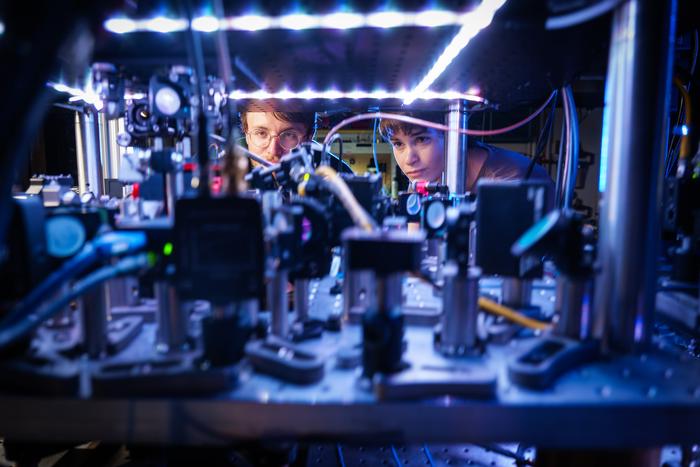
In a groundbreaking advancement in quantum sensing, physicists at the University of Colorado Boulder have unveiled an atom interferometer capable of measuring acceleration in three dimensions simultaneously. The device harnesses clouds of rubidium atoms cooled to near absolute zero, achieving a level of precision once thought unattainable in a unit compact enough to fit on a laboratory bench. This achievement signals a bold step forward in navigation technology with profound implications for vehicles ranging from submarines to spacecraft, promising navigation that is resilient, highly accurate, and less susceptible to deterioration over time.
Traditional atom interferometers typically measure acceleration along a single axis, constraining their practical usefulness in navigating real-world environments that inherently involve movement in three-dimensional space. The team from CU Boulder, led by graduate student Kendall Mehling and postdoctoral researcher Catie LeDesma, collaborated with JILA professor Murray Holland to break this barrier. By exploiting advanced quantum control techniques and artificial intelligence, they engineered a vector atom accelerometer, a device that can resolve acceleration vectors along all three spatial dimensions concurrently.
At the heart of their new device lies the extraordinary state of matter known as a Bose-Einstein Condensate (BEC), created when rubidium atoms are chilled to billionths of a degree above absolute zero. Under these conditions, thousands of atoms coalesce into a single quantum state, behaving like coherent matter waves rather than discrete particles. This coherence enables the atoms to act as exquisitely sensitive probes of motion and gravitational effects, making them uniquely suited for precision measurements.
The functioning of the interferometer involves splitting each atom into a superposition where it simultaneously occupies two distinct paths, analogous to splitting a beam of light in classical laser interferometry. However, whereas traditional laser-based systems measure phase shifts in light waves, this atom-based system leverages the wave-like properties of matter. When the separated atomic wave packets are recombined, their interference pattern encodes the acceleration experienced along each path. Decoding this complex quantum fingerprint reveals a precise vector measurement of movement.
Unlike previous devices limited to unidimensional data, this interferometer utilizes six finely tuned laser beams—each thinner than a human hair—to trap and manipulate the atom cloud within an optical lattice. This lattice confines the atoms at precise points in space, facilitating controlled acceleration sensing on multiple axes. The lasers’ intensities and phases are dynamically controlled using machine learning algorithms, optimizing the sequence of operations necessary to achieve reliable splitting, evolution, and recombination of the atomic wave packets with unparalleled accuracy.
The complexity of orchestrating such delicate quantum manipulations over multiple dimensions is immense. Holland explains that the artificial intelligence “plans out” the sequence of laser adjustments required, streamlining what would otherwise be an impossibly elaborate trial-and-error process. This synergy between quantum physics and advanced computation represents a new frontier for sensor engineering, potentially enabling scalable, practical quantum devices for real-world applications.
The device currently measures accelerations thousands of times smaller than Earth’s gravity, a sensitivity level that surpasses most classical inertial sensors. While present-day GPS and electronic accelerometers dominate the commercial market, they suffer from mechanical wear and environmental vulnerabilities over time. Atoms, by contrast, do not age or degrade, offering long-term stability and robustness far beyond traditional technologies. This intrinsic durability positions quantum accelerometers as crucial components for future navigation systems in scenarios where GPS signals are weak, denied, or nonexistent.
Such advancements are already catching the attention of major research institutions and government agencies. In 2023, NASA awarded CU Boulder a $5.5 million grant through its Quantum Pathways Institute to continue advancing this sensor technology, underlining the strategic importance of quantum-enhanced navigation in aerospace and defense sectors. Future iterations of the device aim to dramatically improve sensitivity and miniaturization, moving from bench-top prototypes toward deployable instruments capable of operation in challenging environments.
For decades, interferometry has been a central tool in physics, underpinning key breakthroughs in understanding the universe—from detecting gravitational waves to enabling ultra-precise timekeeping in atomic clocks. This new form of atom interferometry expands the paradigm, leveraging quantum superposition and coherence for acceleration sensing. The stamp-like interference patterns observed upon recombining the atom waves serve as unique “fingerprints” of motion, providing insight into dynamic forces influencing the atoms’ trajectories.
Despite the promise, the researchers caution that this technology is still in its infancy. The device’s size, currently comparable to an air hockey table, and the need for sophisticated cooling and laser systems present substantial engineering challenges. Nevertheless, the team remains optimistic about future scalability. LeDesma notes that despite the intricacy, the simplicity of the experimental design holds potential for field deployment once key technological hurdles are overcome.
The implications extend beyond navigation: high-precision vector accelerometry could revolutionize geophysical surveys, tests of fundamental physics, and even autonomous vehicle guidance systems. By harnessing the quantum wave nature of matter, scientists are opening doors to measurement capabilities that could redefine how we understand and interact with motion.
From a conceptual standpoint, this new atom interferometer bridges the gap between fundamental quantum mechanics and practical engineering, demonstrating how sophisticated quantum states can be harnessed outside of purely academic experiments. As Holland remarks, the full ramifications of their work remain uncertain but undoubtedly far-reaching—it is a “door” that, once opened, invites transformative innovations in quantum sensing and beyond.
As the research progresses, the fusion of quantum physics, laser technology, and artificial intelligence exemplifies the multidisciplinary synergy necessary to achieve such breakthroughs. The advancements at CU Boulder highlight a bright future where quantum devices evolve from laboratory curiosities into indispensable tools for navigation and measurement, capable of meeting the increasingly complex demands of modern technology and exploration.
News Publication Date: 4-Jun-2025
Web References:
– https://www.science.org/doi/full/10.1126/sciadv.adt7480
– https://jila.colorado.edu/
– https://jila.colorado.edu/news-events/news/nasa-awards-grant-group-quantum-institutes-including-jila-and-university-colorado
– https://www.nist.gov/nist-and-nobel/eric-cornell/nobel-moment-eric-cornell
Keywords
Quantum sensing, atom interferometer, Bose-Einstein Condensate, vector accelerometry, laser manipulation, machine learning, navigation technology, quantum metrology, quantum measurement, artificial intelligence, rubidium atoms, optical lattice
Cite Scienmag News
Katie Riggs. (June 11, 2025). Quantum Navigation Breakthrough: Atom-Based Device Measures 3D Acceleration with Unprecedented Precision. Scienmag. https://scienmag.com/quantum-navigation-breakthrough-atom-based-device-measures-3d-acceleration-with-unprecedented-precision/
Katie Riggs. "Quantum Navigation Breakthrough: Atom-Based Device Measures 3D Acceleration with Unprecedented Precision." Scienmag, 11 June 2025, https://scienmag.com/quantum-navigation-breakthrough-atom-based-device-measures-3d-acceleration-with-unprecedented-precision/. Accessed 4 September 2026.
Katie Riggs. "Quantum Navigation Breakthrough: Atom-Based Device Measures 3D Acceleration with Unprecedented Precision." Scienmag. June 11, 2025. https://scienmag.com/quantum-navigation-breakthrough-atom-based-device-measures-3d-acceleration-with-unprecedented-precision/


