


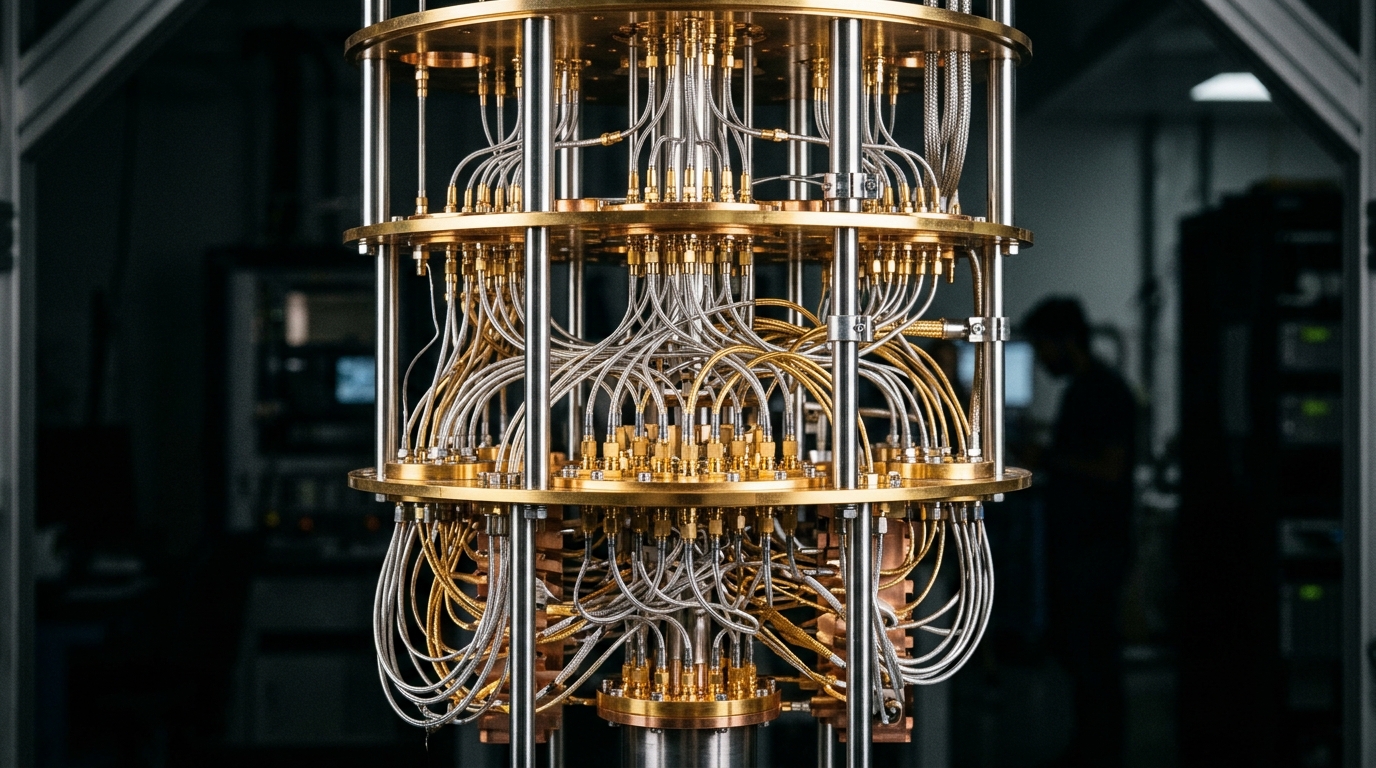
The analysis investigates whether hardware-level error suppression, system-level noise diagnosis, and real-time algorithmic decoding are more effectively resolved as a single coordinated adaptive control problem rather than as isolated engineering disciplines. Operating across superconducting, neutral-atom, and bosonic quantum processors, the surveyed literature establishes a formal three-layer functional taxonomy. Layer 1 encompasses physical substrate protection, Layer 2 governs probabilistic characterization and attribution, and Layer 3 performs sub-microsecond real-time decoding. By mapping recent milestones across commercial and academic quantum platforms, the scoping survey reveals that hardware acceleration has largely resolved initial latency bottlenecks at moderate code distances, shifting modern development toward hybrid machine-learning architectures that dynamically adjust to structured, correlated physical noise through continuous closed-loop feedback.
The fundamental necessity for an integrated error handling framework arises directly from the underlying physics of quantum noise, which disrupts fragile physical qubits far more acutely than classical bits. Environmental fluctuations such as energy decay across relaxation timescales, phase randomization during dephasing windows, control electronics miscalibrations, and multi-qubit crosstalk induce complex physical errors during quantum gate execution. To achieve scalable fault tolerance, quantum systems implement stabilizer codes that encode logical qubits across many physical qubits, measuring commuting multi-qubit Pauli operators whose simultaneous positive eigenspace forms the protected codespace. Physical errors push states out of this manifold, generating syndrome measurement patterns that decoders must resolve. For superconducting architectures, these quantum error correction cycles must be interpreted within strict microsecond coherence windows, creating a timing crisis where traditional software algorithms executed on general-purpose central processing units run ten to one hundred times slower than required.
Within the first layer of the taxonomy, symmetric hardware-level error suppression relies on advanced microfabrication and lattice design to uniformly reduce noise across all computational channels before applying standard surface codes. In December 2024, Google Quantum AI demonstrated this principle using its 105-qubit Willow transmon processor, achieving below-threshold operation with an error suppression factor of Lambda equals 2.14 plus or minus 0.02 at distance-7. The distance-7 rotated surface code memory utilized 101 physical qubits—comprising 49 data qubits, 48 measure qubits, and 4 dedicated leakage-removal qubits—yielding a logical error rate of 0.143 percent per cycle and a logical memory lifetime of 291 microseconds that exceeded the best physical qubit lifetime by a factor of 2.4. Despite this milestone, large-scale transmon lattices remain vulnerable to correlated error bursts caused by high-energy particle impacts and energetic phonons. Implementing normal-metal backside reservoirs achieved a twentyfold reduction in pair-breaking phonon flux, while active leakage removal units maintained a 98.4 percent removal fraction. In parallel, dynamic walking surface codes that periodically shift logical lattices reduced time-correlated errors by over an order of magnitude.
In contrast to symmetric transmons, asymmetric hardware suppression alters the underlying economics of quantum error correction by physically extinguishing specific error channels within the physical substrate itself. Amazon Web Services demonstrated this paradigm with the Ocelot processor, which utilizes superconducting cat qubits that encode information within coherent states of a harmonic oscillator stabilized by engineered two-photon dissipation. Because physical bit-flip errors require quantum tunneling across a distinct phase-space distance, bit flips are suppressed exponentially with increasing photon number, resulting in oscillator bit-flip lifetimes exceeding 100 milliseconds and reaching 22 seconds in external squeezed-cat demonstrations. Because bit flips are suppressed through hardware dissipation, Ocelot replaces complex two-dimensional surface codes with a simple one-dimensional repetition code designed solely to handle phase-flip errors. Utilizing bias-preserving controlled-NOT gates to avoid converting phase errors into bit flips, Ocelot demonstrated below-threshold phase-flip operation with a distance-5 repetition code achieving a 1.65 percent logical error rate per cycle, supporting theoretical projections of an approximate 90 percent hardware overhead reduction compared to standard surface codes.
The third hardware paradigm reviewed in Layer 1 is topological protection, embodied by Microsoft’s Majorana 1 architecture, which aims to eliminate local noise vulnerabilities by encoding information non-locally across spatially separated Majorana zero modes. Built upon hybrid indium arsenide and aluminum topoconductors designed to form topological superconducting phases, the processor incorporates tetron units comprising two parallel nanowires connected by a superconducting backbone. However, the survey emphasizes that these topological claims remain scientifically disputed within the quantum physics community. Independent peer reviews accompanying Nature publications noted that the reported experimental signatures fail to provide definitive evidence for Majorana zero modes because trivial Andreev bound states were not ruled out. Furthermore, external critiques demonstrated that topological gap measurement protocols could generate false positive signals. Unlike Willow and Ocelot, Majorana 1 has published neither logical error rates nor formal error-correction threshold values, leaving topological hardware at an unverified proof-of-concept stage where decoder requirements and fault mechanisms remain largely undefined.
Bridging physical hardware and algorithmic execution, Layer 2 of the taxonomy addresses system-level error diagnosis by generating continuous, interpretable models of hardware noise channels and deterministic software faults. Classical diagnostic baselines, including quantum process tomography, face severe operational limitations because they scale exponentially with qubit count, require sixteen-to-the-n measurements, and remain vulnerable to state preparation and measurement errors that disguise coherent drift. Gate set tomography resolves these ambiguities by self-consistently characterizing complete gate operations without calibrated reference states, providing rigorous diamond-norm bounds and detecting simultaneous crosstalk. Recent experimental applications of gate set tomography have optimized universal gate sets in diamond nitrogen-vacancy centers to achieve 99.9991 percent single-qubit fidelity. To deliver comparable diagnostic accuracy inside real-time operating pipelines, researchers have introduced compressive approximations, non-Markovian process tomography achieving tenfold to hundredfold parameter compression in silicon spin qubits, and classical shadow protocols that utilize low-depth random Clifford circuits to exponentially reduce observable sample complexity.
A critical diagnostic function within Layer 2 is error attribution, which seeks to differentiate physical hardware drift from deterministic bugs in compiled quantum circuits so systems can select appropriate remediations. The Bias-Entropy statistical model addresses this challenge by evaluating output distribution properties, recognizing that stochastic decoherence increases Shannon entropy by dispersing probability mass, whereas deterministic software bugs cause reproducible bias amplification toward specific incorrect states. This model establishes an analytical noise threshold based on gate count and the dimension of desired target states, attributing anomalous runs with high bias below this threshold to software bugs. Extending this concept, Adaptive Neuro-Fuzzy Inference Systems replace fixed analytical thresholds with learned fuzzy membership functions based on physics-grounded features, including pattern regularity across shots, probability centroid displacement, and depth correlation. This neuro-fuzzy implementation achieved 89.5 percent classification accuracy on a benchmark suite of 105 circuits and 93.3 percent strict accuracy on a held-out hardware suite with pre-frozen thresholds, effectively isolating compilation faults that produce probability divergences above intrinsic device noise floors.
Despite these diagnostic capabilities, the scoping review identifies a fundamental identifiability limit termed the coherent error blind spot that constrains all entropy-based attribution frameworks. When systematic control hardware miscalibrations alter a gate rotation angle by an increment that precisely mirrors a mistyped software parameter, the resulting executed quantum circuits and their induced output distributions are physically identical across every measurement basis and shot count. In this exact-equivalence regime, hardware noise and software bugs represent one identical physical state bearing two distinct labels, making them formally indistinguishable from internal execution data alone. Furthermore, systematic coherent miscalibrations accumulate quadratically with circuit depth due to constructive quantum interference, compounding a minor fraction-of-a-degree over-rotation across thousands of sequential operations into massive deterministic deviations that precisely mimic logic errors. Resolving this blind spot requires external validation interventions, such as executing circuits across alternate devices, recompiling gate decompositions, applying randomized compiling to convert coherent rotations into stochastic noise, or maintaining sequential Bayesian updates to continuously track calibration drift.
Layer 3 executes the algorithmic decoding task, taking incoming syndrome bits and deducing the most probable error chain within microsecond hardware cycles. Classical graph-matching decoders like Minimum-Weight Perfect Matching construct detector graphs where edge weights represent the negative logarithms of specific fault probabilities, with specialized implementations like Sparse Blossom exceeding one million corrections per core-second. Complementary Union-Find decoders achieve near-linear worst-case complexity by growing and merging syndrome clusters along spanning trees. Groundbreaking hardware-accelerated decoders have transformed this operational landscape: the Micro Blossom field-programmable gate array decoder achieves 0.8-microsecond latency for distance-13 codes, while Riverlane’s 12-nanometer FinFET application-specific integrated circuit operates at megahertz decoding rates within an 8-milliwatt cryogenic power footprint. Similarly, distributed Helios architectures achieve 11.5-nanosecond rounds at distance-21, and IBM Relay-BP completes 12-cycle decoding windows in under 480 nanoseconds for bivariate bicycle codes. By effectively satisfying raw microsecond latency constraints at moderate distances, these hardware accelerators shift the primary challenge toward achieving decoding accuracy under complex, correlated noise.
To overcome the accuracy limits of static decoders, modern research focuses on neural and hybrid machine-learning architectures that extract complex error correlations directly from experimental data. While transformer models like AlphaQubit achieve exceptional accuracy—reducing logical errors by 30 percent compared to correlated matching—their fourth-power computational scaling with code distance limits real-time viability, prompting exploration into linear-scaling Mamba state-space models and graph neural networks. The most impactful breakthrough occurs in Neural Belief Propagation, which resolves the severe error degeneracy problem that causes standard belief propagation to oscillate on quantum low-density parity-check codes. By unrolling iterative message passing onto deep neural networks trained with degeneracy-aware loss functions, Neural Belief Propagation penalizes mismatches in logical classes rather than individual physical Pauli operators, yielding accuracy gains of up to three orders of magnitude. Integrating these components into a closed-loop framework—where online diagnostic sensing feeds reinforcement learning agents that update decoder priors in real time—represents the emerging frontier for fully autonomous, self-correcting quantum computers.
Subject of Research: Adaptive error management architectures for fault-tolerant quantum computing
Article Title: Adaptive error management for fault-tolerant quantum computing across hardware-level suppression, system-level diagnosis, and real-time decoding
Article References: Donkol, M. R., & Kaabouch, N. (2026). Adaptive error management for fault-tolerant quantum computing across hardware-level suppression, system-level diagnosis, and real-time decoding. Discover Quantum Science, 2(1), Article 46. https://doi.org/10.1007/s44464-026-00050-8
Image Credits: AI Generated
DOI: 10.1007/s44464-026-00050-8
Keywords: quantum computing, quantum error correction, fault tolerance, machine learning decoding, cat qubits, superconducting qubits, neural belief propagation, hardware acceleration, Adaptive, error, management, fault-tolerant
Cite Scienmag News
Katie Riggs. (November 7, 2026). Quantum Error Handling Converges Toward Adaptive Closed-Loop Systems Across Computing Layers. Scienmag. https://scienmag.com/quantum-error-handling-converges-toward-adaptive-closed-loop-systems-across-computing-layers/
Katie Riggs. "Quantum Error Handling Converges Toward Adaptive Closed-Loop Systems Across Computing Layers." Scienmag, 7 November 2026, https://scienmag.com/quantum-error-handling-converges-toward-adaptive-closed-loop-systems-across-computing-layers/. Accessed 8 November 2026.
Katie Riggs. "Quantum Error Handling Converges Toward Adaptive Closed-Loop Systems Across Computing Layers." Scienmag. November 7, 2026. https://scienmag.com/quantum-error-handling-converges-toward-adaptive-closed-loop-systems-across-computing-layers/




