


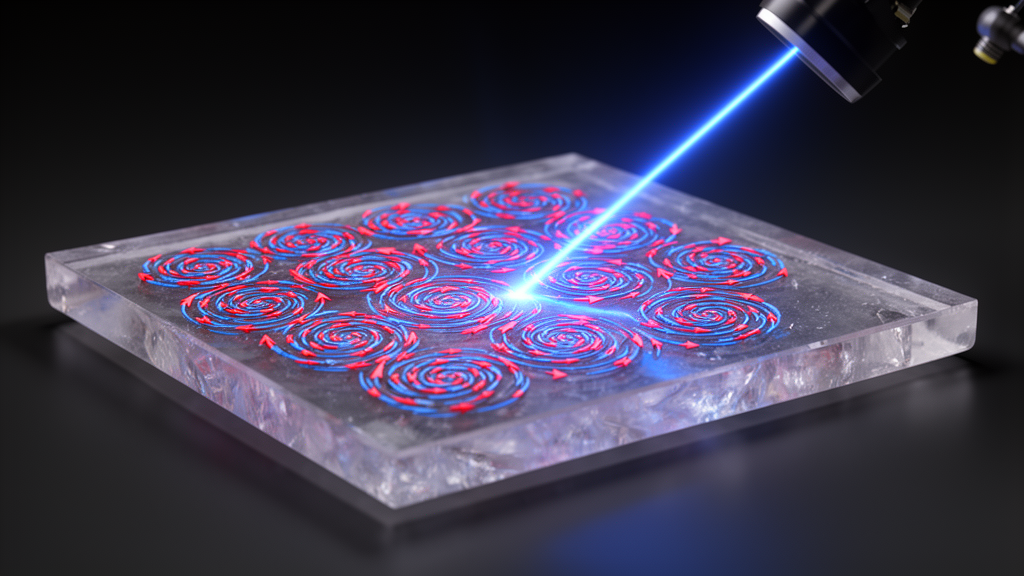
In a result that reads like science fiction but was published in the pages of Light: Science & Applications, a team of physicists from South Africa, Italy and the United States has shown that the topology of a single particle of light can be controlled from a distance, switched and animated by measurements performed on its entangled twin. The work, led by Fazilah Nothlawala and Andrew Forbes at the University of the Witwatersrand together with Bereneice Sephton and Vincenzo D’Ambrosio in Naples and Liang Feng in Philadelphia, delivers the first visualisation of tripartite entanglement dynamics through topological structure, and in doing so creates the first quantum multiskyrmions, particle-like textures of light that move, orbit and spin in response to a remote quantum measurement.
Skyrmions were originally conceived by Tony Skyrme in the 1960s as solitonic solutions of nonlinear field theories, particle-like knots in a continuous field whose identity is fixed by an integer topological charge. In magnetic materials, ultracold atomic gases, liquid crystals and even acoustic systems, these whirls of spin have been studied intensively because their topology protects them against small perturbations, making them attractive carriers of information. In optics, skyrmions have been built from the interplay of polarisation and spatial structure, with the Stokes parameters of a paraxial beam mapping the transverse plane onto the Poincaré sphere. What remained elusive was a quantum version in which the topology itself is not merely a static property of a prepared state but a dynamic, remotely addressable feature of an entangled system.
The new experiment begins with a deceptively simple quantum state. Photon A carries only polarisation, existing in a superposition of right- and left-circular states, while photon B carries one of two possible skyrmion states, each a non-separable combination of the photon’s polarisation and its orbital angular momentum, the twisted spatial structure described by Laguerre-Gaussian modes. Crucially, photon B on its own is described by a mixture of these skyrmion states, so no well-defined spin texture or skyrmion number exists until a measurement is made on photon A. Only when the polarisation of the partner photon is projected does the topology of photon B crystallise into a definite skyrmion with a definite topological number. The researchers describe this arrangement as a non-local quantum dial for topological structure.
To map this dial, the team introduced a conceptual tool they call the topological Bloch sphere. Whereas a conventional Bloch sphere parametrises the states of a two-level quantum system, this new sphere has basis vectors that are themselves topological states, so every point on the sphere corresponds to a different superposition of the two skyrmion states and therefore to a different Bell state, carrying its own skyrmion number. At the poles of the sphere, where the projections select the basis states, the polarisation texture forms a higher-order skyrmion. Along the equator, where the two basis states are combined in superposition, the texture breaks apart into multiple localised quasiparticles, each with its own skyrmion number, whose individual contributions sum to the total wrapping number of the field.
Experimentally, the photons were generated by spontaneous parametric downconversion in a nonlinear crystal, producing pairs entangled in orbital angular momentum at two different wavelengths, 1550 nanometres and 810 nanometres, separated by a dichroic mirror. Electrically tunable q-plates, liquid-crystal devices with azimuthally varying optical axes, then transformed the orbital-angular-momentum-entangled state into the desired spin-skyrmion entangled tripartite state, with the q-plate charge tailoring the accessible skyrmion sectors. Spatial light modulators, waveplates and single-mode fibres coupled to avalanche photodiodes completed the apparatus, with coincidences recorded within a half-nanosecond window.
The verification was rigorous. A violation of the Clauser-Horne-Shimony-Holt Bell inequality confirmed the non-local character of the correlations, with Bell parameters of 2.53 plus or minus 0.005 and 2.47 plus or minus 0.004 for the two heralded states, both beyond the classical bound of two. A full quantum state tomography, comprising six polarisation projections on the heralding photon and twenty-one combined measurements on the skyrmion photon, reconstructed the density matrix with a fidelity of 0.93 and a purity of 0.96. From the reconstructed state the team extracted the spatially varying Stokes parameters and computed the skyrmion number directly, observing the expected switching between topological sectors: for one configuration the number moved between approximately minus two at the poles and minus four at the equator, and for a second, generated with higher-charge q-plates, between approximately minus three and minus six, in each case matching theory to within a few percent.
The most visually striking outcome is the dynamics. By continuously varying the amplitude and phase angles of the polarisation projection on photon A, the researchers watched the localised quasiparticles of photon B’s multiskyrmion move. Changing the amplitude angle drove the quasiparticles radially, drawing them in from infinity toward the central distribution as the angle increased, until near the pole of the sphere they merged with the central skyrmion and could no longer be resolved as separate objects. Changing the phase angle instead set the quasiparticles orbiting around the centre, while each also exhibited a local spin arising from the precession of its Stokes vector. The symmetry of the distribution governed the total angles traversed: the two-quasiparticle configuration completed one orbit and one spin rotation per full phase scan, while the threefold-symmetric configuration completed an orbit of two-thirds of a full turn and a spin of four-thirds of a turn.
Beneath the spectacle lies a deeper point about multipartite entanglement. By constraining photon B to two of its three spatial modes, the team isolated an embedded GHZ-like state, the tripartite analogue of a Bell pair, in which the polarisation of photon A, the polarisation of photon B and one orbital angular momentum mode of photon B form the familiar pattern of a GHZ state. Projecting photon A onto its basis states collapses the remainder into separable states with trivial topology, while superposition projections collapse it into Bell states encoded in the spin and orbital angular momentum of photon B, each visible as a distinct skyrmionic texture with the same skyrmion number but a different spatial pattern. The Bell-state structure of the embedded GHZ state thus becomes something one can literally see in the polarisation field of a single photon.
The implications stretch toward quantum technology. Because the evolving skyrmionic structure of one photon can serve as a probe of its entangled partner, any perturbation acting on the partner can be read out as a transition between topological sectors or as a subtle shift in the quasiparticle dynamics, suggesting a route to quantum sensing in which complex channel features are mapped onto robust topological observables. The non-degenerate, dual-wavelength implementation adds versatility, allowing topological control at one technologically convenient wavelength while the topology is used or detected at another, with prospects including nonlinear quantum transport and the remote transfer of skyrmionic topology to matter. The authors also envision sharing such states across quantum networks, granting a resource-scarce partner access to complex topological structures that would otherwise be beyond their experimental reach, and exploiting the multipartite state complexity for multi-level quantum communication encoding.
What began six decades ago as an abstract field-theoretic construction has now become a controllable, moving, quantum-mechanical object of light, steered from afar by nothing more than the choice of measurement made on a distant entangled photon. In turning the topology of light into a remote-controlled dial, the researchers have not only made entanglement visible in an entirely new way but have opened a laboratory in which the particle-like textures of quantum fields can be engineered, animated and ultimately put to work.
Subject of Research: Remote control of quantum skyrmion topologies in entangled photon states to visualise tripartite entanglement dynamics
Article Title: Remote engineering of particle-like topologies to visualise entanglement dynamics
Article References: Nothlawala, F., Sephton, B., Ornelas, P., Koni, M., Piccirillo, B., Feng, L., Nape, I., D’Ambrosio, V., & Forbes, A. (2026). Remote engineering of particle-like topologies to visualise entanglement dynamics. Light: Science & Applications, 15(1), Article 368. https://doi.org/10.1038/s41377-026-02443-x
Image Credits: AI Generated
DOI: 10.1038/s41377-026-02443-x
Keywords: skyrmions, quantum entanglement, quantum photonics, orbital angular momentum, topological Bloch sphere, GHZ states, Bell inequality, structured light, quantum state tomography, q-plates, quantum sensing, multiskyrmions
Cite Scienmag News
Katie Riggs. (October 9, 2026). Quantum Dial for Light: Physicists Remotely Steer Skyrmions to Watch Entanglement in Action. Scienmag. https://scienmag.com/quantum-dial-for-light-physicists-remotely-steer-skyrmions-to-watch-entanglement-in-action/
Katie Riggs. "Quantum Dial for Light: Physicists Remotely Steer Skyrmions to Watch Entanglement in Action." Scienmag, 9 October 2026, https://scienmag.com/quantum-dial-for-light-physicists-remotely-steer-skyrmions-to-watch-entanglement-in-action/. Accessed 9 October 2026.
Katie Riggs. "Quantum Dial for Light: Physicists Remotely Steer Skyrmions to Watch Entanglement in Action." Scienmag. October 9, 2026. https://scienmag.com/quantum-dial-for-light-physicists-remotely-steer-skyrmions-to-watch-entanglement-in-action/


