


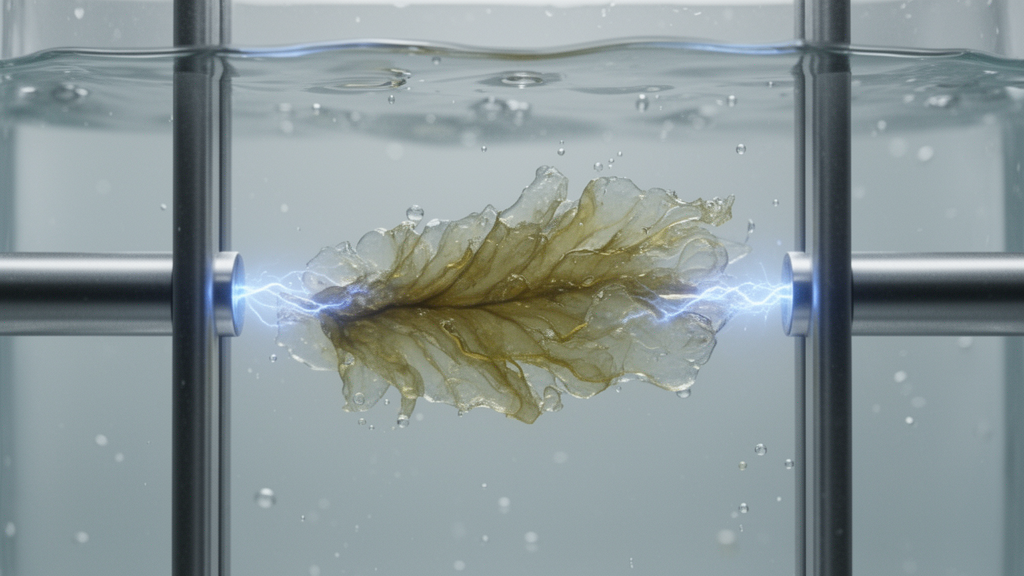
Researchers have demonstrated that a sequential process combining pulsed electric field (PEF) pretreatment with cellulase hydrolysis significantly enhances protein recovery and antioxidant activity from the brown seaweed Undaria pinnatifida. Published in Bioresources and Bioprocessing, the study provides a laboratory-scale framework for optimizing non-thermal extraction techniques to overcome the structural barriers inherent in macroalgal biomass. The primary finding indicates that the combined treatment yielded a protein concentration of 1307 ± 38.62 µg mL⁻¹, substantially outperforming individual treatments and untreated controls. This approach addresses the challenge of extracting high-value bioactive compounds from seaweed, which possesses a rigid, polysaccharide-rich cell wall that typically hinders the release of intracellular proteins.
The study, conducted by a team including Antony Rinthiya Mariadavid and Jae-Suk Choi, focused on the specific optimization of PEF parameters to maximize protein release. Undaria pinnatifida is a promising candidate for biorefinery applications due to its relatively high protein content, ranging from 11% to 14% on a dry-weight basis, along with significant amounts of dietary fiber and antioxidant compounds. However, the complex cell wall structure, composed of alginates, fucoidan, laminarin, and cellulose, creates strong mass transfer resistance. Traditional extraction methods often require high temperatures or long processing times, which can degrade heat-sensitive bioactive molecules. The integration of PEF technology offers a mild, non-thermal alternative that induces electroporation, a process where short, high-voltage electrical pulses create transient pores in cell membranes, thereby facilitating the outflow of intracellular constituents.
To identify the optimal conditions, the researchers employed a sequential one-factor-at-a-time experimental design to evaluate electric field strength, pulse width, pulse repetition frequency, and treatment duration. The electric field strength was varied from 1 to 5 kV cm⁻¹, revealing a non-linear response in protein release. The highest protein concentration of 490 ± 3.23 µg mL⁻¹ was observed at 3 kV cm⁻¹, while higher field strengths of 4 and 5 kV cm⁻¹ resulted in decreased recovery, suggesting that excessive treatment severity may be detrimental to extraction efficiency. This finding underscores the importance of balancing membrane permeabilization with potential thermal or electrical damage to the biomass.
Further optimization of pulse characteristics identified 10 µs as the ideal pulse width, producing a protein concentration of 487 ± 3.54 µg mL⁻¹. Extending the pulse width to 15 or 20 µs led to lower yields, indicating that the duration of electrical exposure must be carefully calibrated. Similarly, pulse repetition frequency was tested from 40 to 100 Hz, with 100 Hz yielding the highest protein release at 493 ± 3.52 µg mL⁻¹. Unlike field strength and pulse width, the response to frequency increased continuously within the tested range, suggesting that a greater number of pulses enhances cumulative permeabilization. Treatment duration was optimized at 60 seconds, after which protein concentration declined, confirming that prolonged electrical exposure does not necessarily improve extraction outcomes.
The physical state of the seaweed also played a critical role in extraction efficiency. The researchers evaluated the effects of mechanical cutting and saline soaking on the biomass. Cutting the seaweed into approximately 1 × 1 cm segments increased the exposed surface area, facilitating mass transfer. Soaking the cut samples in a 3.5% sodium chloride solution for two days proved to be the most effective pretreatment, yielding a protein concentration of 493 ± 2.06 µg mL⁻¹ after PEF treatment.
Under the optimized PEF conditions of 3 kV cm⁻¹, 10 µs pulse width, 100 Hz frequency, and 60 s duration, the process required a total electrical energy input of only 0.18 kJ. The energy efficiency was calculated at 684.72 ± 2.78 mg protein per kJ, highlighting the resource-efficient nature of the method. Electrical conductivity of the seaweed matrix increased from 708 ± 5.29 to 1350 ± 4.00 µS cm⁻¹ following treatment, providing indirect evidence of increased ionic mobility and membrane permeabilization. The temperature remained stable between 23.1 and 23.5 °C, confirming that the process was predominantly non-thermal and that protein release was driven by electrical effects rather than bulk heating.
While PEF alone achieved a protein concentration of 512 ± 15.94 µg mL⁻¹, the addition of 1% cellulase after PEF treatment boosted the yield to 1307 ± 38.62 µg mL⁻¹. This combined treatment produced approximately 50% more protein than 1% cellulase alone and 375% more than the untreated control. The results suggest that PEF pretreatment enhances the accessibility of the seaweed matrix to cellulase, allowing the enzyme to more effectively degrade the structural polysaccharides that remain after electroporation. This complementary mechanism allows for a more complete recovery of intracellular proteins compared to either method used in isolation.
In addition to protein recovery, the antioxidant properties of the extracts were evaluated using three independent assays: DPPH, ABTS, and FRAP. The PEF plus 1% cellulase treatment consistently produced the highest antioxidant responses across all three methods. The extract exhibited 52.08 ± 2.68% DPPH radical-scavenging activity and 51.00 ± 1.08% ABTS radical-scavenging activity. The FRAP assay, which measures ferric reducing antioxidant power, recorded a value of 679 ± 1.08 µM Fe²⁺ equivalents for the combined treatment. These values were significantly higher than those obtained from PEF alone, cellulase alone, or the untreated control, indicating that the integrated process not only increases protein yield but also preserves or enhances the functional antioxidant capacity of the recovered compounds.
The consistency of the results across different antioxidant assays provides convergent evidence that the sequential PEF–cellulase process improves the overall quality of the extract. DPPH and ABTS assays assess radical-scavenging capacity through different chemical mechanisms, while FRAP evaluates reducing capacity. Although the study did not identify specific antioxidant compounds, the enhanced activity is likely due to the improved liberation of bioactive constituents from the seaweed matrix, such as phlorotannins and peptides, which are known to possess antioxidant properties.
Statistical analysis confirmed that both PEF treatment and cellulase concentration independently contributed to the increase in protein concentration, although the interaction between the two factors was not statistically significant. This implies that while both treatments are beneficial, their effects may be additive rather than strictly synergistic in a statistical sense. Nevertheless, the practical benefit of applying PEF before cellulase hydrolysis is clear, as the combined treatment achieved the highest protein concentrations and antioxidant activities. The study highlights the importance of optimizing physical and enzymatic parameters in concert to overcome the structural limitations of macroalgal biomass.
The findings are specific to the laboratory-scale batch conditions used in the study, including the electrode configuration, treatment volume, and biomass loading. The researchers noted that the energy performance and extraction efficiency may vary under industrial-scale or continuous-flow conditions, where factors such as electric-field homogeneity and electrical losses play a more significant role. Therefore, the optimal conditions identified should not be directly extrapolated to large-scale processing without further evaluation. Future work should focus on scale-up studies, continuous-flow operation, and detailed compositional characterization of the recovered protein and antioxidant fractions to fully establish the biorefinery potential of this process.
This research contributes to the growing body of knowledge on non-thermal processing technologies for marine biomass valorization. By demonstrating that PEF can be effectively used as a pretreatment for enzymatic hydrolysis, the study offers a sustainable and efficient strategy for recovering high-value compounds from brown seaweed. The ability to enhance protein recovery and antioxidant activity with minimal energy input and without thermal degradation makes this approach attractive for the development of functional foods and nutraceuticals.
Subject of Research: Optimization of pulsed electric field pretreatment followed by cellulase hydrolysis for enhanced protein recovery and antioxidant activity from brown seaweed (Undaria pinnatifida)
Article Title: Optimization of pulsed electric field pretreatment followed by cellulase hydrolysis for enhanced protein recovery and antioxidant activity from brown seaweed (Undaria pinnatifida)
Article References: Mariadavid, A. R., Malikhaturohmah, M., An, H.-R., Mansoor, S., Luzi, G., Sohn, J. H., Bashir, K. M. I., & Choi, J.-S. (2026). Optimization of pulsed electric field pretreatment followed by cellulase hydrolysis for enhanced protein recovery and antioxidant activity from brown seaweed (Undaria pinnatifida). Bioresources and Bioprocessing, 13(1), Article 140. https://doi.org/10.1186/s40643-026-01140-2
Image Credits: AI Generated
DOI: 10.1186/s40643-026-01140-2
Keywords: Optimization, pulsed, electric, field, pretreatment, followed, cellulase, hydrolysis, enhanced, protein, recovery, antioxidant
Cite Scienmag News
Gregory Coleman. (November 8, 2026). Pulsed Electric Fields Boost Seaweed Protein Extraction. Scienmag. https://scienmag.com/pulsed-electric-fields-boost-seaweed-protein-extraction/
Gregory Coleman. "Pulsed Electric Fields Boost Seaweed Protein Extraction." Scienmag, 8 November 2026, https://scienmag.com/pulsed-electric-fields-boost-seaweed-protein-extraction/. Accessed 9 November 2026.
Gregory Coleman. "Pulsed Electric Fields Boost Seaweed Protein Extraction." Scienmag. November 8, 2026. https://scienmag.com/pulsed-electric-fields-boost-seaweed-protein-extraction/




