

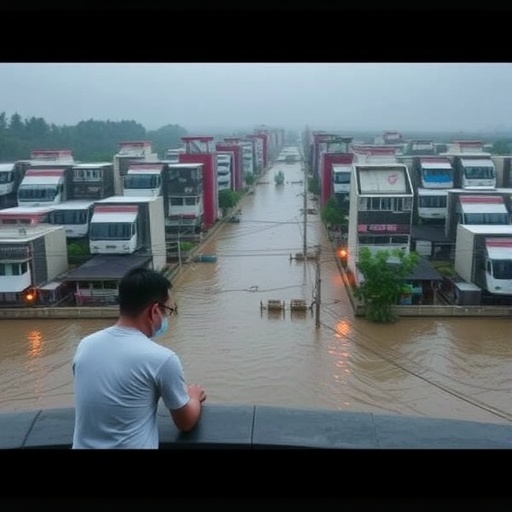
In the wake of one of China’s deadliest natural disasters, the 2021 Henan floods, groundbreaking research has shed new light on the intricate psychological trajectories experienced by survivors in the aftermath of such catastrophic events. The study, conducted by Zhang, Dang, and Ma and published in the 2025 edition of BMC Psychology, meticulously traces the evolution of posttraumatic stress disorder (PTSD) and posttraumatic growth over a six-month period among the victims. What makes this research particularly compelling is its dual focus not only on the typical spectrum of trauma-induced psychological distress but also on the paradoxical phenomenon of growth following trauma, exploring how social dynamics and media consumption specifically short video exposure, can significantly shape these outcomes.
Floods of the magnitude experienced in Henan province bring with them not only immediate physical devastation but long-lasting psychological scars. PTSD is widely recognized as a common psychological response to trauma, characterized by symptoms such as intrusive memories, heightened arousal, and avoidance behavior. However, posttraumatic growth (PTG) — the positive psychological change experienced as a result of struggling with highly challenging life circumstances — has increasingly captured the attention of clinical researchers eager to understand resilience in the face of adversity. Zhang and colleagues offer a rare longitudinal perspective, charting the ebb and flow of these sometimes competing psychological states over half a year, thus illuminating the profound complexity of human adaptation following natural disasters.
Central to the study’s findings is the role of social support, which emerged as a robust protective factor promoting psychological recovery and growth. Drawing from extensive surveys and psychological assessments, the researchers uncovered that individuals with strong, supportive social networks were less likely to develop chronic PTSD symptoms and more likely to experience meaningful personal transformation. The buffering effect of social support aligns with decades of psychological theory underscoring the importance of interpersonal connections during times of extreme stress. This study enhances our understanding by contextualizing social support within the unique cultural and situational contours of post-disaster recovery in China.
In contrast to the beneficial effects of social support, the research highlights a more nuanced and potentially detrimental influence wielded by short video exposure during the disaster period. The ubiquitous consumption of short, often sensationalized videos via social media platforms was found to exacerbate PTSD symptoms in many survivors. This phenomenon may be attributed to the repetitive visual trauma triggered by viewing frightening content and the amplification of stress brought about by the continuous flow of potentially distressing information. Zhang et al. detail how these short-form videos create an immersive, emotionally charged environment that can re-traumatize individuals, hindering their psychological healing process.
Delving deeper, the research dissects the content and context of short video exposure, noting that not all media consumption exerts negative impacts uniformly. For some, curated exposure to community solidarity and recovery efforts through these platforms played a role in fostering hope and encouraging adaptive coping mechanisms. Nevertheless, the overall profile indicates that unchecked or passive consumption amplifies distress and diminishes the potential for posttraumatic growth. This dualistic effect presents critical implications for disaster management and mental health interventions, calling for a more discerning approach to media engagement among trauma survivors.
The methodology underpinning this study is as rigorous as its findings are provocative. Employing repeated measures design and advanced statistical trajectory modeling, Zhang and colleagues tracked a large cohort of Henan flood survivors across several post-disaster phases. Participants underwent standardized clinical evaluations of PTSD symptom severity alongside assessments designed to quantify dimensions of posttraumatic growth, including new appreciation for life, enhanced personal strength, and improved relationships. Importantly, the study also integrated sociological indicators measuring perceived social support and detailed logs of media consumption patterns, innovatively bridging psychological science with media studies.
From a technical standpoint, the use of latent growth mixture modeling allowed the researchers to identify distinct subpopulations within the sample, each characterized by unique PTSD and PTG trajectories. These sophisticated techniques surpass traditional cross-sectional studies by illuminating the nonlinear and dynamic nature of psychological recovery. Zhang et al. were able to classify participants as resilient, recovering, chronic distress, or growth-dominant, revealing that a sizable minority not only recovered but thrived in the aftermath of the floods, providing a more nuanced portrait of human response to trauma than ever before.
Beyond individual psychological trajectories, the research critically addresses the broader social context influencing recovery. The Henan floods occurred in an era marked by rapid digital communication and unprecedented access to short video platforms that disseminate disaster imagery instantaneously. This saturation of visual content creates a pervasive psychological environment where survivors may feel constantly reminded of the trauma, blurring the lines between past experience and ongoing threat. The study’s findings suggest that managing media consumption should be a key component of disaster response policies aimed at mitigating secondary traumatization.
Moreover, the interplay between social support and media consumption indicates complex mechanisms through which communities either facilitate healing or inadvertently contribute to psychological harm. In situations where social networks mobilize to provide emotional, informational, and instrumental assistance, survivors’ mental health outcomes markedly improve. However, when social connections concurrently encourage or fail to regulate harmful media exposure, these benefits may be undermined. Recognizing these interactions is vital for shaping psychosocial interventions that harness the protective potentials of social ties while cautioning against unmoderated media consumption.
The implications of this research stretch far beyond the borders of Henan province or the specifics of flood disaster survivors. In an era where climate change is driving the frequency and intensity of natural disasters globally, understanding the psychological ripples these events cause is essential for public health preparedness. Zhang and colleagues’ work adds a critical layer of evidence suggesting that efforts to foster posttraumatic growth must incorporate strategies to enhance social support systems and mitigate harmful media exposure simultaneously.
The study also invites interdisciplinary dialogue between mental health professionals, disaster management authorities, and digital media regulators. Collaborative frameworks can be envisioned that integrate mental health screenings with community-based support initiatives and responsible media dissemination policies. By designing culturally sensitive programs that optimize social resources and modulate media exposure, future disaster responses can more effectively nurture resilience and growth among affected populations.
Furthermore, this research points to important avenues for future investigation. The differential impacts of specific types of video content, the role of individual differences in media literacy, and the potential for digital interventions aimed at promoting healthy media consumption habits warrant further scientific inquiry. Advances in computational psychology and big data analytics could be leveraged to monitor and tailor support for survivors in real time, enhancing the precision of mental health interventions in disaster contexts.
In conclusion, Zhang, Dang, and Ma’s study delivers profound insights into the dual trajectories of posttraumatic stress and growth, urging a reevaluation of how disaster aftermaths are managed psychologically and socially. Their evidence decisively spotlights social support as an unequivocal asset while casting a critical eye on the potentially insidious effects of unregulated short video exposure. As societies worldwide grapple with the escalating human costs of natural calamities, such research is indispensable in crafting nuanced, effective strategies to foster recovery and transform trauma into opportunity.
Ultimately, their findings challenge a one-dimensional view of trauma recovery, revealing a dynamic interplay where adversity engenders both immense suffering and significant growth. By harnessing the protective power of social connectedness and conscientiously curating digital media engagement, we can better support survivors in reclaiming control over their narratives and catalyzing psychological resilience. Zhang and colleagues’ work stands as a pivotal contribution toward building a scientifically grounded, compassionate response infrastructure for the mental health crisis latent within natural disasters.
Subject of Research: Psychological trajectories of posttraumatic stress disorder (PTSD) and posttraumatic growth among victims of the 2021 Henan floods, with a focus on the impact of social support and short video exposure during the disaster.
Article Title: Trajectories of posttraumatic stress disorder (PTSD) and posttraumatic growth among victims 6 months after the 2021 Henan floods: predictive roles of social support and short video exposure during the disaster.
Article References: Zhang, Y., Dang, J. & Ma, Z. Trajectories of posttraumatic stress disorder (PTSD) and posttraumatic growth among victims 6 months after the 2021 Henan floods: predictive roles of social support and short video exposure during the disaster. BMC Psychol (2025). https://doi.org/10.1186/s40359-025-03807-5
Image Credits: AI Generated


