
Saturday, February 28, 2026
Science
No Result
View All Result
  • Login
  • HOME
  • SCIENCE NEWS
  • CONTACT US
  • HOME
  • SCIENCE NEWS
  • CONTACT US
No Result
View All Result
Scienmag
No Result
View All Result
Home Science News Technology and Engineering

Proof-of-principle demonstration of 3-D magnetic recording

April 18, 2024
in Technology and Engineering
Reading Time: 3 mins read
0
Figure
66
SHARES
599
VIEWS
Share on FacebookShare on Twitter
ADVERTISEMENT

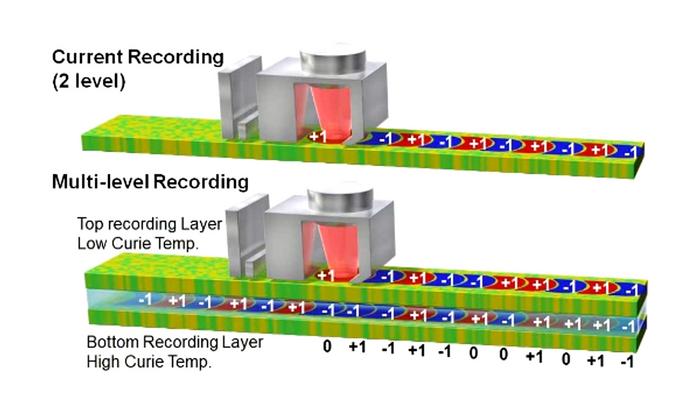
1. Research groups from NIMS, Seagate Technology, and Tohoku University have made a breakthrough in the field of hard disk drives (HDD) by demonstrating the feasibility of multi-level recording using a three-dimensional magnetic recording medium to store digital information. The research groups have shown that this technology can be used to increase the storage capacity of HDDs, which could lead to more efficient and cost-effective data storage solutions in the future.

Figure

Credit: Yukiko Takahashi
NIMS,
Thomas Chang
Seagate Technology,
Simon Greaves
Tohoku University

1. Research groups from NIMS, Seagate Technology, and Tohoku University have made a breakthrough in the field of hard disk drives (HDD) by demonstrating the feasibility of multi-level recording using a three-dimensional magnetic recording medium to store digital information. The research groups have shown that this technology can be used to increase the storage capacity of HDDs, which could lead to more efficient and cost-effective data storage solutions in the future.

2. Data centers are increasingly storing vast amounts of data on hard disk drives (HDDs) that use perpendicular magnetic recording (PMR) to store information at areal densities of around 1.5 Tbit/in². However, to transition to higher areal densities, a high anisotropy magnetic recording medium consisting of FePt grains combined with heat-assisted laser writing is required. This method, known as heat-assisted magnetic recording (HAMR), is capable of sustaining areal recording densities of up to 10 Tbit/in². Furthermore, densities of larger than 10 Tbit/in² are possible based on a new principle demonstrated by storing multiple recording levels of 3 or 4 compared with the binary level used in HDD technology.

3. In this study, we succeeded in arranging the FePt recording layers three dimensionally, by fabricating lattice-matched, FePt/Ru/FePt multilayer films, with Ru as a spacer layer. Measurements of the magnetization show the two FePt layers have different Curie temperatures. This means that three-dimensional recording becomes possible by adjusting the laser power when writing. In addition, we have demonstrated the principle of 3D recording through recording simulations, using a media model that mimics the microstructure and magnetic properties of the fabricated media.

4. The three-dimensional magnetic recording method can increase recording capacity by stacking recording layers in three dimensions. This means that more digital information can be stored with fewer HDDs, leading to energy savings for data centers. In the future, we plan to develop processes to reduce the size of FePt grains, to improve the orientation and magnetic anisotropy, and to stack more FePt layers to realize a media structure suitable for practical use as a high-density HDD.

***

5. This research was conducted by Dr. P. Tozman, Distinguished Researcher, and Dr. Yukiko Takahashi, Group Leader of NIMS Center for Magnetic and Spintronics Materials Research, Dr. T.Y. Chang, Researcher at Seagate Technology, and Prof. S.J. Greaves of Tohoku University. This work was supported by Japan Science and Technology Agency (JST) Strategic Basic Research Programs (CREST) “Integrated Devices and Systems Utilizing Information Carriers” JPMJCR22C3.

6. This research was published in Acta Materialia on March 24, 2024.


Journal

Acta Materialia

DOI

10.1016/j.actamat.2024.119869

Method of Research

Experimental study

Subject of Research

Not applicable

Share26Tweet17
Previous Post

This 3D printer can figure out how to print with an unknown material

Next Post

Coral researchers awarded EXIST start-up funding

Related Posts

blank
Technology and Engineering

In-Memory Wireless Neural Networks Enhance Communication

February 28, 2026
blank
Technology and Engineering

Pediatric Viral Myocarditis: Causes, Models, and Gaps

February 28, 2026
blank
Technology and Engineering

Clarifying Terms in Neonatal Encephalopathy Trials

February 28, 2026
blank
Technology and Engineering

How Alkali Cations Influence Electrochemical Carbon Dioxide Reduction

February 28, 2026
blank
Technology and Engineering

Intensive Phototherapy for Neonatal Jaundice: Efficacy and Risks

February 28, 2026
blank
Technology and Engineering

Hall Rectenna Achieves 100+ GHz Ultra-Wide Bandwidth

February 28, 2026
Next Post
A three months old stony coral Acropora millepora

Coral researchers awarded EXIST start-up funding

  • Mothers who receive childcare support from maternal grandparents show more parental warmth, finds NTU Singapore study

    Mothers who receive childcare support from maternal grandparents show more parental warmth, finds NTU Singapore study

    27618 shares
    Share 11044 Tweet 6902
  • University of Seville Breaks 120-Year-Old Mystery, Revises a Key Einstein Concept

    1022 shares
    Share 409 Tweet 256
  • Bee body mass, pathogens and local climate influence heat tolerance

    665 shares
    Share 266 Tweet 166
  • Researchers record first-ever images and data of a shark experiencing a boat strike

    532 shares
    Share 213 Tweet 133
  • Groundbreaking Clinical Trial Reveals Lubiprostone Enhances Kidney Function

    517 shares
    Share 207 Tweet 129
Science

Embark on a thrilling journey of discovery with Scienmag.com—your ultimate source for cutting-edge breakthroughs. Immerse yourself in a world where curiosity knows no limits and tomorrow’s possibilities become today’s reality!

RECENT NEWS

  • Botulinum Toxin Causes Masseter Atrophy via Autophagy Impairment
  • Creating Effective Fall Programs for Older Adults
  • Spinal Cord Organoids Reveal Injury and Therapy Insights
  • In-Memory Wireless Neural Networks Enhance Communication

Categories

  • Agriculture
  • Anthropology
  • Archaeology
  • Athmospheric
  • Biology
  • Biotechnology
  • Blog
  • Bussines
  • Cancer
  • Chemistry
  • Climate
  • Earth Science
  • Editorial Policy
  • Marine
  • Mathematics
  • Medicine
  • Pediatry
  • Policy
  • Psychology & Psychiatry
  • Science Education
  • Social Science
  • Space
  • Technology and Engineering

Subscribe to Blog via Email

Success! An email was just sent to confirm your subscription. Please find the email now and click 'Confirm Follow' to start subscribing.

Join 5,190 other subscribers

© 2025 Scienmag - Science Magazine

Welcome Back!

Login to your account below

Forgotten Password?

Retrieve your password

Please enter your username or email address to reset your password.

Log In
No Result
View All Result
  • HOME
  • SCIENCE NEWS
  • CONTACT US

© 2025 Scienmag - Science Magazine