


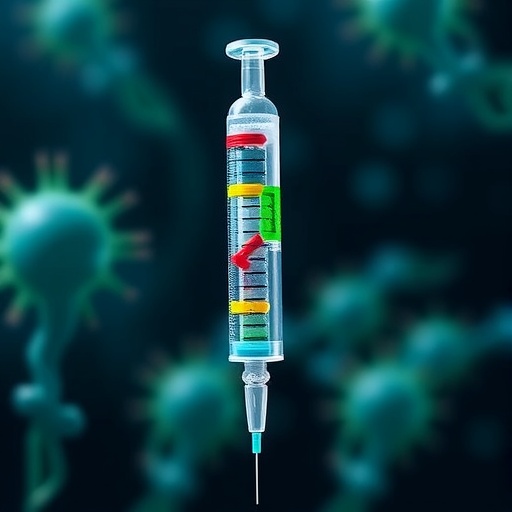
A new DNA-based nanoscale device could give scientists an unprecedented way to control how engineered objects cross cell membranes. In a study published in Nature Nanotechnology, researchers report a programmable “DNA origami nanosyringe” designed to direct membrane translocation—the process by which a molecular structure passes through the lipid barrier surrounding a cell. The technology combines the geometric precision of DNA origami with the functional logic of a syringe, creating a nanoscale system intended to recognize a membrane, engage with it, and guide the passage of molecular cargo. If the approach can be developed for biological applications, it could open a new chapter in targeted delivery, synthetic biology, nanomedicine, and the construction of artificial cellular machines.
Cell membranes are extraordinarily effective barriers. Their lipid bilayers protect the contents of a cell while allowing only selected molecules to enter or leave through channels, receptors, and transport proteins. For researchers trying to deliver proteins, nucleic acids, drugs, or molecular sensors into cells, this barrier is both essential and frustrating. Many delivery systems rely on passive diffusion, membrane-disrupting chemicals, viral vectors, or endocytosis, in which a cell engulfs an external object inside a vesicle. These methods can be inefficient, difficult to control, or potentially damaging. A device that could actively guide a defined cargo across the membrane, rather than simply attach to the cell or become trapped inside an endosome, would address one of the central problems in molecular delivery.
The nanosyringe described by Ding, Fan, Hao and colleagues is based on DNA origami, a method that turns DNA from a genetic information carrier into a programmable construction material. In DNA origami, a long scaffold strand is folded into a predetermined three-dimensional shape by hundreds of shorter “staple” strands. Each staple binds to specific sections of the scaffold, allowing researchers to design structures with nanometre-scale dimensions and precisely positioned functional elements. The resulting objects are not biological needles in the conventional sense. Instead, they are molecular machines assembled through predictable base pairing, with their shape, flexibility, binding sites, and mechanical movements encoded in the DNA sequence.
The syringe concept adds a functional architecture to that molecular framework. A conventional syringe has a barrel that holds cargo, a needle that reaches a target, and a plunger that applies force. At the nanoscale, those components must be recreated through molecular geometry and interactions rather than metal, plastic, or mechanical seals. A DNA origami structure can provide a hollow compartment or channel, while programmable strands and structural elements can act as gates, hinges, anchors, or moving parts. By engineering these features into one object, the researchers aim to transform membrane crossing from an uncontrolled physical event into a sequence of coordinated molecular steps.
The central challenge is not merely touching a membrane, but crossing it in a directed and useful way. A DNA nanostructure approaching a cell encounters a chemically complex surface covered with proteins, carbohydrates, and charged molecules. The membrane itself is a dynamic two-dimensional fluid, and its interior is hydrophobic, making it energetically difficult for a water-loving DNA object to pass through. A successful nanosyringe therefore needs mechanisms that help it bind to the correct surface, orient itself, interact with the lipid bilayer, and create or exploit a transient pathway. The device’s programmability is important because these stages can, in principle, be adjusted independently through changes to its DNA sequence and attached molecular components.
This strategy differs from many nanocarriers that deliver material by entering cells through vesicles. Endocytic uptake can bring a particle into the cell, but the cargo may remain enclosed in an endosome and later be degraded or recycled. Direct membrane translocation seeks to bypass that route by establishing a more immediate connection between the external environment and the cell interior. Such a pathway would be valuable for cargoes that must reach the cytoplasm, where many therapeutic and synthetic-biology functions take place. It could also allow researchers to study membrane transport under controlled conditions, separating the effects of targeting, membrane penetration, and cargo release instead of treating delivery as a single, poorly defined step.
The programmable nature of the system is what makes the work especially significant. DNA nanotechnology allows binding sequences to be selected for particular molecular targets, potentially enabling a nanosyringe to distinguish between different membrane environments. It may also permit control over when the structure opens, closes, docks, or releases its cargo. In principle, such instructions could be triggered by complementary DNA or RNA strands, changes in molecular concentration, environmental conditions, or interactions with a chosen receptor. This does not mean that a universal cell-penetrating machine has already been created. Rather, the work points toward a modular platform in which targeting and translocation behaviours can be redesigned without rebuilding the entire device from scratch.
The technology could eventually have applications in precision medicine, although substantial barriers remain before any clinical use. A practical delivery system would need to function in the complex fluids of the body, avoid rapid degradation, reach the intended tissue, distinguish diseased cells from healthy ones, and release its cargo at the correct location and dose. DNA nanostructures can be vulnerable to nucleases, immune recognition, aggregation, and clearance. Their performance may also change dramatically in the presence of serum proteins and crowded biological surroundings. Scaling up production with consistent quality would present another challenge. These issues are familiar across the field of DNA nanotechnology, and the nanosyringe concept does not eliminate them; it offers a new architecture in which they can be investigated systematically.
Beyond medicine, the device could become a tool for building more sophisticated artificial cells and molecular robots. Researchers have long sought ways to make synthetic compartments exchange materials with their surroundings in a controlled fashion. A programmable nanosyringe could contribute to artificial systems that sense their environment, import selected molecules, and respond through predefined chemical circuits. It could also help scientists explore how membrane permeability, mechanical force, and molecular recognition operate together. Because DNA origami structures can be imaged, modified, and produced with sequence-level precision, they provide an experimental platform for testing design principles that are difficult to isolate in natural membrane proteins.
The study’s broader message is that DNA nanotechnology is moving beyond static shapes and passive carriers toward active devices with defined tasks. A DNA origami nanosyringe does not simply provide a container for cargo; it is conceived as a coordinated molecular instrument that can engage a membrane and direct translocation. Whether that vision leads to reliable therapeutic delivery will depend on future experiments addressing efficiency, selectivity, safety, and operation in living organisms. For now, the work demonstrates how programmable molecular construction can be paired with one of biology’s most demanding engineering problems. By turning a familiar macroscopic tool into a nanoscale DNA machine, the researchers have offered a striking example of how synthetic structures may one day perform targeted operations inside living systems.
Cite Scienmag News
Denise Maddox. (August 25, 2026). Programmable DNA Origami Nanosyringe Enables Targeted Membrane Translocation. Scienmag. https://scienmag.com/programmable-dna-origami-nanosyringe-enables-targeted-membrane-translocation/
Denise Maddox. "Programmable DNA Origami Nanosyringe Enables Targeted Membrane Translocation." Scienmag, 25 August 2026, https://scienmag.com/programmable-dna-origami-nanosyringe-enables-targeted-membrane-translocation/. Accessed 4 September 2026.
Denise Maddox. "Programmable DNA Origami Nanosyringe Enables Targeted Membrane Translocation." Scienmag. August 25, 2026. https://scienmag.com/programmable-dna-origami-nanosyringe-enables-targeted-membrane-translocation/


