

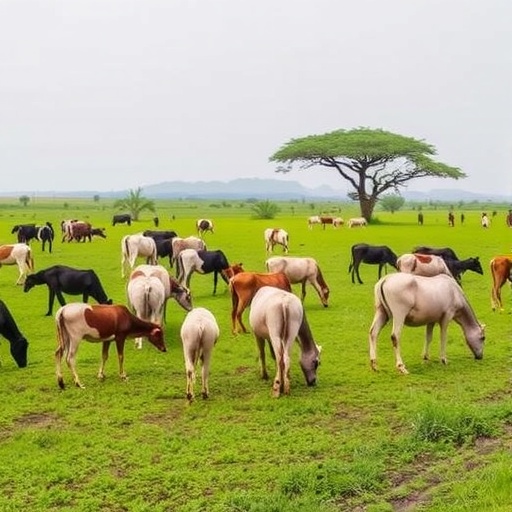
In recent years, the urgency to combat climate change has extended its reach into sectors that have traditionally received less attention, notably agriculture. Within this sector, ruminant livestock—comprising cattle, sheep, and goats—represent a significant source of greenhouse gas emissions, particularly methane. Africa, with its vast ruminant populations, faces both challenges and opportunities in mitigating these emissions. A novel perspective emerging from recent research emphasizes the pivotal role of private-sector engagement in driving greenhouse gas mitigation across Africa’s ruminant livestock value chains, bringing fresh hope for sustainable agricultural transformation on the continent.
The livestock sector in Africa is unique: it is deeply intertwined with the livelihoods of millions and remains a cornerstone for food security, cultural identity, and economic stability. However, this sector is also responsible for a substantial portion of the continent’s greenhouse gas emissions. Methane, produced during enteric fermentation in ruminants, contributes significantly to global warming, trapping heat far more effectively than carbon dioxide in the short term. Addressing these emissions without disrupting livelihoods poses a formidable policy and practical challenge. The new research underscores the private sector’s crucial capacity to innovate, invest, and implement solutions tailored to the specific conditions of Africa’s livestock systems.
Private-sector actors in this context range from agribusinesses, feed producers, veterinary pharmaceutical companies to financial institutions. Their influence extends from the grassroots level in rural farming communities to the corridors of international trade. Crucially, these players bring technological advancements, managerial expertise, and capital flows that are indispensable for scaling up mitigation activities. For example, improved feed formulations, breeding programs focused on low-emission livestock, and enhanced animal health services are all areas where private enterprises have demonstrated considerable potential, effectively transforming livestock productivity while reducing emissions.
One of the main bottlenecks hindering effective greenhouse gas mitigation has been the fragmented nature of livestock value chains in Africa. Smallholder farmers often operate in isolation, lacking the resources or market access to adopt advanced practices. Here, the private sector’s engagement helps to bridge these gaps by establishing supply chains that incentivize sustainable production. For instance, companies involved in dairy and meat processing can work directly with farmers to encourage adoption of emission-reducing practices, creating a win-win scenario: farmers gain better market access and income while supply chains become greener.
Financial instruments tailored for climate-smart agriculture further catalyze this transformation by de-risking investments in sustainable practices. Impact investing, carbon credit programs, and blended finance mechanisms designed by private financial institutions enable farmers and enterprises to overcome initial capital barriers. These financial innovations are essential because many mitigation strategies require upfront investment which small-scale producers cannot afford independently, even if these practices yield long-term economic and environmental benefits.
Another key area highlighted by the research is technological adoption. Digital platforms and mobile applications, frequently developed by private tech firms, have significantly enhanced data collection, performance monitoring, and extension services delivery in African livestock systems. Real-time data on feed efficiency, animal health, and emissions enable targeted interventions that maximize mitigation impact. Such technologies not only streamline operations but also empower farmers with actionable information, enhancing both productivity and sustainability.
The role of policy frameworks cannot be understated in shaping private-sector engagement. Governments across Africa are increasingly recognizing the mutual benefits of public-private partnerships aimed at reducing agricultural emissions. By creating enabling environments through appropriate regulations, subsidies, and supportive infrastructure, they attract private investment and innovation. This symbiosis is critical to ensuring that mitigation efforts are not only technically feasible but also economically viable and socially acceptable.
Furthermore, market mechanisms such as certification schemes and consumer-driven demand for sustainable products are growing in importance. The private sector’s responsiveness to shifting consumer preferences for low-carbon and ethically produced foods is an accelerating force for change. Export-oriented agribusinesses, in particular, are adopting greenhouse gas mitigation strategies to meet international standards, thereby gaining competitive advantages and fostering broader industry transformation.
An often-overlooked aspect of private-sector involvement lies in the mobilization of regional and continental networks. Companies and industry associations are leveraging their interconnectedness to disseminate best practices, harmonize standards, and advocate for policies that facilitate mitigation. These collaborations extend the reach and impact of individual initiatives, fostering a cohesive response to the shared challenge of livestock emissions.
Yet, despite these promising developments, hurdles remain. The heterogeneity in production systems, varying access to markets and finance, and limited awareness among producers pose significant constraints. The research stresses the need for tailored approaches that respect local contexts and integrate indigenous knowledge with scientific innovation. This nuanced understanding enhances adoption rates and maximizes the sustainability of mitigation interventions.
Capacity building emerges as a foundational pillar for successful private-sector engagement. Training programs for farmers, extension workers, and company staff foster the skills necessary to implement and maintain emission-reduction technologies. Private companies, in tandem with government and non-governmental organizations, have been instrumental in rolling out education campaigns and technical support, driving grassroots change and embedding sustainable practices within the livestock sector’s fabric.
Looking ahead, the integration of climate mitigation with broader goals such as poverty alleviation, gender equality, and resilience building promises multiple co-benefits. Private-sector initiatives that holistically address these dimensions enhance their social legitimacy and durability. By framing greenhouse gas mitigation as an opportunity rather than a burden, stakeholders can unlock synergies that foster inclusive and sustainable growth across Africa’s livestock value chains.
In conclusion, the new perspective offered by this research highlights private-sector engagement not as a peripheral player but as a core driver of greenhouse gas mitigation in Africa’s ruminant livestock systems. Its ability to provide innovative solutions, mobilize finance, and catalyze market-based incentives is indispensable. The challenge ahead lies in scaling these efforts, fostering inclusive partnerships, and embedding mitigation strategies within the continent’s complex socio-economic and ecological landscapes. As climate pressures mount, this integrated, multi-stakeholder approach will be fundamental for ensuring the sustainability of Africa’s livestock future.
Subject of Research: Private-sector involvement in mitigating greenhouse gas emissions in Africa’s ruminant livestock value chains.
Article Title: Private-sector engagement in greenhouse gas mitigation in Africa’s ruminant livestock value chains: a perspective based on illustrative examples.
Article References:
Komarek, A.M., Rufino, M.C., Snow, V. et al. Private-sector engagement in greenhouse gas mitigation in Africa’s ruminant livestock value chains: a perspective based on illustrative examples. npj Sustain. Agric. 4, 15 (2026). https://doi.org/10.1038/s44264-026-00124-1
Image Credits: AI Generated
DOI: https://doi.org/10.1038/s44264-026-00124-1


