
Saturday, February 7, 2026
Science
No Result
View All Result
  • Login
  • HOME
  • SCIENCE NEWS
  • CONTACT US
  • HOME
  • SCIENCE NEWS
  • CONTACT US
No Result
View All Result
Scienmag
No Result
View All Result
Home Science News Athmospheric

Prestigious Eni Award for Würzburg Chemistry Professor Holger Braunschweig

August 14, 2024
in Athmospheric
Reading Time: 3 mins read
0
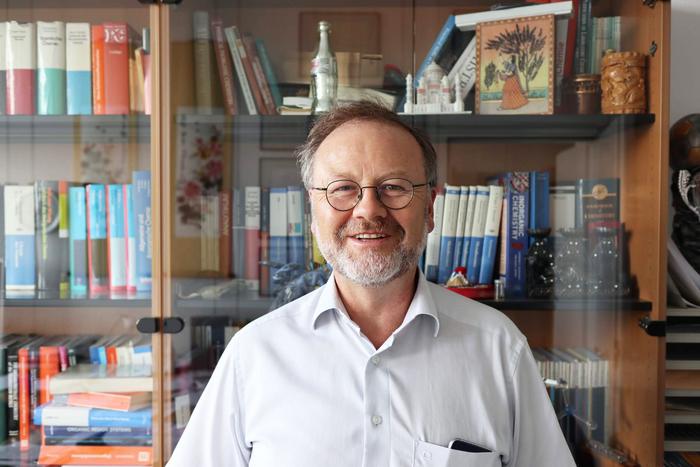
Chemistry Professor Holger Braunschweig
65
SHARES
592
VIEWS
Share on FacebookShare on Twitter
ADVERTISEMENT

Since 2007, the Italian oil and energy company Eni has awarded a prize for outstanding research achievements worldwide that aim to reduce the consumption of energy and raw materials and minimise environmental impact. Chemistry Professor Holger Braunschweig from Julius-Maximilians-Universität (JMU) Würzburg is one of the 2024 prize winners.

Chemistry Professor Holger Braunschweig

Credit: Rian Dewhurst / University of Wuerzburg

Since 2007, the Italian oil and energy company Eni has awarded a prize for outstanding research achievements worldwide that aim to reduce the consumption of energy and raw materials and minimise environmental impact. Chemistry Professor Holger Braunschweig from Julius-Maximilians-Universität (JMU) Würzburg is one of the 2024 prize winners.

What the JMU professor is being honoured for: He has developed new methods that have the potential to produce fertilisers, pharmaceuticals and other nitrogen compounds more sustainably – without the use of heavy metals, with lower energy consumption and fewer waste products.

The Würzburg chemist will receive the Eni Award in the “Advanced Environmental Solutions” category. He will be presented with the award on 15 October 2024 in Rome at a ceremony with the Italian President. At 200,000 euros, the Eni Prize is one of the most highly endowed industrial science prizes in the world. Holger Braunschweig is free to use the prize money as he wishes.

“Around 30 years ago, we began investigating a special class of boron compounds, known as borylenes, which now enable the activation of nitrogen. I am delighted that this work, carried out by my students and colleagues, has now been recognised in this way,” says the professor.

Holger Braunschweig’s Outstanding Research

Almost all nitrogen-containing chemicals, including synthetic plant fertilisers based on ammonia or nitrate, are produced by the industrial conversion of atmospheric nitrogen using the Haber-Bosch process. This process consumes a huge amount of energy, estimated at one to two per cent of global electricity generation. It also produces a lot of waste, some of which is toxic, due to the transition metals used as catalysts.

About ten years ago, Holger Braunschweig’s team discovered boron-containing molecules with unique properties similar to those of transition metals: they can bind and activate inert molecules such as atmospheric nitrogen. The research group quickly realised that the novel boron molecules could open the way to a more sustainable alternative to the Haber-Bosch process.

Groundbreaking Publications

In an article published in Science in 2018, the JMU research group showed that Holger Braunschweig’s boron molecules facilitate nitrogen activation and reduction on boron. The following year, a second article in Science presented the world’s first coupling of two nitrogen molecules. In a 2020 article in Nature Chemistry, the JMU team then presented a simple synthesis of ammonia without transition metals and the full chemical identification of each intermediate in the process.

The scientific community immediately categorised these results as groundbreaking: The 2018 article was cited almost 800 times by other researchers in the five years following its publication.

The systems developed by Holger Braunschweig’s team are still a long way from industrial application. Nevertheless, they provide a basis for producing nitrogen-containing molecules with fewer synthesis steps, less (toxic) waste and lower energy consumption.

Braunschweig’s concept also laid the foundation for a sharp increase in research in this field worldwide. It should therefore only be a matter of time before the fruits of his research reach industry.



Share26Tweet16
Previous Post

Fracking frenzy in India: A water crisis in the making?

Next Post

iFAB Tech Hub grows net-zero industrial chemical partnerships, champions bioeconomy

Related Posts

blank
Athmospheric

New Study Finds Cyanobacteria Could Facilitate Antibiotic Resistance Spread in Estuarine Ecosystems

February 6, 2026
blank
Athmospheric

Ancient Life Forms Possibly Used Oxygen Long Before Atmosphere Was Filled

February 6, 2026
blank
Athmospheric

41 US States Experience Unique Patterns of Warming, Reveals UC3M and UNIZAR Study

February 6, 2026
blank
Athmospheric

Could Ionospheric Disturbances Trigger Earthquakes?

February 6, 2026
blank
Athmospheric

Boston College Researchers Uncover Causes Behind Early 2020s Methane Surge

February 6, 2026
blank
Athmospheric

Methane Spike Driven Not Only by Emissions but Also by Temporary Atmospheric Breakdown

February 6, 2026
Next Post
Research team at IBRL

iFAB Tech Hub grows net-zero industrial chemical partnerships, champions bioeconomy

  • Mothers who receive childcare support from maternal grandparents show more parental warmth, finds NTU Singapore study

    Mothers who receive childcare support from maternal grandparents show more parental warmth, finds NTU Singapore study

    27610 shares
    Share 11040 Tweet 6900
  • University of Seville Breaks 120-Year-Old Mystery, Revises a Key Einstein Concept

    1017 shares
    Share 407 Tweet 254
  • Bee body mass, pathogens and local climate influence heat tolerance

    662 shares
    Share 265 Tweet 166
  • Researchers record first-ever images and data of a shark experiencing a boat strike

    529 shares
    Share 212 Tweet 132
  • Groundbreaking Clinical Trial Reveals Lubiprostone Enhances Kidney Function

    515 shares
    Share 206 Tweet 129
Science

Embark on a thrilling journey of discovery with Scienmag.com—your ultimate source for cutting-edge breakthroughs. Immerse yourself in a world where curiosity knows no limits and tomorrow’s possibilities become today’s reality!

RECENT NEWS

  • Adapting to Transition Risks: Indonesian Coal Companies’ Strategies
  • LRRK2R1627P Mutation Boosts Gut Inflammation, α-Synuclein
  • 3D Gut-Brain-Vascular Model Reveals Disease Links
  • Low-Inflammation in Elderly UTIs: Risks and Resistance

Categories

  • Agriculture
  • Anthropology
  • Archaeology
  • Athmospheric
  • Biology
  • Biotechnology
  • Blog
  • Bussines
  • Cancer
  • Chemistry
  • Climate
  • Earth Science
  • Editorial Policy
  • Marine
  • Mathematics
  • Medicine
  • Pediatry
  • Policy
  • Psychology & Psychiatry
  • Science Education
  • Social Science
  • Space
  • Technology and Engineering

Subscribe to Blog via Email

Enter your email address to subscribe to this blog and receive notifications of new posts by email.

Join 5,190 other subscribers

© 2025 Scienmag - Science Magazine

Welcome Back!

Login to your account below

Forgotten Password?

Retrieve your password

Please enter your username or email address to reset your password.

Log In
No Result
View All Result
  • HOME
  • SCIENCE NEWS
  • CONTACT US

© 2025 Scienmag - Science Magazine

Discover more from Science

Subscribe now to keep reading and get access to the full archive.

Continue reading