


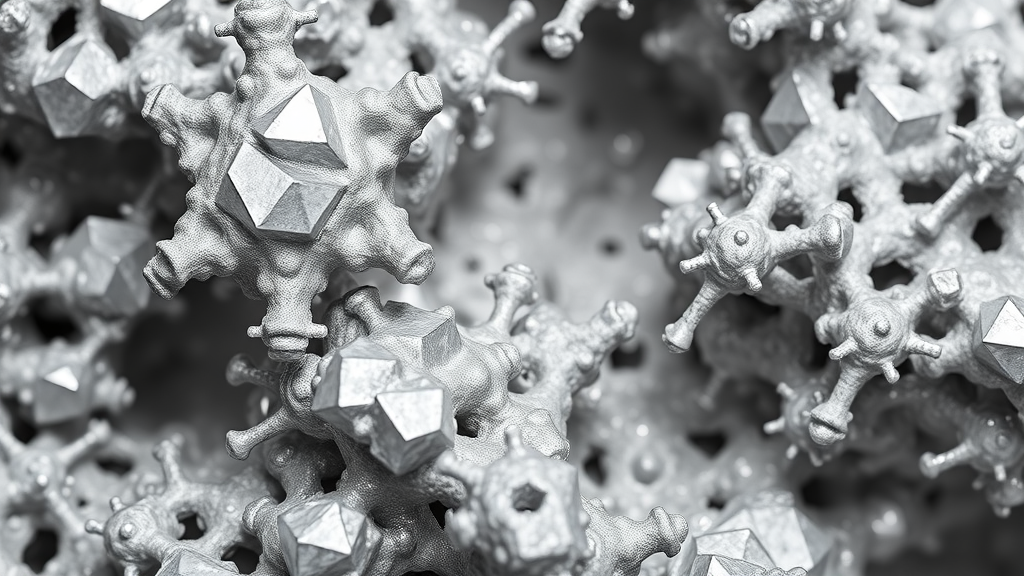
Quasicrystals are among the strangest solids ever discovered. Their atoms are arranged in patterns that are ordered but never repeat, a state long thought impossible for matter. In aluminum alloys, tiny icosahedral quasicrystal particles can act as extraordinarily strong reinforcements, delivering high specific strength, good ductility and excellent wear resistance. But these exotic phases are also metastable: heat them too much and they decompose into ordinary, less useful crystalline compounds. A new study published in the Journal of Materials Science by researchers at the University of Connecticut and Collins Aerospace shows how to lock these remarkable particles in place, producing fully dense bulk aluminum composites in which the quasicrystals survive completely intact.
The challenge has always been the gap between making the material and making it usable. Quasicrystals in aluminum alloys form only when molten metal cools extremely rapidly, which is why the starting materials are usually produced as fine powders by gas atomization. In that process, a stream of molten alloy is broken into droplets and solidified at rates high enough to trap the icosahedral quasicrystalline phase, known as I-phase, in a nanocomposite structure of quasicrystal dispersoids embedded in an aluminum matrix. Turning those powders into a solid engineering component, however, normally requires elevated temperatures and long holding times, exactly the conditions that allow the metastable quasicrystals to transform into equilibrium phases and destroy the microstructure that gives the alloy its special properties.
Spark plasma sintering, or SPS, has emerged as a promising way to bridge that gap. In SPS, a pulsed electric current passes through a conductive die and the powder compact itself, while a uniaxial pressure is applied simultaneously. The result is very rapid heating, short cycle times and low overall process temperatures, all of which suppress the diffusion-controlled transformations that would otherwise consume metastable phases. The technique has been used before to consolidate quasicrystal-forming alloys, but until now no study had reported achieving full density in an aluminum-quasicrystal composite while completely preventing decomposition of the quasicrystalline phase. That is the milestone the Connecticut team set out to reach.
The researchers worked with gas-atomized powders of an Al-Cr-Co-Mn-Zr alloy, a composition developed in a series of earlier studies on icosahedral-phase-strengthened aluminum. The powders displayed the desired nanocomposite structure: fine icosahedral quasicrystals dispersed throughout an aluminum matrix. The team consolidated the powders using SPS under an applied pressure of 100 megapascals at temperatures ranging from 350 to 600 degrees Celsius, then examined the resulting microstructures with X-ray diffraction and electron microscopy to determine exactly what happened to the quasicrystals at each processing condition.
The results revealed a sharp transition. Samples sintered at 350 degrees Celsius retained their quasicrystals but remained porous, meaning the powder particles had not bonded into a fully dense solid. At 400 degrees Celsius and above, the compacts densified, but the quasicrystals began to decompose, transforming into coarse equilibrium phases identified as Al45(Cr,Mn)7 and Al9Co2. By 600 degrees Celsius the transformation was complete, leaving a dense but ordinary material that had lost the nanocomposite character of the starting powder. Using X-ray diffraction and electron microscopy, the team pinpointed 400 degrees Celsius as the onset temperature for quasicrystal decomposition under these processing conditions, defining a narrow and unforgiving processing window.
That window posed a dilemma: densification seemed to require temperatures that destroyed the very phase the researchers wanted to keep. Their solution was to change the other processing variable. Instead of raising the temperature, they raised the pressure. In a second set of SPS trials conducted at just 375 degrees Celsius, below the decomposition threshold, the team applied higher pressures than in the first campaign. The additional pressure provided the driving force needed to close the remaining porosity through plastic deformation and creep of the aluminum matrix, mechanisms well documented in field-assisted sintering of metals, without ever pushing the quasicrystals past their thermal limit.
The strategy worked. The samples sintered at 375 degrees Celsius under higher pressure reached full density while retaining the quasicrystalline phase completely, with no detectable decomposition. Microscopy confirmed that the fine icosahedral dispersoids survived intact in the aluminum matrix, preserving the nanocomposite architecture of the gas-atomized powder. Remarkably, this fully dense, quasicrystal-retaining material also exhibited the highest hardness of any sample in the study, measuring 164.8 plus or minus 3.8 HV. The combination of full densification, complete phase retention and maximum hardness in a single sample demonstrates that the pressure-temperature trade-off can be exploited to beat the kinetics of decomposition entirely.
The significance extends beyond one alloy system. Aluminum-quasicrystal composites are attractive for tribological applications such as wear-resistant coatings and components, and related quasicrystal-strengthened alloys have been explored for additive manufacturing, cold spray deposition and other powder-based processing routes. In each of these contexts, the metastable quasicrystals face the same threat: any thermal exposure during consolidation or deposition can degrade them. The new results show that by carefully balancing pressure against temperature, and by exploiting the rapid heating and short cycle times inherent to SPS, it is possible to consolidate metastable-phase composites to full density without sacrificing the microstructure that makes them valuable. The authors connect the observed microstructures and hardness values to the densification mechanisms operating during SPS processing, providing a mechanistic framework that other groups can apply to their own metastable systems.
The work also fits into a broader effort at the University of Connecticut to understand and exploit icosahedral-phase-strengthened aluminum alloys, spanning gas atomization, thermal stability studies, laser powder bed fusion and additive friction stir deposition. By establishing a processing route that preserves I-phase through the most thermally demanding step, bulk consolidation, the study closes a critical link in that chain. For a class of materials whose defining feature is an atomic arrangement that nature rarely allows at equilibrium, the message is clear: with the right combination of heat, pressure and speed, even the most fragile order can be coaxed into a dense, durable and remarkably hard bulk solid.
Subject of Research: Spark plasma sintering of aluminum-quasicrystal nanocomposites to retain the metastable icosahedral I-phase
Article Title: Retention of I-phase during spark plasma sintering of aluminum-quasicrystal nano-composites
Article References: Yavas, B., Jenabi, A., Rommel, S., Benson, C. L., Aindow, M., & Dupuy, A. D. (2026). Retention of I-phase during spark plasma sintering of aluminum-quasicrystal nano-composites. Journal of Materials Science. https://doi.org/10.1007/s10853-026-13812-7
Image Credits: AI Generated
DOI: 10.1007/s10853-026-13812-7
Keywords: quasicrystals, spark plasma sintering, aluminum alloys, nanocomposites, icosahedral phase, gas atomization, metastable phases, powder metallurgy, hardness, wear resistance, Al-Cr-Co-Mn-Zr, densification
Cite Scienmag News
Denise Maddox. (September 25, 2026). Pressure Trick Preserves Fragile Quasicrystals in Dense Aluminum Composites. Scienmag. https://scienmag.com/pressure-trick-preserves-fragile-quasicrystals-in-dense-aluminum-composites/
Denise Maddox. "Pressure Trick Preserves Fragile Quasicrystals in Dense Aluminum Composites." Scienmag, 25 September 2026, https://scienmag.com/pressure-trick-preserves-fragile-quasicrystals-in-dense-aluminum-composites/. Accessed 4 October 2026.
Denise Maddox. "Pressure Trick Preserves Fragile Quasicrystals in Dense Aluminum Composites." Scienmag. September 25, 2026. https://scienmag.com/pressure-trick-preserves-fragile-quasicrystals-in-dense-aluminum-composites/


