

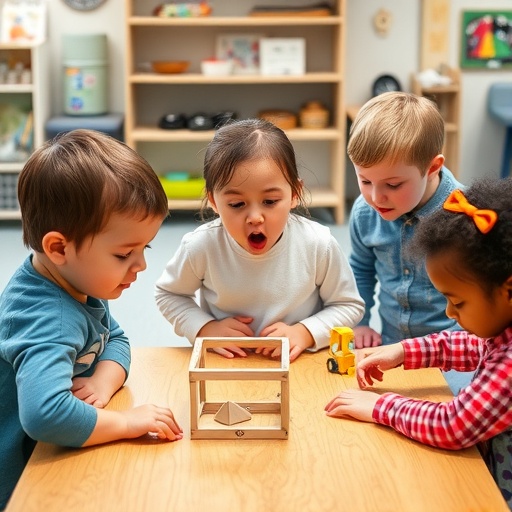
In the realm of early childhood education, a new wave of research is illuminating how preschool-age children navigate the intricate world of spatial sensemaking within the domains of science and engineering. A collaborative effort led by researchers Plummer, Lewis, and Cho sheds light on this essential cognitive process that is often overlooked but plays a critical role in developing problem-solving skills at an early age. The research highlights the importance of spatial reasoning as an integral component of not just scientific thought but also of everyday problem solving, setting the stage for deeper learning and innovation as these young minds grow.
Spatial sensemaking refers to the ability to understand and manipulate the spatial properties of objects and their relationships to each other. This study marvels at how children as young as three or four years old begin to express this complex cognitive skill, demonstrating an innate curiosity and aptitude for understanding the environment around them. The researchers employed a mix of observational studies, classroom interventions, and experimental methods to capture how young children engage with their surroundings and the devices or materials placed before them—elements that are foundational in science and engineering.
One astonishing finding of the study reveals that preschool children can identify spatial relationships in ways that are sophisticated for their age. For instance, when presented with blocks of different shapes and sizes, these children were not only able to construct simple structures but also explained their reasoning for placing certain pieces in specific orientations. This cognitive endeavor is vital as it mirrors the foundational steps scientists and engineers take when first grappling with concepts of design, construction, and analysis in their fields.
Moreover, the researchers noted that children often engage in discussions with their peers and educators that reflect a growing understanding of spatial concepts. Phrases like “above,” “below,” “next to,” and “in front of” became common in their vocabulary, showcasing how language development is intertwined with spatial reasoning. The authors argue that this linguistic growth can be nurtured by creating an engaging learning environment. By fostering dialogue around spatial concepts, educators can help cultivate these vital skills, thereby enhancing children’s academic trajectories as they advance through their education.
The study also emphasizes the role of play in fostering spatial reasoning. Through both structured and unstructured play, children are continuously interacting with their environment, manipulating objects, and solving problems in real-time. This exploratory behavior is essential, as it allows them to test hypotheses, learn from trial and error, and develop a foundational framework upon which more complex science and engineering concepts can be built in their later education. By employing various toys and materials that encourage this form of engagement, educational practitioners can provide rich pathways for children to explore spatial relationships without the pressure of traditional academic formats.
Educators in early childhood settings should consider integrating more hands-on activities that involve manipulation of objects, whether it be through building blocks, puzzles, or interactive digital tools. This approach aligns with the findings of Plummer et al., which highlight that when children are given opportunities to explore their spatial abilities in meaningful contexts, they demonstrate greater enthusiasm and a more profound understanding of scientific and engineering principles.
Additionally, the implications for parents are equally significant. By understanding the importance of spatial reasoning, parents can actively encourage their children’s natural curiosity about the world. Simple activities such as navigating a new park, building a fort with cushions, or sorting household items by shape and size can lay down the groundwork for these essential skills. This research underscores the idea that children learn best when they are actively engaged with their environment, prompting parents to seek out diverse experiences that foster exploration.
As education systems worldwide continue to evolve, integrating findings from studies such as this one may prove invaluable. The emphasis on spatial reasoning as a critical area of development can lead to curricula that not only cover traditional subjects but also incorporate lessons on spatial awareness and problem solving. By equipping educators with the tools and methodologies derived from this research, schools can create a generation that is not only adept in STEM fields but also possesses the vital ability to think critically and innovate.
In conclusion, the research led by Plummer, Lewis, and Cho redefines how we think about early learning in the fields of science and engineering. It challenges long-standing views of cognitive development by demonstrating that children are capable of sophisticated spatial reasoning from a young age. This study invites educators and parents alike to embrace the notion that nurturing these skills will foster a more scientifically literate and innovative future generation.
As we look ahead, it is evident that fostering spatial sensemaking in preschool children is not just about preparing them for academic success. It is about igniting a passion for science and engineering that could serve as the foundation for future innovators and problem solvers. As we equip the leaders of tomorrow with the cognitive tools they need, the possibilities become endless.
Strong collaborations among educators, researchers, and parents are essential to ensure that the learning environments we create remain conducive to exploration and growth. By valuing the significance of spatial reasoning and its applications in everyday life, we pave the way for our children to not only understand the world around them but also to shape it for the better.
The potential of preschool-age children’s spatial sensemaking could yield profound implications, transforming educational practices and fostering an environment where science and engineering thrive. The sooner we recognize and champion these early cognitive skills, the more robust our future generations will be in facing the challenges of tomorrow.
In light of these insights, it is critically important for educational stakeholders to invest time and resources into exploring how best to harness the innate curiosity of young children. As we redirect our focus to these foundational elements of learning, we stand to usher in a new era of educational practices aimed at nurturing creativity, critical thinking, and innovation, all stemming from a core understanding of spatial reasoning.
By embracing this cutting-edge research, we not only equip children with vital academic skills but also open doors to lifelong learning opportunities. The future rests in the hands of these preschoolers as they embark on their journeys enriched by spatial sensemaking in the vibrant domains of science and engineering.
Subject of Research: Preschool-age children’s spatial sensemaking in science and engineering.
Article Title: Preschool-age children’s use of spatial sensemaking in science and engineering.
Article References:
Plummer, J.D., Lewis, H.K., Cho, K. et al. Preschool-age children’s use of spatial sensemaking in science and engineering. Discov Educ (2026). https://doi.org/10.1007/s44217-026-01129-1
Image Credits: AI Generated
DOI:
Keywords: Spatial reasoning, early childhood education, science and engineering, cognitive development, problem-solving skills.


