


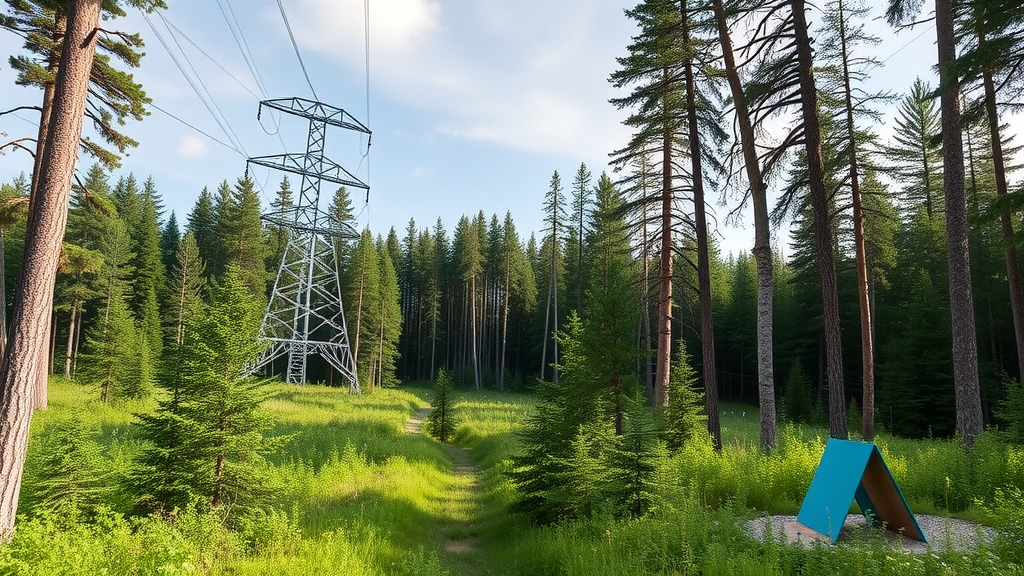
Power lines are among the most visible signatures of humanity’s appetite for electricity, slicing through forests in straight, treeless corridors that can stretch for hundreds of kilometers. A new study conducted across the vast hydropower network of Québec, Canada, reveals that these industrial clearings do far more than interrupt the forest canopy—they systematically reorganize the functional diversity of plant communities, with the strongest effects concentrated in a surprising place: the forest edge itself. The research, published in Environmental and Sustainability Indicators, offers one of the most comprehensive trait-based assessments of power line rights-of-way to date, and its findings carry implications for how utility companies manage vegetation beneath their lines.
Global electricity demand is growing at roughly twice the rate of overall energy demand, and the expansion of transmission networks shows no sign of slowing. While linear infrastructure is often associated with habitat loss and fragmentation, ecologists have increasingly recognized that power line corridors can act as novel habitats, supporting diverse plant communities and providing forage for pollinators such as bees and butterflies. What has been missing, the authors argue, is a mechanistic understanding of how these corridors shape vegetation—not simply how many species they contain, but what ecological strategies those species represent.
To address this gap, a research team led by Samuel Roy Proulx of Université du Québec à Chicoutimi, working with colleagues including Évelyne Thiffault, David Paré, Jean-François Boucher, Yann Chavaillaz, and Maude Larochelle, surveyed 18 power line rights-of-way across an enormous territory spanning roughly 205,000 square kilometers of Québec. Their sites ranged from the northern mixed forest biome in the south to the edge of the continuous boreal forest in the north, crossing four distinct bioclimatic domains and a mean annual temperature gradient from 4.6 °C down to −1.6 °C. Corridor widths ranged from 30 to 160 meters, and the lines had been installed at various points between 1927 and 2021.
At each site, the team laid out a transect of seven circular sampling plots running perpendicular to the corridor: three within the cleared right-of-way itself, two in the forest edge approximately 20 meters from the corridor margin, and two in control forest interiors about 60 meters away. Vegetation was surveyed in three strata—trees, shrubs, and forbs—using nested plots of different sizes, from 400-square-meter circles for mature trees down to one-square-meter quadrats for low-growing herbs. In total, the surveys recorded 139 plant species across the study area.
Rather than relying solely on species counts, the researchers assembled functional traits for each species, drawing on the TOP and TRY plant trait databases. The traits included specific leaf area, plant height, foliage persistence, flower color, inflorescence type, and flowering period—characteristics that together capture how plants respond to disturbance and how they might support pollinators. From these traits, the team calculated four complementary functional diversity indices: functional richness, which measures the volume of trait space occupied; functional evenness, which describes how evenly abundances are distributed within that space; functional dispersion, the mean trait distance of species from the community centroid; and Rao’s quadratic entropy, which combines abundance and functional differences. A Shannon diversity index provided a taxonomic benchmark for comparison.
The statistical analysis used linear mixed models with bioclimatic domain and site identity as random effects, and candidate predictors including corridor position, right-of-way width, installation year, topographic wetness, growing degree-days above 5 °C, seasonal precipitation, and soil clay and silt content. Model selection via the corrected Akaike Information Criterion produced a striking result: the position relative to the right-of-way, and its interaction with climatic variables, dominated the patterns—while the corridor’s own attributes, such as width and age, mattered far less than the researchers had hypothesized.
For the forb layer, forest edges emerged as functional hotspots. Every functional index except evenness peaked at the edge, followed by control forests, with corridors scoring lowest. Functional richness of forbs was strongly and positively related to growing degree-days interacting with position, with edge and forest predictions substantially exceeding corridor values as thermal sums increased. Functional evenness told a subtler story: within corridors, evenness remained stable as seasonal precipitation rose from 430 to 640 millimeters, whereas it declined sharply in edge and control forests over the same gradient. Rao’s quadratic entropy was roughly 63 percent higher at forest edges and 50 percent higher in control forests than in corridors.
The shrub stratum showed an even clearer positional signature. Functional evenness in corridors averaged 0.31 compared with 0.74 in control forests, and functional dispersion and Rao’s entropy were dramatically lower inside corridors—expected consequences of mechanical clearing that removes woody vegetation on a four-to-ten-year cycle to prevent electrical arcing and fire. Notably, corridor characteristics such as installation year and width had little explanatory power for shrub diversity, suggesting that the recurring management regime, rather than corridor history, is the dominant filter. For trees, which were entirely absent from corridors, the only significant effects were higher functional richness at edges with increasing degree-days and a decline in functional dispersion as corridor width increased from 30 to 91 meters—a hint that very wide clearings homogenize the surrounding forest’s tree communities.
Why did corridors, with their open, sun-drenched conditions, fail to show the highest functional diversity? The authors point to several mechanisms. Repeated cutting leaves behind accumulated trunks, branches, and twigs that can create suboptimal seedbeds for forbs, while decomposing woody debris and canopy openings elevate soil inorganic nitrogen, favoring a narrow set of nitrophilous species such as raspberry and strawberry. Recurrent disturbance may also act as an environmental filter, culling species whose traits do not tolerate regular removal and thereby compressing the community’s functional trait space even when species richness persists. Notably, the study found little evidence that corridors promote invasives: of the 139 species recorded, only six were exotic or invasive, and their mean cover across plots was a mere 0.52 percent.
The broader significance lies in what functional diversity implies for ecosystem services. Because floral traits such as flower color, inflorescence type, and flowering period are known predictors of pollinator communities, the high functional diversity of forbs and shrubs at forest edges suggests these transitional zones may offer particularly suitable pollinator habitat—consistent with European studies linking corridor vegetation traits to bee and butterfly diversity. The authors are careful to note that pollinators were not directly surveyed, so their results indicate habitat potential rather than demonstrated biodiversity support. Still, the message for land managers is clear: the forest edge, not the corridor interior, is where the richest functional vegetation persists, and management strategies that maintain diverse, low-growing communities while removing cut biomass could enhance the ecological value of these ubiquitous linear infrastructures across boreal and temperate forests.
Subject of Research: Vegetation functional diversity across power line rights-of-way, forest edges, and control forests in eastern Canadian boreal and temperate forests.
Article Title: Vegetation functional diversity along power line rights-of-way in eastern Canadian forests
Article References: Proulx, S. R., Thiffault, É., Paré, D., Boucher, J.-F., Chavaillaz, Y., & Larochelle, M. (2026). Vegetation functional diversity along power line rights-of-way in eastern Canadian forests. Environmental and Sustainability Indicators, 32, Article 101507. https://doi.org/10.1016/j.indic.2026.101507
Image Credits: AI Generated
DOI: 10.1016/j.indic.2026.101507
Keywords: functional diversity, power line rights-of-way, plant functional traits, boreal forest, forest edges, Québec, pollinator habitat, vegetation management, forbs, shrubs, boreal forest ecology, linear infrastructure
Cite Scienmag News
Sloane Callahan. (September 12, 2026). Power Line Corridors Reshape Plant Functional Diversity in Eastern Canadian Forests. Scienmag. https://scienmag.com/power-line-corridors-reshape-plant-functional-diversity-in-eastern-canadian-forests/
Sloane Callahan. "Power Line Corridors Reshape Plant Functional Diversity in Eastern Canadian Forests." Scienmag, 12 September 2026, https://scienmag.com/power-line-corridors-reshape-plant-functional-diversity-in-eastern-canadian-forests/. Accessed 5 October 2026.
Sloane Callahan. "Power Line Corridors Reshape Plant Functional Diversity in Eastern Canadian Forests." Scienmag. September 12, 2026. https://scienmag.com/power-line-corridors-reshape-plant-functional-diversity-in-eastern-canadian-forests/


