


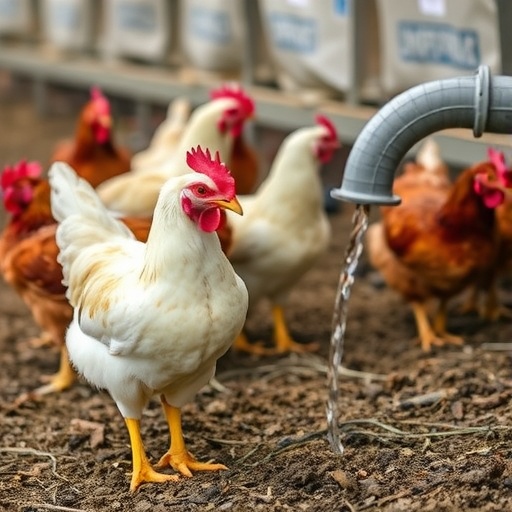
Water quality plays a crucial role in determining the microbial community within poultry drinking water lines, a recent study has revealed. The research, which was conducted by scientists from the Arkansas Agricultural Experiment Station and the Mississippi Agricultural and Forestry Experiment Station, highlights the significant implications this has for poultry health and safety. The study indicates that poor water quality not only affects the immediate health of the birds but may also lead to the formation of biofilms that can harbor pathogenic bacteria, such as Salmonella.
Biofilms, characterized as slimy layers consisting of carbohydrates, proteins, fats, and microbial communities, are known to develop in various environments, including the drinking water lines of poultry houses. Tomi Obe, the assistant professor of poultry science leading the study, explains that biofilm formation occurs regardless of the inherent quality of the water supplied to the poultry. This incessant development of biofilms calls for an increased understanding and monitoring of the microbial species residing within these colonies.
The researchers evaluated two groups of poultry houses in the study—one group had access to water with historically normal sulfur-iron levels, while the other group had water with significantly high sulfur-iron concentrations. The analysis resulted in no observable differences in the prevalence of Salmonella in the litter samples from the two groups; however, distinct differences were found in the microbial compositions present in the drinking water biofilms of the respective poultry houses. Notably, a probiotic species of Bacillus was more frequently found in the biofilms from houses with normal water quality, in contrast to a pathogenic Bacillus variant that dominated in those with high sulfur-iron levels.
Intriguingly, the researchers also observed that one farm exhibiting low Salmonella levels in its biofilm simultaneously displayed a higher quantity of Salmonella in its litter. This disparity challenges previous assumptions about water quality and its direct correlation with microbial health. Obe emphasizes the complexity of the interactions between water quality and microbial populations, suggesting that future research should focus on documenting the diverse microbial communities present in poultry drinking water supplies.
The need for effective biofilm management in poultry drinking water lines has never been more apparent. These biofilms are a crucial aspect of controlling Salmonella during the pre-harvest stage of poultry production. The findings suggest that despite regular monitoring of drinking water quality at the source, very few evaluations extend to the inside of the water pipelines, which serve as vital reservoirs for biofilm accumulation. If biofilms are not adequately addressed, the associated risks of pathogen colonization will remain a significant threat to poultry production.
The study underscores that maximum permitted levels for drinking water in poultry should be carefully adhered to. Existing guidelines recommend iron levels should be kept below 0.3 parts per million, and sulfates in drinking water should not exceed 200 parts per million. There may be detrimental effects on bird performance associated with water containing higher concentrations of calcium and magnesium, particularly observed in rural poultry farms that utilize well water. This situation is further exacerbated when considering the nutrient contributions that high levels of iron and manganese provide, facilitating the survival of certain pathogens in water systems.
Water plays an indispensable role in poultry diets, and the importance of routinely monitoring water lines cannot be overstated. Li Zhang, a co-author of the study, advocates for a proactive approach to ensure water quality and content is consistently evaluated to protect bird health and productivity. The study’s findings prompted the researchers to propose the implementation of “sight glasses”—translucent windows that will allow for visual observations of biofilms within pipelines, thereby enabling manual sampling and analysis of microbial content.
As the research continues to evolve, the scientists plan to conduct additional studies to identify both beneficial and harmful microbial species and their interactions within drinking water biofilms. The desire to develop proactive measures that can mitigate risks associated with pathogenic bacteria lies at the forefront of their ongoing research endeavors. The significance of water quality in poultry systems warrants ongoing discussion and collaboration within the agricultural community to protect the global food supply.
The combined efforts of researchers across institutions demonstrate a commitment to improving poultry health management practices through evidence-based research. The agricultural sector stands to benefit immensely from insights into the microbial dynamics present in water lines, particularly in preventing the proliferation of pathogens. These findings have the potential to incite a paradigm shift in how water quality is viewed and monitored on poultry farms.
Ultimately, the research conducted by the Arkansas Agricultural Experiment Station and Mississippi Agricultural and Forestry Experiment Station establishes a foundation for future studies aimed at understanding the relationship between water quality and microbial communities. As the poultry industry faces increasing challenges regarding food safety and pathogen control, the need for a refined approach to water quality monitoring becomes imperative. The impact of this research extends beyond immediate poultry production benefits, reflecting broader implications for food safety and human health.
Through continued research and innovation, experts are poised to develop new strategies that prioritize both the health of poultry and public safety. Ensuring that every aspect of poultry production, particularly water quality, is optimized for health and performance can help secure the future of poultry farming amidst growing global demands for safe and sustainable food sources.
Keywords
Water quality, microbial population, biofilm, poultry production, Salmonella, agricultural research, food safety, sustainable farming, pathogen control, fecal contamination, water line monitoring, poultry health.
Cite Scienmag News
William Thompson. (October 9, 2025). Poultry Producers: Have You Recently Inspected Your Water Lines? Scienmag. https://scienmag.com/poultry-producers-have-you-recently-inspected-your-water-lines/
William Thompson. "Poultry Producers: Have You Recently Inspected Your Water Lines?" Scienmag, 9 October 2025, https://scienmag.com/poultry-producers-have-you-recently-inspected-your-water-lines/. Accessed 4 September 2026.
William Thompson. "Poultry Producers: Have You Recently Inspected Your Water Lines?" Scienmag. October 9, 2025. https://scienmag.com/poultry-producers-have-you-recently-inspected-your-water-lines/


