

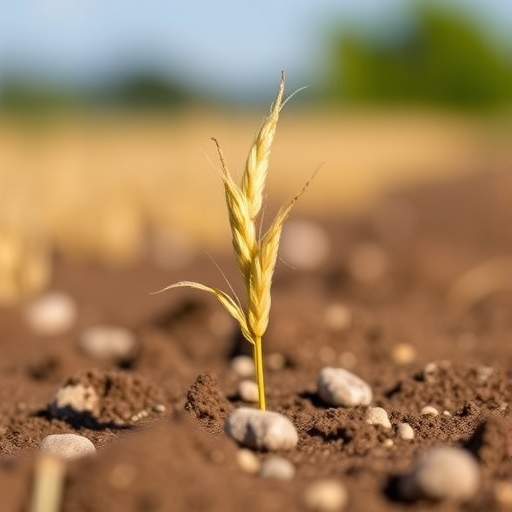
In a groundbreaking meta-analysis set to redefine agricultural practices worldwide, researchers Liang and Schlesinger have unveiled compelling evidence that potassium fertilization not only boosts cereal crop yields but also significantly enhances soil organic carbon content. Published in Nature Communications in 2026, this comprehensive study synthesizes data across numerous geographic regions and cropping systems, affirming potassium’s dual role in both crop productivity and long-term soil health—a discovery that could transform strategies for sustainable agriculture and climate mitigation.
The implications of these findings resonate profoundly amid escalating global food security challenges and the urgent need for sustainable soil management. Historically, potassium has been recognized for its critical role in plant physiology, regulating processes such as enzyme activation, water use efficiency, and photosynthesis. Yet, its influence on soil carbon dynamics has remained largely underexplored until now. Liang and Schlesinger’s meta-analysis integrates multiple datasets to demonstrate that potassium fertilization improves the stabilization and sequestration of organic carbon in soil, thus fostering fertile soil ecosystems while simultaneously increasing cereal yields.
Methodologically, the study harnessed a rigorous meta-analytical framework, aggregating results from over 80 field experiments worldwide. These trials spanned diverse climatic zones, soil types, and cereal species—including wheat, rice, and maize—providing a robust and globally representative dataset. By applying advanced statistical modeling, the researchers quantified the responses of both crop output and soil organic carbon stocks to varied potassium fertilization levels. This integrative approach allowed the identification of consistent trends that transcend regional and crop-specific variability, marking a significant advancement over individual experimental studies.
From an agronomic perspective, the enhancement of cereal yields under potassium fertilization is well justified by potassium’s physiological functions. Potassium facilitates the translocation of photosynthates from leaves to developing grains and contributes to the synthesis of adenosine triphosphate (ATP), essential for cellular energy. These processes underpin stronger plant growth, improved resistance to abiotic stresses such as drought, and more efficient nutrient uptake. The meta-analysis corroborates these mechanisms with empirical evidence, revealing yield increases ranging up to 25% depending on initial soil potassium status and fertilization rates.
Beyond crop production, the study’s revelations regarding soil organic carbon are perhaps even more consequential for environmental sustainability. Soil organic carbon is a pivotal indicator of soil health, influencing nutrient cycling, water retention, and microbial activity. Importantly, it acts as a major terrestrial carbon sink, sequestering atmospheric CO2 and thus mitigating climate change. Liang and Schlesinger identify that potassium fertilization fosters not only microbial and root biomass growth but also promotes soil aggregation, which protects organic matter from decomposition. Consequently, the meta-analysis reports an average increase of 12% in soil organic carbon content following potassium application.
These dual benefits stem from intricate soil-plant interactions. Potassium improves root architecture and exudation, enhancing microbial communities responsible for organic matter stabilization. Enhanced root biomass increases rhizodeposition—the release of organic compounds into the soil—which feeds soil microbiota and accelerates the formation of stable organo-mineral complexes. Improved soil aggregation, facilitated by potassium-driven microbial activity, physically shields organic carbon within soil microaggregates. Thus, potassium fertilization tangibly boosts the capacity of soils to act as a long-term carbon reservoir.
The research also elucidates spatial variability in potassium’s effects, accentuating the need for site-specific fertilization practices. Soils severely depleted in available potassium demonstrated the most pronounced yield and soil organic carbon gains. Conversely, in potassium-rich soils, the marginal benefits were comparatively modest, underscoring the importance of soil testing and precision agriculture techniques. As a result, the study advocates for tailored potassium management strategies to optimize agronomic and environmental outcomes while minimizing fertilizer overuse and potential negative ecological impacts.
Liang and Schlesinger’s findings arrive at a pivotal moment, as the global agricultural community grapples with the dichotomy of increasing food production and curbing environmental footprints. Conventional approaches often emphasize nitrogen and phosphorus fertilization, sometimes neglecting potassium’s critical yet nuanced role. This study brings potassium into sharper focus, advocating for its integration into nutrient management frameworks aimed at achieving higher yields sustainably and contributing to carbon sequestration goals aligned with international climate accords.
Furthermore, the study explores the economic viability of potassium fertilization. Enhanced yields translate into improved farmer incomes, especially in regions where cereal crops are staple foods and primary sources of livelihood. Simultaneously, long-term soil organic carbon enrichment can sustain soil fertility, reducing the need for costly inputs over time. This synergy of economic and ecological benefits reinforces potassium’s strategic importance in future-proofing agricultural systems, particularly in developing nations facing soil nutrient depletion and food insecurity.
In addition to the agronomic and ecological dimensions, the study highlights methodological advancements in meta-analysis applications. By systematically collating and harmonizing heterogeneous datasets—ranging from small plot trials to regional agronomic surveys—researchers have overcome previous limitations related to scale and comparability. The application of hierarchical statistical models enabled nuanced dissection of interacting factors, such as climate variability, management intensity, and soil type, offering a multidimensional understanding of potassium’s multifaceted impact.
The scale and rigor of the analysis also point toward emerging priorities for further research. The authors call for long-term experiments that can disentangle potassium’s effects on soil carbon fractions, microbial community structure, and nutrient cycling dynamics over decadal timescales. Such research could refine mechanistic models of soil carbon sequestration and establish guidelines for integrating potassium fertilization within broader soil health and climate action frameworks.
The study’s significance extends to policy realms as well. By providing robust quantitative evidence linking potassium management to both productivity gains and carbon sequestration, Liang and Schlesinger offer a compelling scientific basis for revising fertilizer recommendations and subsidies. Policymakers are urged to support potassium fertilizer accessibility and promote localized soil testing infrastructure, thereby enabling optimized application rates that balance agronomic efficiency with environmental stewardship.
Moreover, the findings have broader implications for global carbon accounting and agricultural sustainability metrics. Current estimates of soil carbon fluxes often neglect the modulating influence of potassium fertilization. Incorporating this variable into carbon budgeting could enhance the accuracy of greenhouse gas inventories and inform strategies for achieving net zero emissions in the agricultural sector.
At the intersection of science, agriculture, and environmental policy, this meta-analysis represents a decisive step forward. By uniting yield enhancement with soil carbon enrichment in a single nutrient management paradigm, Liang and Schlesinger’s work challenges conventional fertilization practices and opens new avenues for sustainable intensification. The message is clear: potassium is not just a crop nutrient but a pivotal lever for advancing global food security and climate resilience.
Farmers, agronomists, environmentalists, and policymakers worldwide stand to benefit from these insights. Bridging plant physiology with soil science and climate action, this research embodies the transdisciplinary approach necessary to confront the complex challenges of the 21st century. As the agriculture sector evolves amid changing climates and resource constraints, the legacy of this study will be its demonstration that sustainability and productivity are achievable in tandem through intelligent nutrient management.
In sum, the meta-analysis by Liang and Schlesinger reconfigures our understanding of potassium fertilization from a single-dimensional yield enhancer to a multifunctional agent promoting both agronomic success and environmental integrity. The dual uplift in cereal productivity and soil organic carbon storage heralds a new era of nutrient management—a paradigm where agricultural inputs carefully nurture the soil’s capacity to feed humanity and safeguard the planet concurrently. This pioneering research thus offers a beacon of hope for sustainably feeding a growing global population while simultaneously curbing the adverse impacts of modern agriculture on ecosystems and climate.
Subject of Research: Potassium fertilization effects on cereal crop yields and soil organic carbon dynamics.
Article Title: Potassium fertilization enhances both cereal yield and soil organic carbon: a meta-analysis.
Article References: Liang, G., Schlesinger, W.H. Potassium fertilization enhances both cereal yield and soil organic carbon: a meta-analysis. Nat Commun (2026). https://doi.org/10.1038/s41467-026-71154-z
Image Credits: AI Generated
DOI: 10.1038/s41467-026-71154-z
Keywords: potassium fertilization, cereal yield, soil organic carbon, meta-analysis, sustainable agriculture, soil health, carbon sequestration, nutrient management, crop productivity


