


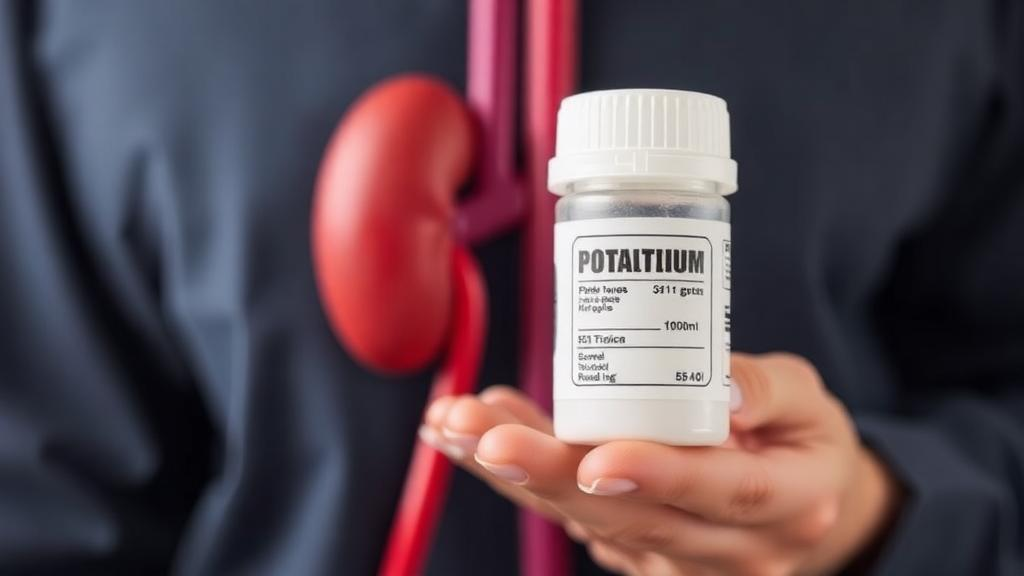
Millions of people living with both chronic kidney disease and heart failure face a frustrating clinical paradox: the very drugs that could save their hearts are often withheld or kept at low doses because they push potassium to dangerous levels in their blood. A new randomised, double-blind, placebo-controlled trial published in Nature Communications suggests a way out of this bind. Researchers led by Debasish Banerjee of St George’s University Hospitals NHS Foundation Trust and City St George’s University of London found that the potassium-lowering agent sodium zirconium cyclosilicate, known as SZC, allowed substantially more patients with reduced ejection fraction heart failure and stage 3 to 5 kidney disease to reach target doses of renin-angiotensin-aldosterone system inhibitors without developing hyperkalaemia. The results, presented in preliminary form at the World Congress of Nephrology 2025, offer one of the clearest demonstrations yet that a potassium binder can unlock full-dose guideline-directed therapy in this vulnerable population.
The biological problem at the heart of the trial is well known to cardiologists and nephrologists alike. Renin-angiotensin-aldosterone system inhibitors, or RAASi, which include angiotensin-converting enzyme inhibitors, angiotensin receptor blockers and mineralocorticoid receptor antagonists, are cornerstones of treatment for heart failure with reduced ejection fraction. They reduce mortality, slow disease progression and improve quality of life. Yet these drugs suppress aldosterone, the hormone that drives potassium excretion by the kidneys. In patients whose kidneys are already impaired, potassium clearance is compromised, and RAASi therapy can push serum potassium above the normal range. Hyperkalaemia is not a trivial side effect: levels of 5.6 mmol/L or higher can destabilise the cardiac rhythm and, in severe cases, trigger fatal arrhythmias. As a result, clinicians frequently down-titrate or discontinue these life-prolonging medications, leaving patients under-protected.
Sodium zirconium cyclosilicate belongs to a newer class of non-absorbed, inorganic crystalline agents designed to solve exactly this problem. Taken orally, the compound acts as a selective trap in the gastrointestinal tract, binding potassium ions throughout the intestinal lumen in exchange for hydrogen and sodium. Because it is not absorbed into the bloodstream, its effect is confined to the gut, where it lowers the amount of dietary and secreted potassium that would otherwise be absorbed. This mechanism effectively gives the gut a role as an auxiliary route of potassium elimination, compensating for the reduced renal excretion that characterises advanced chronic kidney disease. Earlier studies established that SZC can normalise serum potassium and maintain it in the normal range, but questions remained about whether that pharmacological effect would translate into genuine, sustained up-titration of RAASi therapy in real patients.
The new trial was designed to answer that question directly. The investigators enrolled 112 adults with heart failure with reduced ejection fraction and chronic kidney disease stages 3 to 5, all of whom had mildly elevated serum potassium between 5.0 and 5.5 mmol/L, a range high enough to make clinicians hesitant to intensify RAASi therapy. Participants were randomised in a one-to-one ratio to receive either SZC or a matching placebo. The trial ran for 14 weeks, during which the clinical team attempted to optimise each patient’s RAASi regimen toward guideline-recommended target doses. The primary outcome was deliberately stringent: a patient was counted as a success only if they achieved the target dose of RAAS inhibition without ever crossing the hyperkalaemia threshold of 5.6 mmol/L during the 14-week period. Failing either criterion, whether through under-dosing or through a potassium excursion, counted as not meeting the endpoint.
The results were striking. In the per-protocol analysis, which included the 43 of 53 participants in the SZC arm and 53 of 59 in the placebo arm who completed the protocol, 24 of 43 patients in the SZC group, or 56 percent, achieved target RAASi dosing without developing hyperkalaemia, compared with 15 of 53 patients, or 28 percent, in the placebo group. That difference was statistically significant, with a p value of 0.006. The intention-to-treat analysis, which included all 112 randomised participants regardless of protocol adherence, produced a nearly identical picture, with a p value of 0.007. Expressed as an odds ratio, patients receiving SZC were 3.16 times more likely to reach the target dose without their potassium climbing to 5.6 mmol/L or above, with a 95 percent confidence interval of 1.35 to 7.39 and a p value of 0.008.
Just as important as the efficacy signal was the safety profile. The investigators observed no significant differences in adverse events between the two groups, an encouraging finding given that the trial deliberately pushed RAASi doses upward in patients with substantially impaired kidney function. In a population where both under-treatment and potassium toxicity carry real risks, the absence of a safety penalty is what transforms a statistically significant result into a clinically actionable one. The trial was double-blind and placebo-controlled, meaning neither participants nor the treating team knew who was receiving the active binder, which protects the results from the placebo effects and ascertainment biases that can distort open-label potassium studies.
The trial’s design choices deserve attention because they reflect the practical realities of modern cardiology and nephrology. By setting the entry potassium range at 5.0 to 5.5 mmol/L, the investigators targeted the exact grey zone in which clinicians most often hesitate: potassium is technically above normal, but not yet at an emergency level. By requiring both dose optimisation and potassium safety within a 14-week window, the trial tested whether rapid optimisation, rather than slow, cautious titration over many months, is feasible. Speed matters in heart failure with reduced ejection fraction, because patients spend the intervening months at elevated risk of hospitalisation and death while their medication regimen remains incomplete. A strategy that compresses optimisation into weeks rather than quarters could meaningfully change the trajectory of the disease.
The implications extend beyond the individual patient. Under-prescription of RAASi therapy in patients with coexisting kidney disease is a widespread and persistent quality-of-care gap, documented across health systems worldwide. If a potassium binder can be deployed as a routine companion to RAASi up-titration, it gives clinicians a concrete tool to close that gap rather than simply an aspiration to prescribe better. The findings also feed into a broader shift in thinking about hyperkalaemia: rather than treating elevated potassium as an automatic stop sign for cardioprotective drugs, the field is increasingly exploring whether binders can convert hyperkalaemia from a barrier into a manageable laboratory abnormality. The trial’s primary endpoint, which demanded both full dosing and potassium safety, was constructed to test precisely that proposition.
Some caveats are worth bearing in mind. The trial enrolled 112 participants, a sample size that provides confidence in the primary endpoint but leaves room for uncertainty about rarer adverse events and about subgroups such as patients at different CKD stages within the 3-to-5 spectrum. The per-protocol populations were smaller still, with 43 and 53 participants respectively, and some participants did not complete the protocol. The study was funded by AstraZeneca through an Externally Sponsored Scientific Research grant, ESR-19-20174, although the funder had no contribution to the trial design, data collection, analysis or interpretation, and the study was conducted with independent trial steering and data safety monitoring committees. The corresponding author has disclosed speaker fees from AstraZeneca and Vifor Pharma. These disclosures are standard for industry-sponsored trials of an approved agent, but readers should weigh them when interpreting the results.
Nevertheless, the trial, registered as NCT05004363 on ClinicalTrials.gov and 2020-002946-18 in the EudraCT database, adds a rigorous randomised data point to a question that has long been answered only by observational evidence and expert opinion. For the large population of patients whose heart failure and kidney disease coexist, the message is concrete: with a modern potassium binder, full-dose RAAS inhibition appears achievable in a matter of weeks, with roughly double the success rate of placebo and no excess adverse events. The work, published open access under a Creative Commons licence and partially supported by the National Institute for Health and Care Research, points toward a future in which the kidneys’ limitations no longer dictate the ceiling of heart failure therapy. Confirmatory studies in larger and more diverse cohorts will determine how broadly this strategy should be adopted, but for now the trial offers a compelling proof of concept that the potassium barrier to optimal heart failure care can, in fact, be lowered.
Subject of Research: Use of the potassium binder sodium zirconium cyclosilicate to enable optimisation of renin-angiotensin-aldosterone system inhibitor therapy in patients with chronic kidney disease and heart failure with reduced ejection fraction
Article Title: Rapid Renin Angiotensin Aldosterone System inhibitor optimisation in patients with chronic kidney disease and heart failure with reduced ejection fraction using potassium binder: a randomised, double-blinded, placebo-controlled trial
Article References: Rapid Renin Angiotensin Aldosterone System inhibitor optimisation in patients with chronic kidney disease and heart failure with reduced ejection fraction using potassium binder: a randomised, double-blinded, placebo-controlled trial. (n.d.). https://doi.org/10.1038/s41467-026-78377-0
Image Credits: AI Generated
DOI: 10.1038/s41467-026-78377-0
Keywords: heart failure, chronic kidney disease, hyperkalaemia, sodium zirconium cyclosilicate, RAAS inhibitors, randomised controlled trial, potassium binder, cardiology, nephrology, drug titration, HFrEF, clinical trial
Cite Scienmag News
Jerry Hayes. (October 14, 2026). Potassium binder helps heart failure patients with kidney disease reach full drug doses. Scienmag. https://scienmag.com/potassium-binder-helps-heart-failure-patients-with-kidney-disease-reach-full-drug-doses/
Jerry Hayes. "Potassium binder helps heart failure patients with kidney disease reach full drug doses." Scienmag, 14 October 2026, https://scienmag.com/potassium-binder-helps-heart-failure-patients-with-kidney-disease-reach-full-drug-doses/. Accessed 14 October 2026.
Jerry Hayes. "Potassium binder helps heart failure patients with kidney disease reach full drug doses." Scienmag. October 14, 2026. https://scienmag.com/potassium-binder-helps-heart-failure-patients-with-kidney-disease-reach-full-drug-doses/


