


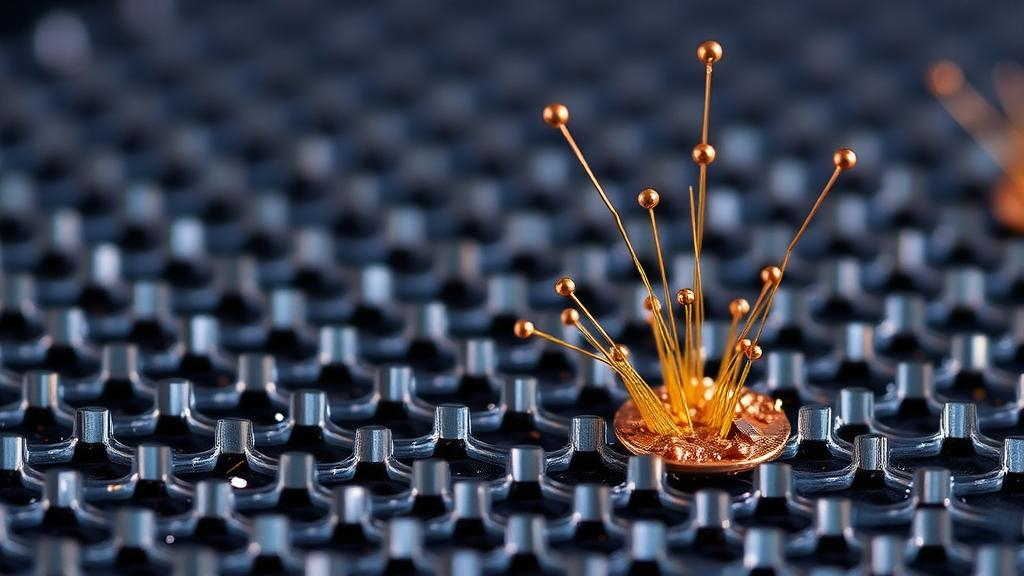
Potassium metal batteries have long promised a cheaper route to the energy densities that lithium-ion cells struggle to reach, but the metal anode at the heart of the technology has remained stubbornly unruly. Potassium deposits unevenly during charging, sprouting needle-like dendrites that can pierce separators and short-circuit cells, while the metal swells and shrinks so dramatically with each cycle that the electrode structure quickly falls apart. A new study published in the journal Ionics by Zengli Cui of Shanxi Polytechnic College in China reports a carefully engineered answer to both problems at once: a freestanding, three-dimensional porous host made of reduced graphene oxide decorated with copper nanoparticles, designed to coax potassium into depositing smoothly and safely.
The central idea behind the design is potassiophilicity, the chemical affinity a surface has for potassium. On ordinary copper foil current collectors, potassium ions are forced to nucleate at random, high-energy sites, and the resulting nuclei grow into protrusions that concentrate the local electric field, accelerating further growth in a runaway process. By scattering uniformly distributed copper nanoparticles across the conductive reduced graphene oxide framework, the new host provides abundant potassiophilic seeds that lower the nucleation barrier for potassium. Instead of a handful of dangerous hotspots, deposition begins at countless sites across the entire scaffold, spreading the metal into a flat, dense layer rather than a forest of spikes.
The three-dimensional architecture does the second half of the work. A flat foil offers almost no room for the potassium metal that accumulates during plating, so the electrode’s thickness changes violently with every cycle, cracking the solid electrolyte interphase and exposing fresh metal to the electrolyte again and again. The porous rGO/Cu host, by contrast, is riddled with interconnected pore space that acts as a reservoir for the deposited metal. The volume change is absorbed internally by the scaffold rather than expressed as a dimensional explosion at the electrode surface, which preserves the integrity of the interface over hundreds of cycles.
The porous network also improves the speed of the chemistry. Because potassium ions can travel through continuous channels and electrons can move along the conductive graphene backbone, the interface reaction kinetics are substantially accelerated. That matters most at high charging and discharging rates, where ion transport bottlenecks usually force metal to pile up at the electrode surface. The study reports that the host achieves outstanding rate capability, meaning the electrode can still deliver and accept potassium quickly without losing efficiency or stability.
The electrochemical results are striking. When two identical potassium-loaded electrodes were faced off in a symmetric cell, the rGO/Cu@K configuration cycled for more than 800 hours at a current density of 0.5 milliamperes per square centimeter and an areal capacity of 0.5 milliampere-hours per square centimeter. For a potassium metal anode, sustaining stable plating and stripping for that long at those conditions is a meaningful benchmark, since symmetric cells are the standard proving ground for anode reversibility and typically fail early when dendrites or dead metal accumulate.
Even more telling is the performance in a full battery. Cui paired the potassium-infused host with PTCDA, an organic cathode material, and the resulting cell retained 89.3 percent of its capacity at a demanding 20C rate, which corresponds to charging or discharging in roughly three minutes. Organic cathodes like PTCDA are attractive because they are lightweight and made from abundant elements, but they only shine in a practical cell if the anode can keep pace with fast cycling. The result suggests the host’s kinetic advantages carry through to complete devices, not just laboratory half-cells.
The work sits within a rapidly growing field. Potassium is far more abundant in the Earth’s crust than lithium, and its standard electrode potential is close enough to lithium’s that potassium metal anodes can, in principle, deliver high voltages at low cost. The obstacle has always been the metal itself: potassium is more reactive and its ions are larger and more mobile in electrolytes, making dendrite formation and interfacial instability even harder to control than in lithium systems. Recent years have seen a wave of strategies, including electrolyte additives that build protective fluoride-rich interphases, single-atom catalysts that guide ion migration, ferroelectric nanofiber composites, and alloy seeds such as copper-tin compounds embedded in current collectors.
What distinguishes the rGO/Cu approach is its combination of simplicity and completeness. Many reported hosts address either nucleation or volume change but not both, and some rely on complex synthesis or exotic materials. Here, the potassiophilic copper nanoparticles handle nucleation, the graphene framework handles conductivity and mechanical resilience, and the porosity handles storage volume, all in a freestanding structure that eliminates the need for a separate metal foil current collector. Removing the foil also trims dead weight from the cell, a small but meaningful gain on the path toward practical energy density.
The broader significance lies in what stable potassium metal anodes would unlock. Potassium metal batteries could complement lithium-ion technology in grid storage and other applications where cost per kilowatt-hour matters more than absolute energy density, and they could serve as a bridge toward potassium-ion chemistries that avoid scarce cobalt and nickel. Every demonstration of a dendrite-free anode that survives realistic cycling conditions narrows the gap between promising laboratory results and manufacturable cells. The 800-hour symmetric cell lifetime and the high-rate retention in a full battery are exactly the kind of paired evidence needed to convince engineers that the approach is more than a laboratory curiosity.
Challenges remain before such hosts reach commercial production. Scaling the synthesis of uniformly decorated reduced graphene oxide scaffolds, controlling their thickness and pore distribution at industrial dimensions, and integrating them with the electrolytes and cathodes of full cells all require further work, and the study itself does not report long-term data at the higher current densities that fast-charging applications would demand. Still, the design logic is clear and transferable: give the metal a welcoming place to land, give it room to grow, and give the ions a fast path to reach it. If that recipe proves durable at scale, the humble copper nanoparticle may end up playing an outsized role in the next generation of affordable, high-energy batteries.
Subject of Research: Potassiophilic three-dimensional rGO/Cu hosts for dendrite-free potassium metal battery anodes
Article Title: A potassiophilic and three-dimensional porous rGO/Cu freestanding host for dendrite-free K metal anodes
Article References: Cui, Z. (2026). A potassiophilic and three-dimensional porous rGO/Cu freestanding host for dendrite-free K metal anodes. Ionics. https://doi.org/10.1007/s11581-026-07555-3
Image Credits: AI Generated
DOI: 10.1007/s11581-026-07555-3
Keywords: potassium metal batteries, dendrite-free anodes, reduced graphene oxide, copper nanoparticles, potassiophilicity, 3D porous host, solid electrolyte interphase, PTCDA cathode, energy storage, electrodeposition, Coulombic efficiency, battery anodes
Cite Scienmag News
Neil Sanderson. (October 3, 2026). Porous Graphene-Copper Host Tames Dendrites in Potassium Metal Batteries. Scienmag. https://scienmag.com/porous-graphene-copper-host-tames-dendrites-in-potassium-metal-batteries/
Neil Sanderson. "Porous Graphene-Copper Host Tames Dendrites in Potassium Metal Batteries." Scienmag, 3 October 2026, https://scienmag.com/porous-graphene-copper-host-tames-dendrites-in-potassium-metal-batteries/. Accessed 4 October 2026.
Neil Sanderson. "Porous Graphene-Copper Host Tames Dendrites in Potassium Metal Batteries." Scienmag. October 3, 2026. https://scienmag.com/porous-graphene-copper-host-tames-dendrites-in-potassium-metal-batteries/


