


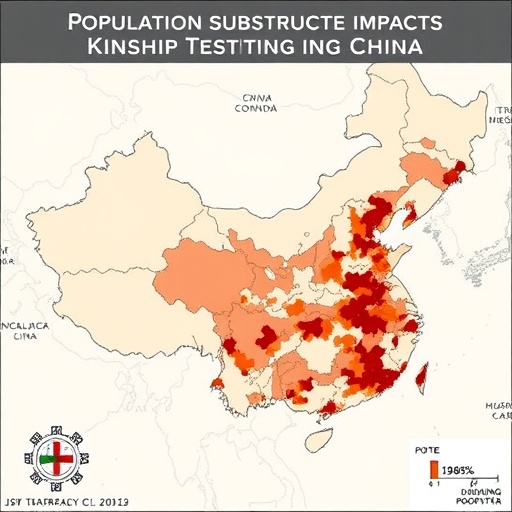
In a striking revelation with far-reaching implications for forensic science and legal medicine, a recent correction published in the International Journal of Legal Medicine highlights the critical impact of population substructure on kinship testing in China’s multi-ethnic regions. This development addresses unforeseen challenges faced by forensic experts when analyzing genetic relationships in populations characterized by intricate ethnic mosaicism. The correction not only underscores the complexity inherent in genotyping diverse genetic pools but also prompts reconsideration of standardized kinship methodologies that previously seemed universally reliable.
At the heart of this correction lies the nuanced concept of population substructure—an often overlooked yet fundamentally important factor in genetic analyses. Population substructure refers to the presence of distinct subpopulations within a larger population, each with differing allele frequencies due to historical, geographical, or social boundaries. In the context of China’s multi-ethnic demography, which includes 56 officially recognized ethnic groups, this substructure dramatically influences genetic data interpretation and, consequently, the accuracy of kinship tests used in forensic and legal contexts.
Historically, kinship testing, crucial for identifying biological relationships during criminal investigations, inheritance disputes, and disaster victim identification, relied heavily on assuming a relatively homogenous population genetic structure. However, such assumptions prove inadequate in multi-ethnic settings where allelic variation is structured unevenly due to differing ancestral lineages. As this correction elucidates, failure to account for these substructures can lead to erroneous conclusions, including false inclusion or exclusion of individuals as relatives, posing serious ramifications for justice and social integrity.
The correction shines light on the specific technical challenges posed by population substructure. It reveals that conventional kinship algorithms, which typically implement likelihood ratio tests based on allele frequency databases, may be biased if the underlying population structure is not properly integrated into models. The authors detail modifications to kinship likelihood calculations, incorporating subpopulation allele frequencies to enhance robustness and reduce both Type I and Type II errors in kinship inference amid genetic heterogeneity.
Moreover, this updated approach necessitates comprehensive genetic sampling from different ethnic groups to build a reliable, structured allele frequency database reflective of China’s demographic complexities. Such a database will significantly refine the precision of forensic kinship assessments, particularly in multi-ethnic border regions where admixture and gene flow blur genetic boundaries. These technical upgrades offer the forensic community novel frameworks and statistical tools optimized for high-resolution kinship testing compatible with real-world genetic diversity patterns.
Intriguingly, this correction also emphasizes the socio-cultural dimensions intertwined with genetic forensics. In multi-ethnic societies, misclassification or inaccuracies in kinship testing may exacerbate ethnic tensions, undermine public trust in forensic institutions, and possibly inflict miscarriages of justice that disproportionately affect minority populations. Hence, integrating population substructure considerations is not merely a technical imperative but also a societal one, fostering more equitable and culturally aware forensic practices.
The corrected study uses advanced genotyping and statistical modeling techniques, including Bayesian inference and principal component analysis, to dissect the genetic architecture underlying population substructure effects. These methods unveil subtle but impactful genetic differentiations that significantly alter kinship likelihood assessments compared to unstructured models. As a result, forensic geneticists are encouraged to adopt multilayered analytical pipelines that transcend simplistic assumptions, ushering in a new era of nuanced legal-medical genetics.
Beyond China’s borders, this correction sets a precedent for other multi-ethnic regions worldwide grappling with similar forensic challenges. Countries with complex demographic histories, such as India, Brazil, and various African nations, may derive valuable lessons and technical blueprints from this work. By highlighting the pitfalls of ignoring subpopulation genetics, the correction advocates a paradigm shift toward more regionally tailored kinship testing protocols that accommodate genetic complexity without compromising accuracy.
The broader implications extend into policy-making and forensic science education. Regulatory bodies responsible for setting kinship testing standards may need to revise guidelines to mandate population-specific validation studies and incorporate substructure considerations. Simultaneously, forensic curricula must evolve to train practitioners in understanding and modeling genetic substructure, ensuring future experts are equipped to navigate these complexities expertly and ethically.
Technological advancements, particularly next-generation sequencing and machine learning algorithms, complement the approaches recommended in this correction. These innovative tools enable more granular genetic differentiation and pattern recognition, providing a fertile ground for the development of next-level kinship testing techniques that can dynamically adjust to population substructure variability. The synergy between such technologies and refined statistical models promises unprecedented accuracy and confidence in forensic kinship determinations.
This correction also resonates with ongoing debates about the limitations and potential biases in forensic genetics. It confronts previously implicit assumptions about population homogeneity and challenges researchers and practitioners to critically reassess established methodologies. The correction thereby fosters a culture of scientific rigor and openness, essential for the continuous improvement of forensic sciences in an increasingly diverse global society.
From a practical standpoint, forensic laboratories and legal authorities confronting kinship disputes in multi-ethnic contexts must reconsider casework interpretations. The correction implies that when ethnicity or population origin is uncertain or mixed, kinship test results should be scrutinized with population substructure-informed frameworks to prevent misjudgments. Such vigilance is vital to uphold the integrity of legal outcomes and maintain public trust in forensic evidence.
Finally, the correction heralds a future where kinship testing is not constrained by oversimplified genetic models but instead embraces the intricate realities of human genetic diversity. It ushers in an era characterized by precision forensic medicine that respects and incorporates ethnic complexities, ultimately enhancing the fairness and reliability of legal processes worldwide. As forensic genetics continues to evolve, acknowledging and addressing population substructure will remain paramount.
In sum, this new correction to the study on the effects of population substructure on kinship testing serves as a seminal reminder of the complexities underlying genetic analysis in heterogeneous populations. It provides a rigorous and methodologically sound response to an urgent forensic challenge, offering pathways to improved accuracy, fairness, and scientific integrity in kinship determination. The forensic science community stands at the cusp of transformative progress, driven by insights from this pivotal work.
Cite Scienmag News
Juliet Wilcox. (October 8, 2025). Population Substructure Impacts Kinship Testing in China. Scienmag. https://scienmag.com/population-substructure-impacts-kinship-testing-in-china/
Juliet Wilcox. "Population Substructure Impacts Kinship Testing in China." Scienmag, 8 October 2025, https://scienmag.com/population-substructure-impacts-kinship-testing-in-china/. Accessed 3 September 2026.
Juliet Wilcox. "Population Substructure Impacts Kinship Testing in China." Scienmag. October 8, 2025. https://scienmag.com/population-substructure-impacts-kinship-testing-in-china/


