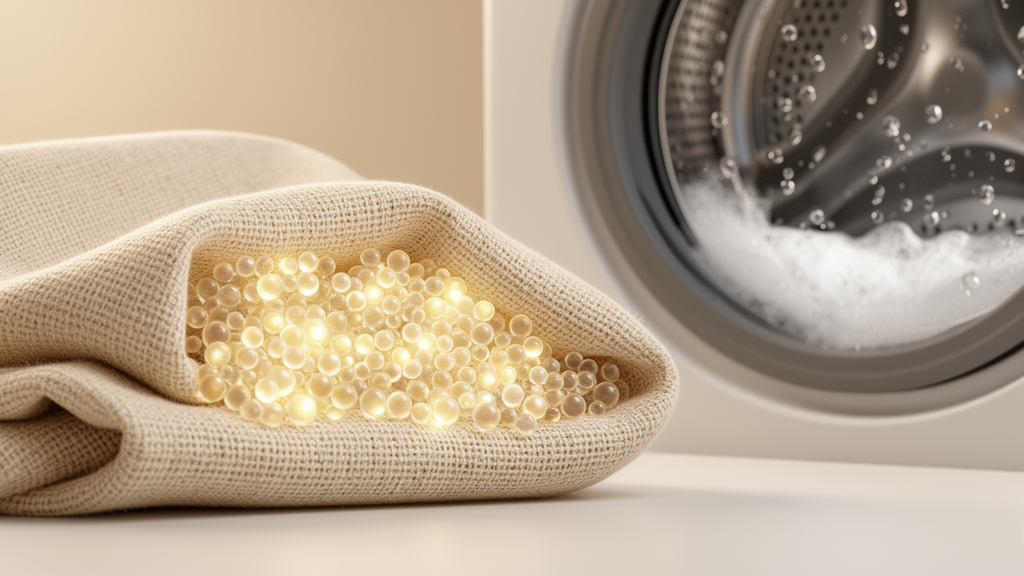
Textiles that do more than cover the body are quietly becoming a major industry. Fabrics engineered to block ultraviolet radiation, kill bacteria, repel mosquitoes, resist flames or release a fragrance all depend on a shared trick: tiny capsules of active compound anchored to the fibers. A new review published in the journal Discover Polymers surveys how polysaccharide polymers, the carbohydrate chains drawn from plants, animals, algae and microbes, serve as the wall materials for these micro- and nanocapsules, and why the durability of the resulting finishes during repeated washing remains the field’s central obstacle.
The commercial stakes are substantial. According to market figures cited in the review, functional textiles were valued at USD 43.8 billion in 2025 and are projected to grow at a compound annual growth rate of 7.2 percent between 2026 and 2034, driven by demand from healthcare, sportswear, protective apparel and home textiles. Many of the features buyers pay for rely on micro- or nanoencapsulation, in which a core of active agent is surrounded by a polymeric shell. The capsule shields the payload from heat, moisture and oxidation, enables controlled release, and can be chemically bonded to the textile fiber to extend its working life.
The size of the capsule matters. Microcapsules span roughly 1 to 1000 micrometers, while nanocapsules range from 10 to 1000 nanometers. Because of their smaller dimensions, nanoparticles offer higher interaction potential, better penetration into fibers and more controlled release than their microscale counterparts. Polysaccharides are attractive wall materials because they are compatible with many actives, nontoxic and biodegradable. The review catalogs the main options: starch, pectin and cellulose from plants; chitin, chitosan and hyaluronic acid from animals; alginate and carrageenan from algae; and xanthan gum, pullulan and bacterial cellulose from microorganisms. Choosing among them means balancing protection, processability and the intended function.
Antimicrobial finishes are the most prominent application. Textiles, particularly those made of natural fibers, are vulnerable to microbial growth that causes odor, staining, discoloration and loss of mechanical strength. Capsule systems can control the release of antimicrobial agents, improve their distribution, lower required dosages and help minimize toxicity. Essential oils such as tea tree oil and thymol are volatile and light sensitive, so encapsulation prolongs their shelf life. Some wall polymers are themselves active: chitosan can disrupt the negatively charged membranes of bacteria, an effect maximized by the large surface area of micro- and nanoparticles, while alginate dressings absorb excess fluid, maintain a moist wound environment and help limit bacterial infection.
Insect repellent textiles address a serious public health need in tropical and subtropical regions where dengue, chikungunya, yellow fever and malaria are transmitted by mosquitoes. Synthetic repellents such as DEET, picaridin and permethrin perform well but raise concerns about biological resistance, toxicity to non-target organisms and skin reactions, especially in children, which has pushed research toward natural alternatives like lemongrass, litsea, lemon, rosemary and neem oils. Encapsulation limits the evaporation and diffusion of these repellents, providing controlled release and longer-lasting activity, and studies cited in the review report that repellents encapsulated in ethyl cellulose, arabic gum and acacia gum showed higher protection rates, durability and wash resistance than unencapsulated formulations.
Flame retardancy and ultraviolet protection illustrate how the capsule wall can contribute chemically, not just as a passive barrier. The carbon backbone and multi-hydroxyl groups of polysaccharides promote formation of a char layer when fabric is exposed to fire, blocking oxygen and heat from reaching the fiber; chitosan additionally releases gases such as ammonia at high temperature, expanding the protective layer as a blowing agent. For UV protection, zinc oxide and titanium dioxide nanoparticles physically block UVA and UVB radiation but tend to agglomerate, producing uneven finishes; polysaccharide encapsulation stabilizes them, and in the case of titanium dioxide also shields the fabric from photocatalytic damage. Encapsulated organic filters benefit too: ethylcellulose nanocapsules carrying the filter 2-ethylhexyl 4-dimethylaminobenzoate gave cotton an ultraviolet protection factor of 45, while Vitis vinifera microcapsules in sodium alginate and carrageenan reached a UPF of 150 on cotton, falling to 111 after 20 washing cycles, still classified as excellent.
Cosmetotextiles, which transfer cosmetic agents such as moisturizers, vitamins, anti-aging compounds and fragrances to the skin, depend heavily on release kinetics. Fragrance capsules need shells tough enough to break gradually under friction between fabric and skin, while other actives can be released when the polysaccharide swells in contact with sweat. Chitosan stands out here because it degrades under the mildly acidic conditions of skin, around pH 5.5, allowing gradual release, and its positive surface charge enhances interaction with the skin barrier. The review also highlights multifunctional systems: chitosan and gum arabic microcapsules with lemongrass oil gave cotton-polyester blends antibacterial activity, aroma release and 88 percent mosquito repellency before washing, dropping to 59 percent after 30 cycles, while chitosan-silica hybrid capsules with peppermint oil combined antimicrobial action against Escherichia coli and Staphylococcus aureus with a UPF near 70.
How the capsules are made and attached determines whether any of this survives the laundry. Encapsulation methods fall into three groups. Physical methods such as spray drying and freeze drying are cost-effective and scale well; spray drying is the preferred route for industrial production, and gum acacia and maltodextrin are common carriers, with citronella oil encapsulated in gum acacia for cosmetic textiles reaching efficiencies above 92 percent. Physicochemical methods include simple and complex coacervation, ionic gelation and layer-by-layer electrostatic deposition, driven by changes in pH, temperature and ionic strength. Complex coacervation typically pairs oppositely charged polymers such as chitosan and gum arabic, and ionic gelation exploits the crosslinking of alginate with calcium ions or chitosan with sodium tripolyphosphate. Chemical methods such as interfacial polymerization demand tighter process control and are less commonly used.
On the fabric, padding remains the dominant industrial technique: the textile is immersed in a capsule suspension, squeezed between rollers to set the pick-up, dried at 100 to 120 degrees Celsius and, in the pad-dry-cure process, fixed at 130 to 160 degrees Celsius. Exhaustion, spraying and coating methods such as screen printing offer alternatives. Durability, however, hinges on fixation chemistry. Cross-linking creates covalent bonds between capsules and fibers and is among the most effective strategies; the polycarboxylic acid BTCA esterifies both the capsule wall and cellulose, with sodium hypophosphite as catalyst lowering the required curing temperature of 160 to 180 degrees Celsius. Citric acid offers a cheaper, food-grade alternative but tends to yellow the fabric. Binders based on acrylics, polyurethanes and silicones provide simpler adhesion but risk blocking release if too strong and wash out if too weak. Microwave and ultraviolet curing are emerging as gentler options: microwave-treated chitosan finishes showed enhanced antibacterial activity and less mechanical strength loss than conventionally cured samples, and UV fixation of ethylcellulose microcapsules containing beta-carotene outperformed thermal fixation in antioxidant tests.
Even with good chemistry, particle size and fabric structure set the limits. One study found maximum impregnation on cotton when the mean capsule diameter matched the fiber diameter of roughly 25 to 30 micrometers; very small capsules were retained poorly and released their contents too quickly, while large ones deposited unevenly. Fiber type matters as well, with cotton and viscose showing distinct retention of chitosan and zinc oxide after 10 washing cycles, and tighter knitted constructions holding finishes better than looser ones. Multilayer and layer-by-layer coatings, along with plasma treatment that activates hydrophobic polyester surfaces by introducing polar groups, extend durability further. The review’s authors argue that wash resistance over a maximum of 20 cycles is currently the main benchmark, but that future work should also test friction, domestic drying heat and ironing, alongside the regulatory and toxicological safety of nanocapsules intended for prolonged skin contact. As formaldehyde-based capsule shells face replacement on toxicity grounds and synthetic polymers add to microplastic pollution, polysaccharide systems, the authors conclude, offer a route to functional textiles that are effective, durable and environmentally defensible, provided the whole process, from cross-linker to curing method, is designed with sustainability in mind.
Subject of Research: The use of polysaccharide polymers as encapsulation matrices for functional textile finishes and their wash durability
Article Title: Polysaccharide polymers as encapsulation matrices in functional textiles: a review
Article References: de Souza Santana, M. H., da Silva, L. S., Mari, R. P., Ferreira, S., da Costa, C., & Bierhalz, A. C. K. (2026). Polysaccharide polymers as encapsulation matrices in functional textiles: a review. Discover Polymers, 3(1), Article 26. https://doi.org/10.1007/s44347-026-00066-4
Image Credits: AI Generated
DOI: 10.1007/s44347-026-00066-4
Keywords: functional textiles, polysaccharides, microencapsulation, nanoencapsulation, chitosan, alginate, textile finishing, wash durability, cross-linking, essential oils, sustainability, coacervation
Cite Scienmag News
Bethany Barker. (October 28, 2026). Polysaccharide Capsules Could Make Functional Textiles Survive the Wash. Scienmag. https://scienmag.com/polysaccharide-capsules-could-make-functional-textiles-survive-the-wash/
Bethany Barker. "Polysaccharide Capsules Could Make Functional Textiles Survive the Wash." Scienmag, 28 October 2026, https://scienmag.com/polysaccharide-capsules-could-make-functional-textiles-survive-the-wash/. Accessed 30 October 2026.
Bethany Barker. "Polysaccharide Capsules Could Make Functional Textiles Survive the Wash." Scienmag. October 28, 2026. https://scienmag.com/polysaccharide-capsules-could-make-functional-textiles-survive-the-wash/