

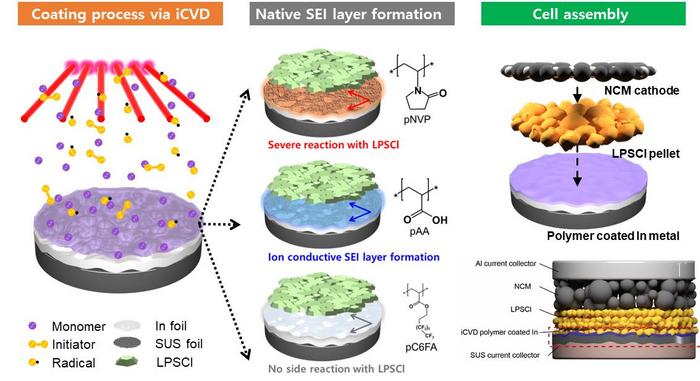
People have various relationships in society including those with family, friends, and coworkers. While these relationships play a significant role in our lives, it’s crucial to maintain a healthy distance as being too close can lead to intense emotions or conflicts. Interestingly, a recent study in the field of chemistry demonstrates that maintaining such distance can enhance battery performance in electric vehicles.

Credit: POSTECH
People have various relationships in society including those with family, friends, and coworkers. While these relationships play a significant role in our lives, it’s crucial to maintain a healthy distance as being too close can lead to intense emotions or conflicts. Interestingly, a recent study in the field of chemistry demonstrates that maintaining such distance can enhance battery performance in electric vehicles.
In this research, Professor Soojin Park, Dr. Sungjin Cho and Youngjin Song, a PhD student, from the Department of Chemistry at Pohang University of Science and Technology (POSTECH) in collaboration with the team of Professor Sung Gap Im from the Department of Chemical and Biomolecular Engineering at Korea Advanced Institute of Science and Technology (KAIST) successfully developed a polymeric protective film that enables safe operation of the anode in sulfide-based all-solid-state batteries. Their research was recently published in the online edition of the international journal Advanced Functional Materials.
The competitiveness of electric vehicles hinges on their range and charging speed, both of which are directly influenced by battery performance. This is why battery research is currently so intensive. Stability is also crucial, and the lithium (Li) ion batteries currently on the market, which use a liquid electrolyte and polymer separator, are susceptible to temperature variations and external impacts.
To address these issues, all-solid-state batteries with solid electrolytes, which can function as both a liquid electrolyte and a polymer separator, have recently been developed. Sulfide-based solid electrolytes have high ionic conductivity (2.5×10⁻² S/cm), making the battery assembly process very simple. However, the interface between the electrode active material and the electrolyte is chemically and electrochemically unstable, leading to increased internal resistance and reduced battery performance.
To solve this issue, the team introduced polymeric materials to prevent direct contact between the anode and the electrolyte in batteries. Using the initiated chemical vapor deposition (iCVD) process, they created a uniform 100 nm (nanometer) thick anode coating film from 8 different polymers with varying polarities.
The team assessed the interfacial stability and battery performance using these 8 polymeric thin films for anode coating. The results demonstrated that thin films made of polymers containing -COOH and C-F bonds (pAA, pC6FA) significantly improved the interfacial stability between the all-solid-state battery anode and electrolyte. All-solid-state batteries utilizing this approach exhibited a high-capacity retention rate (pAA: 64.8%, pC6FA: 50.7%) after more than 100 cycles, a notable improvement over the 29.0% capacity retention rate of conventional all-solid-state batteries without anode coating.
To date, there has been limited research on these polymeric materials in sulfide-based all-solid-state batteries, making this research significant as it reveals the interaction between the polymeric materials and the sulfide solid electrolyte.
Professor Soojin Park of POSTECH stated, “We have demonstrated new potential in enhancing the long-term stability of sulfide-based all-solid-state batteries.” He added, “This work represents a major turning point in the research of sulfide all-solid-state batteries, the next generation of battery technology.”
The research was conducted with support from a project of Korea Planning & Evaluation Institute of Industrial Technology (KEIT) under the Ministry of Trade, Industry and Energy.
Journal
Advanced Functional Materials
Article Title
Functional Polymer Thin Films for Establishing an Effective Electrode Interface in Sulfide-Based Solid-State Batteries
Article Publication Date
26-Apr-2024

