


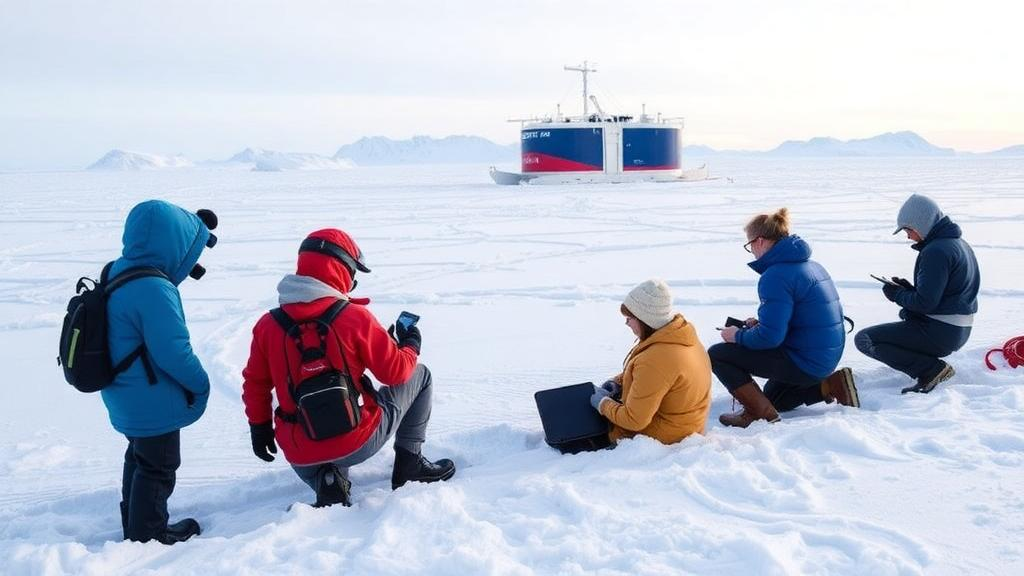
The polar regions are warming at rates two to four times higher than the global average, and the consequences are rippling far beyond the ice. Rising temperatures in the Arctic and Antarctic are reshaping ecosystems, destabilizing coastlines, altering ocean circulation, and redrawing geopolitical maps as nations and industries turn their attention to newly accessible waters and resources. For the scientists whose careers will span the fifth International Polar Year in 2032 to 2033, this is not a distant problem but the defining context of their professional lives. A new perspective article published in PLOS Climate argues that if the next International Polar Year is to deliver meaningful benefits, the research community must fundamentally rethink what counts as impact and how responsible research practices are embedded at every level of polar science.
The article, authored by a team of Polar Early Career Researchers including Samuel G. Hartharn-Evans, Chloe Nunn, Amy Macfarlane, and colleagues, draws on interdisciplinary workshops held in 2025 at the Polar Early Career World Summit in the United States and at the UK Centre for Ecology and Hydrology. The authors argue that prevailing definitions of research impact prioritize narrow, quantifiable metrics such as publication counts, citation indices, and short-term policy citations, while overlooking cultural, environmental, and long-term consequences of scientific work in the polar regions. Their central claim is that the frameworks used to evaluate polar research are poorly suited to the scale, urgency, and ethical complexity of the changes underway, and that the run-up to the next International Polar Year offers a rare institutional moment to correct course.
The International Polar Year has a storied history. The first, in 1882 to 1883, coordinated observations across the circumpolar world; the fourth, in 2007 to 2008, mobilized tens of thousands of researchers from more than 60 countries and produced landmark advances in ice sheet science, oceanography, and climate reconstruction. The fifth International Polar Year, scheduled for 2032 to 2033, will mark the 150th anniversary of the first effort and is expected to be the largest coordinated polar research campaign ever attempted. The early career authors argue that this scale brings with it an equally large responsibility: the choices made now about funding structures, research protocols, and impact evaluation will shape the scientific and ethical legacy of the entire endeavor.
At the heart of the paper is a critique of how impact is measured. Traditional metrics reward outputs that are easy to count, such as papers in high-impact journals, datasets deposited in repositories, and media mentions. But in polar contexts, the authors contend, this accounting misses the most consequential dimensions of research. A project that generates dozens of publications may nonetheless impose burdens on Indigenous communities in the Arctic if it extracts knowledge without consent or reciprocity. Field campaigns that fly research aircraft and ship personnel across the globe carry substantial carbon footprints, meaning the act of studying a warming polar region can itself contribute to the warming. Long-term environmental monitoring, which may yield few immediate publications but is essential for detecting slow-onset changes, is systematically undervalued by metrics that reward speed and volume.
To address these failures, the authors propose a redefinition of research impact for polar science that explicitly incorporates cultural, environmental, and long-term consequences alongside conventional academic outputs. This reframing is not merely semantic. If funding agencies and institutions adopt broader definitions of impact, they can reward practices that are currently penalized or ignored: co-producing research questions with northern communities, investing in sustained observation programs, choosing lower-emission field methods, and training the next generation in ethical engagement. The authors argue that impact should be understood as a relationship between research and society that unfolds over decades, not a transaction completed at the moment of publication.
The paper organizes its recommendations across three levels of action. At the level of the individual researcher, the authors call for reflexivity, meaning the deliberate examination of one’s own position, assumptions, and the potential consequences of one’s methods. They urge early career scientists to promote interdisciplinarity, bringing together natural sciences, social sciences, and Indigenous knowledge systems, and to implement environmentally responsible methods in fieldwork and logistics. Practical examples include consolidating field campaigns to reduce travel emissions, using remote sensing and autonomous platforms where they can substitute for personnel-intensive expeditions, and designing sampling protocols that minimize disturbance to sensitive ecosystems and wildlife.
At the regional and national level, the authors direct their recommendations at the institutions that fund and govern polar research. They argue that these bodies must provide equitable funding, ensuring that researchers from less wealthy nations and from Indigenous communities are not excluded from participation by financial barriers. They must also invest in training that equips researchers with the skills for ethical, interdisciplinary, and environmentally responsible practice, and they must adopt inclusive protocols that recognize diverse forms of knowledge and require meaningful engagement with local and Indigenous partners. Without such structural changes, the authors warn, individual good intentions will remain isolated and ineffective, because career incentives and funding criteria will continue to reward the very practices the community seeks to change.
The third level concerns the international planning bodies coordinating the fifth International Polar Year. The authors recommend that these organizations strengthen communication across national programs and disciplinary boundaries, publish clear guidelines on responsible research practices, and implement regulations designed to prevent exploitative practices. The polar regions have seen growing concerns about scientific colonialism, in which researchers from wealthy institutions extract data and samples from the Arctic without lasting benefit to the communities who live there, and about the potential for the next International Polar Year to amplify such dynamics if left unregulated. The authors argue that explicit, enforceable standards, developed with input from early career researchers and polar residents, are needed to ensure that the campaign’s enormous logistical footprint translates into durable societal and environmental benefit.
What distinguishes this intervention is its provenance and its timing. The recommendations emerge not from senior administrators but from early career researchers, the cohort whose working lives will coincide with the 2032 to 2033 campaign and who will inherit its consequences. The workshops that produced the paper brought together participants from multiple disciplines and countries, reflecting the interdisciplinarity the authors advocate. And the timing is deliberate: planning for the next International Polar Year is already underway, and institutional decisions about governance, funding, and evaluation frameworks are being made now. The authors frame their paper as a roadmap, arguing that the vision of responsible polar science must begin immediately and extend beyond the International Polar Year itself, shaping the culture of the field for decades.
The stakes could hardly be higher. The polar regions function as the planet’s climate regulators, storing vast quantities of carbon in permafrost, reflecting solar radiation from sea ice, and driving global ocean circulation. Their rapid transformation affects weather patterns, fisheries, sea levels, and Indigenous livelihoods across the entire planet. The authors’ argument is that science conducted in these regions must be worthy of them: transparent in its methods, collaborative in its governance, honest about its environmental costs, and accountable to the communities most affected. As the fifth International Polar Year approaches, the message from the researchers who will carry it out is clear: impact must be redefined, responsibility must be institutionalized, and the work must start now.
Subject of Research: Responsible research practices and impact evaluation for the fifth International Polar Year 2032-2033
Article Title: From concept to action: Driving impact through responsible research practices in the International Polar Year 2032–2033 An early career perspective
Article References: Hartharn-Evans, S. G., Nunn, C., Macfarlane, A., Banega, N., Belcher, A., Calmer, R., Holste, S., Mercer, L., Sun, N., van Soest, M. A. J., & Wright, Z. (2026). From concept to action: Driving impact through responsible research practices in the International Polar Year 2032–2033 An early career perspective. PLOS Climate, 5(10), e0001062. https://doi.org/10.1371/journal.pclm.0001062
Image Credits: AI Generated
DOI: 10.1371/journal.pclm.0001062
Keywords: International Polar Year, polar science, early career researchers, research impact, PLOS Climate, Arctic, Antarctic, climate change, responsible research, Indigenous knowledge, interdisciplinarity, research ethics
Cite Scienmag News
Sloane Callahan. (October 10, 2026). Polar Scientists Call for a Rethink of Research Impact Ahead of International Polar Year 2032-2033. Scienmag. https://scienmag.com/polar-scientists-call-for-a-rethink-of-research-impact-ahead-of-international-polar-year-2032-2033/
Sloane Callahan. "Polar Scientists Call for a Rethink of Research Impact Ahead of International Polar Year 2032-2033." Scienmag, 10 October 2026, https://scienmag.com/polar-scientists-call-for-a-rethink-of-research-impact-ahead-of-international-polar-year-2032-2033/. Accessed 10 October 2026.
Sloane Callahan. "Polar Scientists Call for a Rethink of Research Impact Ahead of International Polar Year 2032-2033." Scienmag. October 10, 2026. https://scienmag.com/polar-scientists-call-for-a-rethink-of-research-impact-ahead-of-international-polar-year-2032-2033/


