


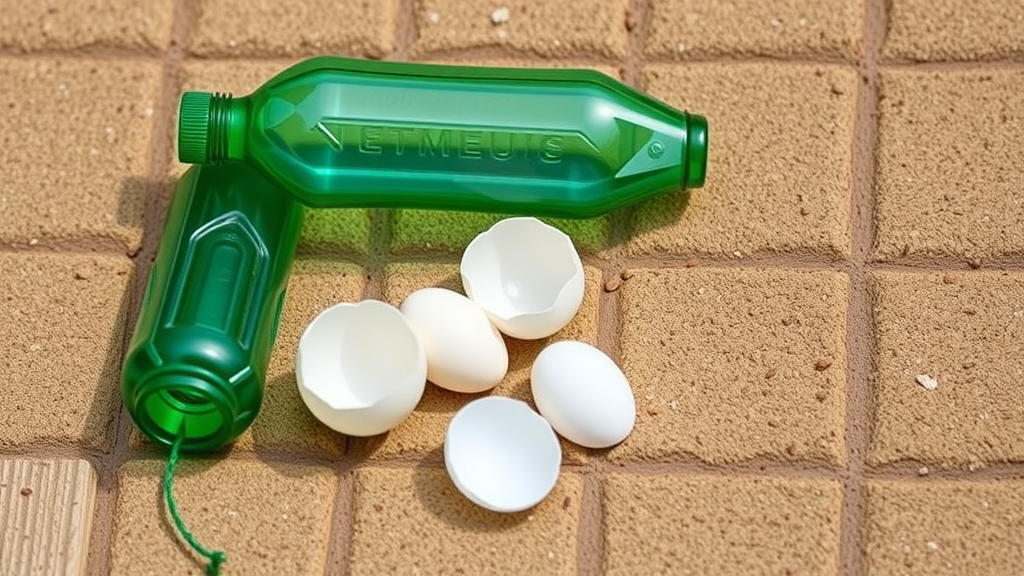
Researchers in Ethiopia have shown that discarded plastic bottles, kitchen eggshells and ordinary river sand can be transformed entirely, with no cement and no virgin aggregates, into paver tiles strong enough for sidewalks and pedestrian zones. The study, published in the Journal of Materials Science: Polymers by Mekete Ababu Damise of Wollo University and Belete Sirahbizu Yigezu of Addis Ababa Science and Technology University, reports that the best formulation achieved a compressive strength of 18.63 megapascals and a flexural strength of 4.10 megapascals, comfortably meeting international standards for light-traffic paving. What makes the work stand out is its complete reliance on waste: the melted polyethylene terephthalate, or PET, serves as the entire binding matrix, while eggshell powder and sand act purely as reinforcing fillers.
The motivation is rooted in a serious waste-management problem. In Ethiopia, PET bottles from single-use beverages and eggshells, which are roughly 94 percent calcium carbonate, are dumped in open sites, contributing to soil and water pollution, pest-borne health risks and mounting disposal costs for local governments. At the same time, the country’s road development programs have pushed demand for cement and aggregates upward, straining both budgets and natural resources. Recycling these abundant waste streams into durable infrastructure products offers a double payoff, cutting pollution while providing cheaper construction materials. The researchers note that their country’s ambition to expand paved road coverage made an alternative, cement-free paver especially attractive.
Previous studies have mostly treated PET and eggshells as partial substitutes: shredded PET replacing a fraction of aggregate, or eggshell powder replacing up to about 10 to 20 percent of cement. Typical recommendations cap PET at roughly 10 percent of a concrete mix, beyond which mechanical performance drops. The novelty of the new work lies in flipping the roles entirely. Here, PET is melted at high temperature to become the continuous matrix that encapsulates and bonds the fillers, fully replacing cement, while eggshell powder and washed river sand together fully replace conventional aggregates. No prior study, the authors say, has combined melted PET with both eggshell and river sand as fillers in a hybrid paver tile.
Preparing the materials demanded careful cleaning and sizing. Discarded bottles were sorted, shredded to roughly 2 millimeters, washed and sun-dried for two days. Eggshells from cafeteria waste were soaked for 24 hours, boiled for 5 to 10 minutes to remove organic residue, dried and ground, then sieved through a No. 16 mesh so that particles were smaller than 1.18 millimeters. River sand was washed to strip away clay and organic impurities, which would otherwise weaken bonding between the plastic and the reinforcement, and dried for two to three days. These steps were critical because contaminant films at the matrix-filler interface directly undermine the strength of the finished composite.
The team then blended four weight-based formulations of PET, eggshell powder and sand: 50:25:25, 60:15:25, 70:20:10 and 85:10:5, producing three specimens for each mix and each test, for 36 samples in total. Shredded PET was melted in an oil furnace between 150 and 260 degrees Celsius, with full melting at about 200 degrees. The fillers were stirred in at around 150 to 160 degrees as the polymer softened, and the homogeneous molten blend was poured into steel molds, compacted to expel trapped air and cooled. Unlike cement-based pavers, which need weeks of water curing to hydrate, the plastic-based tiles required no curing at all, stabilizing at room temperature for 24 hours before testing.
The results revealed a clear optimum. Flexural strengths averaged 3.34, 2.89, 4.10 and 2.54 megapascals for the four mixes respectively, while compressive strengths reached 13.01, 12.10, 18.63 and 6.20 megapascals. The 70:20:10 blend dominated both metrics, with individual cube specimens peaking at 19.71 megapascals and a coefficient of variation of only about 4.8 percent, indicating highly reproducible manufacturing. Water absorption fell steadily as PET content rose, from 1.30 percent at 50 percent PET to just 0.41 percent at 85 percent PET, thanks to the hydrophobic polymer sealing capillary pores around the filler particles. The best mix’s absorption of 0.53 percent sits far below the 6 to 7 percent ceiling allowed by standards such as ASTM C902 and EN 1338.
The explanation for the optimum lies in the microstructure. Scanning electron microscopy of the 70:20:10 tiles showed uniformly dispersed eggshell and sand particles, strong interfacial adhesion and minimal voids, creating efficient stress transfer between the polymer and its rigid reinforcements. Energy-dispersive X-ray spectroscopy confirmed calcium from the eggshell and silicon from the sand distributed through the carbon- and oxygen-rich PET matrix. By contrast, the 50 percent PET mix left filler poorly encapsulated, producing microvoids and weak bonding, while the 85 percent PET mix, despite its dense matrix, starved the composite of reinforcement and became brittle, cracking easily and losing most of its strength.
Statistical analysis reinforced the experimental picture. One-way analysis of variance found that composition significantly influenced flexural strength (F = 9.95, p = 0.004), compressive strength (F = 82.43, p < 0.001) and water absorption (F = 5.27, p = 0.027). Compressive strength proved most sensitive to formulation, and regression between measured and predicted values yielded coefficients of determination as high as 1.000, confirming the reliability of the data. The 70:20:10 mix also showed the tightest variability, an important quality for any material intended for mass production.
Against international benchmarks, the tiles qualify as Quality C pavers, appropriate for pedestrian facilities, courtyards, garden paths and light-traffic driveways under IS 15658:2006, ASTM C902 and EN 1338. The flexural strength also exceeds the roughly 3-megapascal minimum in British and Ethiopian standards for outdoor pavers and compares favorably with prior plastic-composite tiles, which typically absorbed between 1.16 and 6.98 percent water. The authors caution that the study is limited to laboratory-scale testing of four compositions, leaving long-term durability, abrasion resistance, cost analysis and life-cycle assessment to future work, along with field trials and further mix optimization.
Even so, the demonstration carries broad significance. It shows that three of the world’s most ubiquitous waste streams can be reengineered, with a simple melt-and-mold process requiring no cement kilns and no quarrying, into infrastructure components that pass international strength and durability thresholds. For rapidly urbanizing economies facing both plastic pollution and costly construction materials, the message is blunt and practical: the raw ingredients for tomorrow’s sidewalks may already be lying in the trash.
Subject of Research: Paver tiles made entirely from waste PET plastic, eggshell powder and river sand
Article Title: Fully waste-derived PET-eggshell-sand composite paver tiles: processing, microstructure, and mechanical performance
Article References: Damise, M. A., & Yigezu, B. S. (2026). Fully waste-derived PET-eggshell-sand composite paver tiles: processing, microstructure, and mechanical performance. Journal of Materials Science: Polymers, 1(1), Article 15. https://doi.org/10.1007/s44493-026-00015-4
Image Credits: AI Generated
DOI: 10.1007/s44493-026-00015-4
Keywords: waste recycling, PET plastic, eggshell powder, paver tiles, composite materials, compressive strength, flexural strength, water absorption, sustainable construction, microstructure, polymer matrix, circular economy
Cite Scienmag News
Denise Maddox. (September 12, 2026). Plastic Bottles, Eggshells and Sand Turned Into Paver Tiles. Scienmag. https://scienmag.com/plastic-bottles-eggshells-and-sand-turned-into-paver-tiles/
Denise Maddox. "Plastic Bottles, Eggshells and Sand Turned Into Paver Tiles." Scienmag, 12 September 2026, https://scienmag.com/plastic-bottles-eggshells-and-sand-turned-into-paver-tiles/. Accessed 4 October 2026.
Denise Maddox. "Plastic Bottles, Eggshells and Sand Turned Into Paver Tiles." Scienmag. September 12, 2026. https://scienmag.com/plastic-bottles-eggshells-and-sand-turned-into-paver-tiles/


