Hydrocarbon contamination is one of the most stubborn problems in transmission electron microscopy. Under electron-beam irradiation, residual hydrocarbon molecules adsorbed on specimen surfaces or floating inside the microscope chamber undergo radiolysis and polymerize into amorphous carbonaceous deposits. These films degrade image contrast, obscure fine structural details, and undermine the reliability of quantitative spectroscopic analysis. The problem is especially severe in modern aberration-corrected scanning transmission electron microscopy, where highly focused sub-angstrom probes concentrate the electron flux into extremely small areas and accelerate local carbon buildup by orders of magnitude compared with conventional parallel-beam illumination.
The device generates oxygen-radical plasma powered by radio-frequency excitation at 13.56 megahertz, allowing in-situ cleaning of internal chamber surfaces in roughly three hours. In quantitative tests, the carbon-K signal increase rate measured by scanning TEM energy-dispersive X-ray spectroscopy dropped from 2.81 to 0.30 percent per frame after one cleaning cycle, while the carbon deposition rate determined from electron energy-loss spectroscopy fell from 0.54 to 0.02 nanometers per frame, an approximately tenfold decrease in both metrics.
The sources of contamination are numerous. Residual hydrocarbons introduced during specimen preparation, outgassing from holder components and O-ring seals, vacuum grease residues, and hydrocarbon species adsorbed on internal microscope surfaces all contribute. Even commercial carbon support films have been shown to carry substantial mobile hydrocarbon species. A range of mitigation strategies exists, including ultrasonic cleaning of components, plasma cleaning of holders and specimens, liquid-nitrogen or Peltier-cooled cold traps, column baking, beam showering, and ultraviolet-ozone treatment. Among these, plasma cleaning is the most widely adopted because reactive radicals oxidize hydrocarbon species without requiring mechanical disassembly.
Commercial plasma cleaning systems for electron microscopy fall into two main categories. External benchtop systems clean specimens and holders in a dedicated vacuum chamber before insertion into the microscope, but they cannot reach hydrocarbon reservoirs residing on internal chamber surfaces. Remote plasma sources mount externally on microscope ports and deliver reactive oxygen radicals into the chamber through downstream diffusion; they can reduce contamination during routine operation, but the plasma source sits at some distance from the specimen chamber interior. An integrated apparatus combining plasma cleaning with vacuum storage has also been demonstrated, yet it too operates externally rather than inside the column. Internal components, including the chamber walls, condenser and objective apertures, and the pole-piece region, accumulate hydrocarbons over time and act as persistent reservoirs that continuously replenish surface contamination.
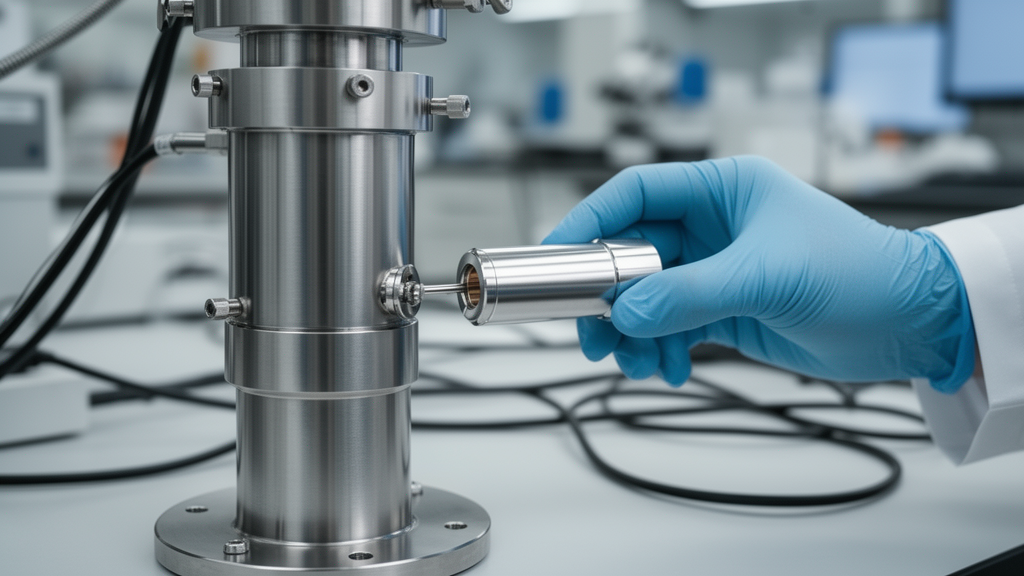
The new device addresses this gap by positioning the plasma source directly inside the chamber. In the reported procedure, performed on a JEOL JEM-ARM200CF transmission electron microscope, the cleaning area sits near the specimen chamber. The leak valve and TEM vacuum valves are operated in a specific sequence: the Leak-T button is switched on to close internal vacuum valves and isolate the sputter ion pump, ambient air is introduced through the plasma holder’s leak valve while the column Penning gauge monitors pressure, and once the gauge reads approximately 230 microamperes the valves reopen to establish a continuous gas flow pathway to the rotary pump. The leak valve is then adjusted to maintain a steady operating pressure of approximately 80 pascals.
With the gas flow established, the 13.56-megahertz radio-frequency generator, operated at 37 watts within a 10 to 300 watt range, is activated to initiate plasma within the column, producing reactive oxygen species that oxidize hydrocarbons. The introduced gas and reaction by-products, primarily carbon monoxide and carbon dioxide, are continuously evacuated through the vacuum system to the rotary pump. Cleaning runs for three hours, after which the system is returned to high-vacuum conditions prior to spectroscopic measurement.
The cleaning performance was quantified on a silicon lamella specimen prepared by focused ion beam milling, using an aberration-corrected STEM operated at 200 kilovolts. The column vacuum during measurements was approximately 7 × 10⁻⁵ pascals, measured without liquid-nitrogen cold-trap cooling, with a probe current of 60 picoamperes and a semi-convergence angle of 24 milliradians. STEM-EDX mapping covered a 247 × 247 square-nanometer field of view with 256 × 256 pixels and a dwell time of 0.1 milliseconds per pixel, delivering an electron dose of roughly 4.0 × 10⁴ electrons per square nanometer per frame. Low-loss EELS spectra for thickness analysis were acquired with a 2 millisecond dwell time, a 1 nanometer step size, and a collection semi-angle of 55 milliradians. Before each measurement session, the silicon lamella was plasma-cleaned externally to remove surface hydrocarbons, ensuring that the measured contamination rates reflected chamber-originated contamination rather than specimen surface residues.
The results were unambiguous. Before cleaning, the carbon-K signal increased continuously over 90 frames at 2.8 percent per frame, indicating progressive carbon accumulation, and the EELS thickness profile showed a clear increase within the irradiated region corresponding to a deposition rate of 0.54 nanometers per frame. After cleaning, the carbon signal increase was substantially suppressed over 170 frames at 0.3 percent per frame, the contamination thickness was only 4 nanometers, and the deposition rate fell to 0.02 nanometers per frame. The silicon-K signal remained stable throughout, confirming that the observed changes originated from carbon deposition rather than substrate variation. The experiments were deliberately run without cold-trap cooling to isolate the cleaner’s effect; under routine conditions with cryogenic trapping, the baseline contamination rate is expected to be substantially lower, and the authors anticipate that combining plasma cleaning with cold-trap operation would provide further suppression, since plasma cleaning removes hydrocarbon reservoirs from internal surfaces while the cold trap captures mobile species from the residual gas phase.
The persistence of the effect was tracked over three months of daily routine operation, with liquid-nitrogen cold-trap cooling in use and no major maintenance such as column venting or aperture replacement. Contamination rates were measured at five time points: before cleaning, immediately after cleaning, two months after cleaning, three months after cleaning, and after a second cleaning cycle. Both metrics showed consistent trends. Immediately after the first cleaning, rates dropped by approximately one order of magnitude relative to pre-cleaning values. Over the following months they gradually rose, and after three months had returned to roughly half of the pre-cleaning level, indicating continuous reintroduction of hydrocarbons during routine operation, likely from specimen transfer, holder components, and residual gas adsorption. A second cleaning cycle then reduced contamination below the levels achieved after the first, with the carbon-K signal increase rate falling from 0.30 to 0.01 percent per frame and the deposition rate from 0.02 to 0.01 nanometers per frame. The authors suggest this cumulative benefit may reflect the first cycle removing loosely adsorbed hydrocarbons while the second addresses more strongly bound residues or species that re-adsorbed from regions not fully reached initially, implying that repeated cleaning may progressively condition the internal chamber environment.
The authors note several limitations. The experiments were performed on a single instrument, and effectiveness on other TEM platforms remains to be verified. Ambient air was used as the process gas for convenience, and the optimal gas composition for maximizing cleaning efficacy while minimizing instrument damage has not been systematically investigated. Regarding potential damage to internal components, the 37-watt radio-frequency power produces low-energy reactive oxygen species that react chemically with hydrocarbons rather than physically sputtering surfaces; the ion energies remain well below the sputtering threshold for the metallic and ceramic components of the column, and over multiple cleaning cycles spanning several months no measurable degradation in imaging resolution or spectroscopic performance was observed. Within those constraints, the roughly three-hour turnaround, compared with the one to several days of downtime required for conventional column baking, offers facilities with high instrument utilization a practical periodic maintenance strategy for keeping chamber contamination, and the image contrast and spectroscopic accuracy it erodes, under control.
Subject of Research: An in-situ plasma cleaning device for removing hydrocarbon contamination inside the transmission electron microscope chamber
Article Title: A holder-type plasma cleaner for in-situ removal of hydrocarbon contamination in the transmission electron microscope chamber
Article References: Kim, H. S., Park, H.-W., Kim, P. K., Lee, M. J., Kim, H., Kim, Y., & Kim, Y.-M. (2026). A holder-type plasma cleaner for in-situ removal of hydrocarbon contamination in the transmission electron microscope chamber. Applied Microscopy, 56(1), Article 15. https://doi.org/10.1186/s42649-026-00138-6
Image Credits: AI Generated
DOI: 10.1186/s42649-026-00138-6
Keywords: transmission electron microscopy, plasma cleaning, hydrocarbon contamination, STEM, EDX, EELS, carbon deposition, electron microscopy maintenance, radio-frequency plasma, reactive oxygen species, instrument downtime, chamber cleanliness
Cite Scienmag News
Denise Maddox. (October 29, 2026). Plasma Cleaner Inserted Through TEM Port Strips Hydrocarbon Contamination in Three Hours. Scienmag. https://scienmag.com/plasma-cleaner-inserted-through-tem-port-strips-hydrocarbon-contamination-in-three-hours/
Denise Maddox. "Plasma Cleaner Inserted Through TEM Port Strips Hydrocarbon Contamination in Three Hours." Scienmag, 29 October 2026, https://scienmag.com/plasma-cleaner-inserted-through-tem-port-strips-hydrocarbon-contamination-in-three-hours/. Accessed 29 October 2026.
Denise Maddox. "Plasma Cleaner Inserted Through TEM Port Strips Hydrocarbon Contamination in Three Hours." Scienmag. October 29, 2026. https://scienmag.com/plasma-cleaner-inserted-through-tem-port-strips-hydrocarbon-contamination-in-three-hours/