

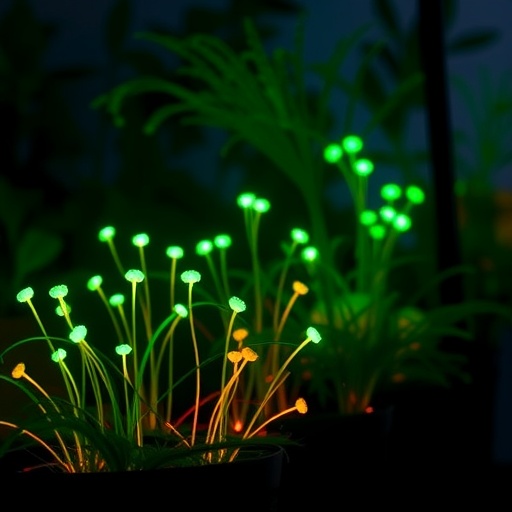
Imagine a world where plants could communicate their distress signals in a way humans can immediately understand—by glowing vividly to alert us when they are under attack, infected, or battling environmental stress. This seemingly fantastical concept is rapidly becoming a reality, thanks to groundbreaking research led by Dr. Karen Sarkisyan, who heads the Synthetic Biology group at the Medical Research Council (MRC) Laboratory of Medical Sciences. Her team has ingeniously harnessed molecular machinery from bioluminescent fungi and integrated it into plant genomes, enabling these genetically engineered plants to emit a soft, green glow whenever their immune systems are activated.
The study, recently published in the prestigious journal Nature Communications, presents a fusion of plant biology and synthetic biotechnology to visualize plant immune responses in real time without the need for invasive tools or extrinsic chemical aids. This innovation represents a monumental leap in how we observe and understand plant physiology, especially innate immunity. The cornerstone of this research lies in connecting two distinct biological systems: the intrinsic plant defense hormones and a bioluminescent pathway borrowed from luminous mushrooms. Together, these systems create a novel self-reporting mechanism that translates invisible molecular signals into visible light.
Plants inherently rely on hormones such as salicylic acid and jasmonic acid as internal messengers that orchestrate defense strategies against diverse threats, ranging from microbial pathogens to physical wounds and insect herbivory. These hormones trigger intricate signaling cascades within the plant cells, activating a battery of genes crucial for immune response. By interfacing these hormonal triggers with a bioluminescent pathway edited into the plant genome, the researchers created a direct link between immune activation and luminescence. When a threat stimulates the plant’s defence network, the engineered plants respond by emitting an unmistakable green glow.
The luminescent machinery originates from bioluminescent mushrooms, organisms that naturally produce their own light without external substrates. Unlike traditional methods requiring the application of external chemicals like luciferin, the mushroom-derived pathway enables continuous and autonomous light production in plants under specific biological conditions. This self-sufficiency allows researchers to observe plant immune responses over extended periods without disrupting their normal physiology, representing a non-invasive and cost-effective monitoring strategy.
Utilizing common digital cameras, the scientists could track the dynamic glow patterns in plants exposed to various stresses and injuries. Remarkably, the light emission manifests within hours of immune activation, offering real-time insight into plant health. For instance, plants subjected to mechanical damage or insect bites exhibited immediate luminescence around the wound sites, revealing a spatially precise immune response. Similarly, infection by pathogenic bacteria triggered distinct patterns of light emission, reflecting the type and progression of the immune engagement. This capability effectively transforms plants into self-reporting biosensors of their own physiological state.
One particularly fascinating observation involved the intensity of glowing during the flowering phase of the plants. This temporal pattern aligns with the well-documented hormonal fluctuations that occur during reproductive development, hinting at broader applications of this technology beyond just defense monitoring. Researchers can now gain unprecedented windows into how hormonal activities modulate growth and development processes in plants, all through a simple visible light signal.
The implications of this technology extend well beyond academic curiosity. With plant diseases and pest infestations posing ever-increasing threats to global food security, early detection of stress responses is critical. The luminous plants offer a powerful platform to screen crop varieties for innate disease resistance rapidly and non-invasively. By visually pinpointing immune activation, agricultural scientists could accelerate breeding programs geared toward resilient varieties, enabling a more sustainable agricultural future.
Moreover, this breakthrough supports the reduction of dependency on chemical pesticides by facilitating real-time monitoring of plant health in greenhouses and open fields. Farmers could leverage the glow signals as early warnings to intervene precisely where and when needed, minimizing environmental impacts and costs associated with blanket pesticide applications. The technology’s adaptability to field conditions, without requiring specialized imaging infrastructure, marks a significant democratization of plant health monitoring tools.
From a synthetic biology perspective, this project exemplifies the transformative potential of engineering biological systems with simplicity and economy in mind. By merging naturally occurring biochemical pathways from different kingdoms of life, the researchers synthesized a new functionality that bridges the gap between molecular biology and macroscopic observation. The work underscores how bioengineering can unveil hidden physiological processes and democratize access to real-time biological data with minimal technical barriers.
The ability to continuously image plants as their immune responses unfold naturally—without destructive sampling or chemical triggers—opens new experimental avenues. Plant biologists can now longitudinally track how specific stressors influence immune dynamics across diverse environmental conditions, providing richer datasets and more ecological accuracy. This capability is particularly important given the complexity of plant-pathogen interactions and the variation induced by factors such as temperature, humidity, and soil nutrient status.
The multi-national nature of this project highlights the collaborative spirit driving innovation in contemporary science. Partners spanning the Czech Republic, Russia, the United States, and the United Kingdom contributed expertise ranging from molecular biology to synthetic genomics. At the core, the MRC’s Synthetic Biology Group provided vital knowledge in genome editing and pathway engineering, enabling the creation of these luminous sentinel plants.
Reflecting on the significance of their findings, Dr. Sarkisyan emphasizes the ease and accessibility of this new imaging technique. “By giving plants the ability to produce their own light in response to immune activation, we can watch defenses unfold in real time using nothing more than a standard camera,” she explains. This simple yet profound advancement promises to transform plant research, making previously impossible experiments feasible outside specialized laboratory settings.
Funded by a constellation of prestigious organizations, including the Medical Research Council and the Biotechnology and Biological Sciences Research Council via the International Science Partnerships Fund, this pioneering research sets the stage for a future where crops can signal their needs directly to farmers and scientists. Such proactive communication tools are essential stepping stones towards smarter, more resilient agricultural ecosystems.
In summation, this innovative fusion of fungal bioluminescence with plant immune signaling charts an exciting new path for understanding and safeguarding plant health. By making the invisible visible, it empowers researchers and agriculturalists alike to engage with plants in an intuitive, dynamic, and non-invasive manner. As global food security faces mounting challenges, such synthetic biological tools could be instrumental in fostering sustainable and responsive agricultural practices worldwide.
Subject of Research: Non-invasive imaging and visualization of plant immune responses through synthetic biology.
Article Title: Non-invasive imaging of defence responses in plants
News Publication Date: 13-Mar-2026
Web References: https://doi.org/10.1038/s41467-026-70075-1
Keywords
Bioluminescence, Plant Immunity, Synthetic Biology, Salicylic Acid, Jasmonic Acid, Plant-Pathogen Interaction, Crop Disease Resistance, Sustainable Agriculture, Bioluminescent Mushrooms, Non-invasive Imaging, Plant Hormones, Agricultural Engineering


