


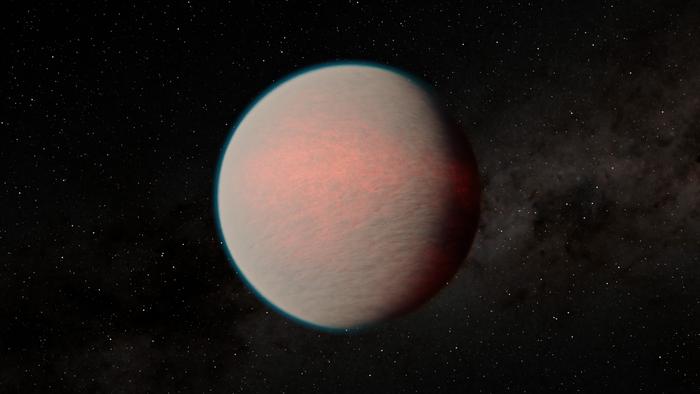
We know that the Earth has an iron core surrounded by a mantle of silicate bedrock and water (oceans) on its surface. Science has used this simple planet model until today for investigating exoplanets – planets that orbit another star outside our solar system. “It is only in recent years that we have begun to realise that planets are more complex than we had thought,” says Caroline Dorn, Professor for Exoplanets at ETH Zurich.

Credit: NASA/JPL-Caltech/R. Hurt
We know that the Earth has an iron core surrounded by a mantle of silicate bedrock and water (oceans) on its surface. Science has used this simple planet model until today for investigating exoplanets – planets that orbit another star outside our solar system. “It is only in recent years that we have begun to realise that planets are more complex than we had thought,” says Caroline Dorn, Professor for Exoplanets at ETH Zurich.
Most of the exoplanets known today are located close to their star. This means they primarily comprise hot worlds of oceans of molten magma that have not yet cooled to form a solid mantle of silicate bedrock like the Earth. Water dissolves very well in these magma oceans – unlike, for instance, carbon dioxide, which quickly outgasses and rises into the atmosphere.
The iron core is located beneath the molten mantle of silicates. So how is the water distributed between the silicates and the iron? This is precisely what Dorn has investigated in collaboration with Haiyang Luo and Jie Deng from Princeton University with the help of model calculations based on fundamental laws of physics. The researchers present their results in the journal Nature Astronomy.
Magma soup with water and iron
To explain the results, Dorn has to go into some detail: “The iron core takes time to develop. A large share of the iron is initially contained in the hot magma soup in the form of droplets.” The water sequestered in this soup combines with these iron droplets and sinks with them to the core. “The iron droplets behave like a lift that is conveyed downwards by the water,” explains Dorn.
Until now this behaviour had only been known to be the case for moderate pressures of the sort that also prevail in the Earth. It was not known what happens in the case of larger planets with higher pressure interior conditions. “This is one of the key results of our study,” says Dorn. “The larger the planet and the greater its mass, the more the water tends to go with the iron droplets and become integrated in the core. Under certain circumstances, iron can absorb up to 70 times more water than silicates. However, owing to the enormous pressure at the core, the water no longer takes the form of H2O molecules but is present in hydrogen and oxygen.
Large amounts of water are also inside the Earth
This study was triggered by investigations of the Earth’s water content, which yielded a surprising result four years ago: the oceans on the Earth’s surface only contain a small fraction of our planet’s overall water. The content of more than 80 of the Earth’s oceans could be hidden in its interior. This is shown by simulations calculating how water behaves under conditions of the kind that prevailed when the Earth was young. Experiments and seismological measurements are accordingly compatible.
The new findings concerning the distribution of water in planets have dramatic consequences for the interpretation of astronomical observation data. Using their telescopes in space and on the Earth, astronomers can under certain conditions measure the weight and size of an exoplanet. They use these calculations to draw up mass-radius diagrams that permit conclusions to be drawn about the planet’s composition. If in doing so – as has been the case so far – the solubility and distribution of water are ignored, the volume of water can be dramatically underestimated by up to ten times. “Planets are much more water-abundant than previously assumed,” says Dorn.
Understanding evolution history
Water distribution is also important if we wish to understand how planets form and develop. The water that has sunk to the core remains trapped there forever. However, the water dissolved in the magma ocean of the mantle can degas and rise to the surface during mantle cooling. “So if we find water in a planet’s atmosphere, there is probably a great deal more in its interior,” explains Dorn.
This is what the James Webb Space Telescope, which for two years has been sending data from space to Earth, is seeking to find. It is capable of tracking down molecules in the atmosphere of exoplanets. “Only the composition of the upper atmosphere of exoplanets can be measured directly,” explains the scientist. “Our group wishes to make the connection from the atmosphere to the inner depths of celestial bodies.”
The new data of the exoplanet called TOI-270d are particularly interesting. “Evidence has been collected there of the actual existence of such interactions between the magma ocean in its interior and the atmosphere,” says Dorn, who was involved in the corresponding publication about TOI-270d. Her list of interesting objects that she wishes to examine more closely also includes the planet K2-18b, which hit the headlines because of the probability of there being life on it.
Are water worlds life-sustaining after all?
Water is one of the preconditions for life to develop. There has long been speculation about the potential habitability of water-abundant Super-Earths – that is, planets with a mass multiple times greater than the Earth and with a surface covered by a deep, global ocean. Then calculations suggested that too much water could be hostile to life. The argument was that in these water worlds a layer of exotic high-pressure ice would prevent the exchange of vital substances at the interface between the ocean and the planet’s mantle.
The new study now reaches a different conclusion: planets with deep water layers are likely to be a rare occurrence as most of the water on Super-Earths is not located on the surface, as has been assumed until now, but is trapped within the core. This leads the scientists to assume that even planets with a relatively high water content could have the potential to develop Earth-like habitable conditions. As Dorn and her colleagues conclude, their study thus casts a new light on the potential existence of water-abundant worlds that could support life.
Journal
Nature Astronomy
Article Title
The interior as the dominant water reservoir in super-Earths and sub-Neptunes
Article Publication Date
20-Aug-2024
Cite Scienmag News
Bethany Barker. (August 20, 2024). Planets contain more water than thought. Scienmag. https://scienmag.com/planets-contain-more-water-than-thought/
Bethany Barker. "Planets contain more water than thought." Scienmag, 20 August 2024, https://scienmag.com/planets-contain-more-water-than-thought/. Accessed 4 September 2026.
Bethany Barker. "Planets contain more water than thought." Scienmag. August 20, 2024. https://scienmag.com/planets-contain-more-water-than-thought/

